I am giving away one of these books. Scroll to the bottom of the post for details of how to enter.
A novel about being queer and Christian at university – about faith, love, doubt and integrity. Read more here, or scroll to the bottom of the post for the giveaway.
Self-publishing in the nineties was grim. I know because both my parents did it. ‘Nobody’ wants to read about queer Christians now, and ‘nobody’ wanted to read about the physiological aspect of childbirth, or look at pictures of buses with passers-by getting in the way of the fleet number then. Doing It Yourself runs in the family. The kitchen table was perpetually shrouded in pencilled layouts for the next coffee table bus book, or hand-drawn diagrams of the hormone process in childbirth.
There was a corridor you couldn’t get through because of the huge bale of bubble wrap. There was a stack of corrugated cardboard that was taller than I was.
And there were books. There were books in the shed; there were books under the stairs. I’m pretty sure there were books in my brother’s bedroom.
There are still books. My parents have moved house four times between them since the last self-published book came out, and I have tripped over cardboard boxes of The Girl In The Street or shrink-wrapped bales of Childbirth Unmasked in every one of those houses.
The lovely thing about Lulu is not having to bother with all that. So far as I’m concerned, everything involved in the publishing process has happened within a square metre footprint. There’s me, and there’s my computer. If someone wants a book, they order it from Lulu (or, as of this lunchtime, Amazon) and someone who isn’t me gets it printed and posts it. It doesn’t go anywhere near me, and I have no boxes to deal with.
(The writing is a different matter, happening as it quite often does at seventy miles an hour, or in a park, or, for one blissful week, in a huge dormitory that I had all to myself. But the exercise books and the archaic Asus Eee on which I actually do the writing take up a lot less space.)
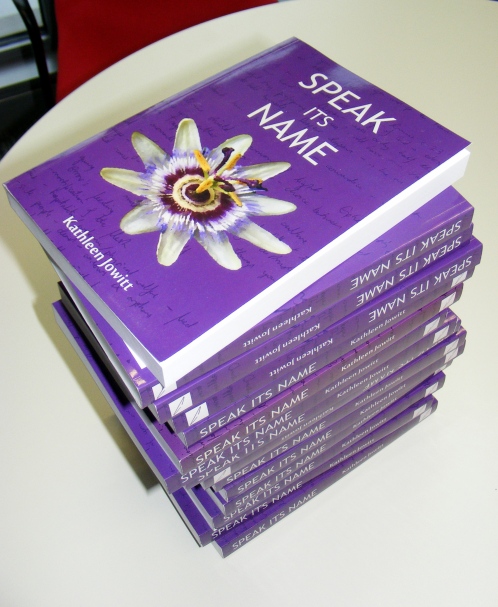
Having said all that, I discovered today that possessing a modest stack of books with my name on is a very good feeling. A lot of the books in the picture have been posted to the people named on the acknowledgements page, and the British Library, and other worthies. But not all of them. For a start, one of them is destined for one of you blog readers.
Leave a comment on this post to enter the giveaway. On 19 February I will use a random number generator to select one of the comments, and I will send a paperback copy of Speak Its Name to the person who left it. No matter where they are in the world.
Speak Its Name is now on Amazon. At least, the paperback version is. The Kindle edition has yet to materialise.
Note how I didn’t say ‘is now available on Amazon’; that’s because it’s listed as ‘currently unavailable’. When that changes I shall let you know.
Possibly more excitingly, it is actually available on the iBookstore (categorised as plain ‘Gay’, but I don’t have the energy to get into a fight with Apple over erasure…)
It wasn’t on Kobo when I looked a couple of hours ago, and it’s not in the Nook store. Again, I’ll let you know when it does show. In the mean time, if you’ve read the book, and if you liked it, and if you feel like reviewing it on Amazon, do go ahead. Or anywhere else, for that matter.
Lulu’s ‘My Revenue’ page, to see if people are buying the book (they are – thank you, people, whoever you are, and I hope you enjoy it)
Lulu’s ‘My Orders’ page, to see if the copies I promised to my long-suffering editors are ever going to turn up (they might, and if they don’t soon I shall be grumpy)
a Google search on the ISBN of the paperback, to see if it’s found its way to Amazon yet (it hasn’t, and probably won’t for a few weeks yet)
a Google search on the ISBN of the ebook, to see if it’s found its way to Kobo, Kindle, iBookstore et al (it hasn’t, but might within the next week or so)
I’ve also been reading Jem Bloomfield‘s fabulous review of Speak Its Name and grinning pretty much constantly.
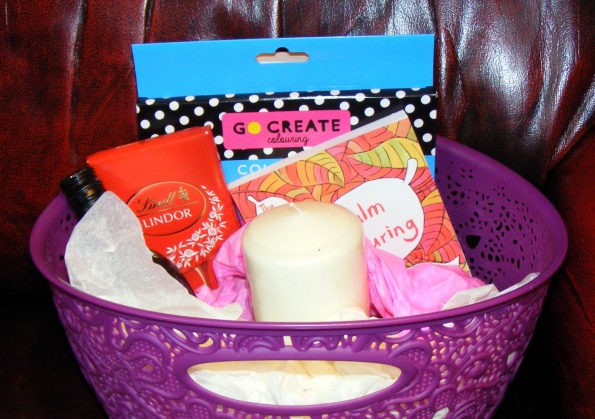
Today, I shall be making use of the Christmas present from my sister-in-law and her family. Thank you, Kat and all! I used to hate colouring – the legacy of a secondary school religious education teacher who used to set it as homework – but since it dawned on me that I didn’t have to finish anything ever if I didn’t feel like it, and nobody was going to mark me for ‘not putting enough effort in’ it’s become a joyful form of pointless quietening. Wine, chocolate and candle are of course guaranteed to improve a day.
I think taking today as annual leave was an excellent plan. If I’d been at work I would have spent the whole day drinking far too much coffee and refreshing Twitter every thirty seconds. This is exactly what I’m doing at the moment, but at least I’m doing it on my own time. And I like my day job. I wouldn’t want to give it up even if I could afford to (if you’re interested, Lulu tells me that I have made £28.61 so far; there’s a long way to go before I make back the cost of the ISBNs); the worst part is the fifty-eight-miles-each-way commute, and I can call that writing time. At least, when I’m awake enough to write I can call that writing time. Reading this article on the life of touring musicians reminded me how fortunate I am, that I can do what I enjoy and make a living, and enjoy what I do making a living, and make, if not a living, some money doing what I enjoy.
Returning to the subject of my in-laws, one of them asked me about my experience with Lulu. My first reaction was to point them at Ankaret’s blog (apart from anything else, she’s got a very nice post about Speak Its Name up there at the moment) because pretty much everything I know about Lulu I learned from Ankaret’s early posts. Things have moved on in Lululand since 2010, particularly in regard to their provision of ebooks, but there’s a lot that remains the same.
Apart from that…
Lulu is very intuitive and easy to use…
… right up to the point where it isn’t and you spend hours swearing at it and crying (not that this was me on Monday or anything)
Specifically, I have learned that if you have a paperback book on Lulu under ‘private access’, and you want it to be available to everyone, all you have to do is click on the title in the ‘My Projects’ thing and change it to ‘general access’. It sounds so obvious, but you’d expect that to be under the ‘Manage Distribution’ button, which is right next to it, and only deals with making it available on things other than Amazon.
You get out what you put in.
One of the things about self-publishing that I found daunting was the fact that I’d have to do everything myself, or find someone else to do it. Cover, type-setting, publicity, editing, proofreading – everything that would be somebody else’s job if I’d gone down the route of traditional publishing, I had to do, or organise its getting done, and the one that was freaking me out the most was the ‘making the book look good’.
Lulu doesn’t help you with that. It’ll chuck the book back at you if you’ve got the margins wrong, or forgotten to put the ISBN on the back cover, but that’s about as far as it goes. You have to make it look as good as you possibly can yourself.
I’m reasonably pleased with how Speak Its Name has turned out – I’m fretting a bit about the definition of the flower on the cover of the paperback, and I don’t much like Times New Roman as an ebook font (but it’s better than all the alternatives) – but it took a lot of work to get it to ‘reasonably pleasing’.
It really helps to know about…
… using styles in Word (or Word-alike – I use LibreOffice Writer) programs. The ebook converter insists on formatting being done this way. You can’t just hit the return key until the text goes where you want it to, because the converter strips that out.
However, if you are using a first line indent style and you want to signify a change of scene with a paragraph break, it will recognise one double return. And I only wish I’d known that before I’d gone through the whole document putting in line breaks with the ‘Insert… line break’ tool, because the converter strips those out, too.
It can be really, really sloooooooooowwww
This is partly the way that Lulu works and partly the way that everything else works. I submitted the ebook for checking prior to distribution to retailers other than Lulu nearly a week ago, and it’s still ‘pending’. And of course even once it has been approved there’ll be a delay before those retailers pick it up. Similarly with the print version – it will filter through to Amazon eventually, but by all accounts this will take the best part of a month, or possibly even longer.
I think that making all versions available on all platforms at the same moment is an impossible dream.
When you really, really want something, it takes longer to arrive
Which I suppose is just life, really. Lulu’s stated printing times for paperbacks are 3-5 business days, and of course with the first proof copy, which I really desperately wanted, it was the full five days.
This all sounds a bit negative
These are the whinges, but overall I’m pretty pleased with Lulu. I’ll post another time about the hell that was self-publishing in the nineties (I know because both my parents did it) but for the moment I’ll just say that Lulu cuts out ninety-five per cent of the hassle that I remember. I gave them a file and they gave me a book. What more can you ask for, really?
Free stuff that isn’t Lulu but that is useful
Paint.net, for the cover. Apart from the way it refuses to let you change text once you’ve added it, which is infuriating, it’s brilliant. Not entirely intuitive, but once you’ve worked out how to do something then it will do it.
LibreOffice, if you don’t want to pay for Microsoft Office. LibreOffice Writer does most of the stuff that MS Word does, albeit in a slightly different way.
the thing within your word processor program that converts to PDF. Essential, so far as I’m concerned, for peace of mind. I didn’t trust Lulu to convert my .odt document into a book. I didn’t really trust it to convert the PDF into a book, but it did do that properly, and the inside of the paperbook looks as I expected it to.
Calibre, for checking the ebook version. For doing just about anything with ebooks, actually. But I found myself downloading the ebook version over and over again, and Calibre lets me look at it on screen, add it to my Kobo, and convert it to different formats.
This is all that occurs to me at the moment, after a couple of months as a member of Lulu and forty-eight hours as a live author. No doubt I’ll discover more of its little quirks along the way. I’ll keep you posted – if, that is, its little quirks are at all interesting.
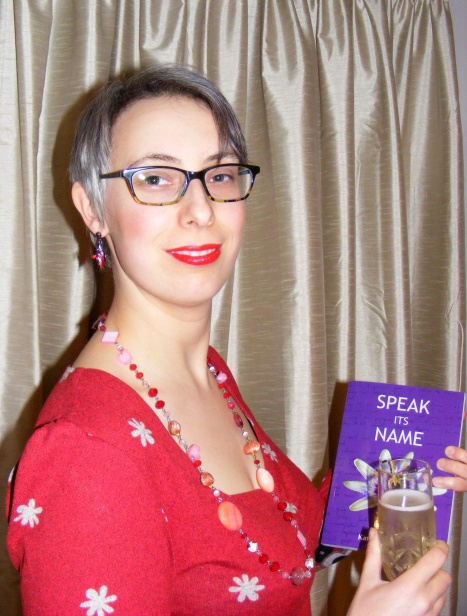
I have prosecco! I have been saving it for just such an occasion ever since my birthday party.
I have a book! It arrived this morning while I was at work.
The book is available as an ebook and as a paperback! It turns out that I have been maligning Lulu – though perhaps not entirely unjustly, because they could make things a lot simpler than they are at the moment.
Let’s have a party! Comments are open for celebration!
This is the slowest launch in history. I am reminded of the scene in one of the later Mary Plain books in which Mary and the Owl Man attempt to launch a rubber dinghy with a plastic bottle of milk. I am beginning to think that Lulu make most of their money by forcing authors to buy proof copy after proof copy when they would swear blind they’ve already bought a bloody proof copy… Suffice it to say, there will be a slight delay to the paperback version. With any luck, it’ll be available to order later today. If it’s any consolation, I don’t have my copy yet either.
However! It is 2 February, and I promised there would be a launch, and I am going to launch something, damn it. The ebook version is available on Lulu. It comes in .epub format; if you want to read it on a device that does not like .epub, and you want to read it now, I recommend Calibre, which is free, and useful enough that I’ve made use of the ‘Show appreciation via Paypal’ button.
The remaining formats will follow, and the .epub version should filter through some of the more mainstream retailers, and I will update this blog with links when they do:
There is indeed such a thing as a church with an octagonal tower
I have the feeling that I ought to be doing something. This is nonsense. I am ill, so I should not be doing anything. This is the week I gave myself to not do anything, and besides, there’s nothing I can do until I get my proof copy. The only thing I could possibly do would be to make the book available, and I’m not doing that until I’ve had the physical copy in my hands and seen for myself that it hasn’t come out upside down, or stripped out all of the formatting, or something.
I’ve compromised by expanding the extract I put up a few weeks ago. It now includes the whole of the first chapter, to give potential readers a fighting chance of discovering whether or not they like my style. And that was just a matter of copy-and-pasting, so hardly counts as doing anything.
Tuppence, who shares her name with none of my characters (though was named after someone else’s)
Firstly, I’m pressing the ‘make available’ button on Speak Its Name a week today. Hurrah!
Secondly, there’s an interesting post over at Women and Words about naming characters. The naming of cats is, famously, a difficult matter. The naming of characters tends to be easier, though that doesn’t mean it’s not something that I think about a lot. It’s something I do a lot, naming characters. Sometimes I name a character again and again.
Some names stick. Lydia has always been Lydia and her mother has always been Judy. Peter and Colette could never have been anything else. I don’t know why. They just couldn’t.
Sometimes I have good plot-related reasons for naming characters certain things. When you know that Lydia’s sister is called Rachel you can infer a lot about their parents and their upbringing. Sometimes I have good plot-related reasons which never actually make it into the plot. Colette’s middle initial is R. It stands for Rosalind, after Franklin. I think that may be the first time I’ve ever typed the full name in this context – it certainly doesn’t make it into the final text – but having it in the back of my mind all the time that I was writing made a difference to the way I wrote Colette.
Minor characters are trickier. Sometimes I get overly attached to a particular letter. L, for example. Whether it’s because I’d started out with Lydia as non-negotiable and my mind got stuck on L, or it’s some troubled corner of my psyche that insists on giving my characters the major consonant sounds of my own name, I don’t know. But I’ve written out a Lily, a Hollie and a Lucy, and have had to remind myself severely that no, I can’t have a Lizzie, and I can’t really have an Elizabeth, either, because I’ve already got an Ellie. I could have had Beth, I suppose. Maybe there’ll be a Beth in the next book.
Another problem is a side-effect of a long writing time. Sometimes I’ve been working with a character name for years and then somebody with the same name comes into my life and it’s just too confusing. I’ve had to change three names in Speak Its Name for that reason. In one case I managed to give a character the exact same name as a senior member of staff in a future employer, which could have been awkward. It was a name I liked, too. Thank goodness for Find and Replace, that’s all I can say.
Sometimes there’s nothing wrong with a name except for the fact that it’s completely implausible for a character of a certain age at a certain date. Georgia, for example, started out as Gina. I like the name very much, or I wouldn’t have used it in the first place, but I’m not sure that anyone’s been christened Gina since about 1955.
The one thing that does strike me as I run through my dramatis personae is the number of names that match pets I’ve known over the years. William was a black labrador. Lydia was a tortoiseshell cat. Ollie is a black and white cat, and you could even make a case for Gin’ginia, though his real name was Marco Polo. The personalities don’t really correspond – except possibly in the case of William, who was stunningly immature and given to dragging people to places they weren’t very interested in going to. It must be something about a name that’s familiar enough to work with but which doesn’t have any particular human associations.
Having said that, I really can’t see myself naming a character Ebenezer, Elegy or Tuppence any time soon, despite the fact that all those names were borrowed from books in the first place. Or perhaps even because of it.
You see that there? That’s what I spent most of yesterday morning doing. This is for the print version; if you hold a piece of paper up over the left hand side of the image you’ll see what the ebook version looks like.
I was not starting from scratch. I got the basic concept down and sorted the flower out months ago. Yesterday was mostly about getting a clearer picture of the handwriting and then getting all the elements into the appropriate position so that they’ll print properly.
The handwriting, if you’re wondering, is excerpts from my own English undergraduate notes: the front cover is talking about The Faerie Queene and the back about Donne’s Holy Sonnets. I adapted the passionflower image from this photograph, which has been made available for such use under a Creative Commons license.
I then ordered a proof copy and went and had some lunch. Coming back, I immediately discovered two errors (a first line that should have been indented and a chapter heading that said One where all the rest said Chapter 1), so I had to pull the .pdf off and replace it with a corrected one.
Then I spent the rest of the afternoon trying to make the cover sit properly on the front of the ebook.
Then I gave up and cooked dinner.
Then this morning I remembered that I hadn’t changed the ISBN on the copyright page of the ebook and so I pulled it off and uploaded a corrected version.
And I have no idea what new errors I’ll find when I look at the proof copy when it arrives next week. I would like to think that, after going through the electronic version, several print-outs, and the ebook, I’d have got them all, but there always seems to be something else to find, even if it’s just a niggly little thing like a missing indent. We’ll see. We’ll see.
… muttering at Lulu that there is no text smaller than 10pt, let alone 6pt, on pages 87, 119, or 265, damn it
… putting the cover together, which entails:
… setting the image size to the nearest pixel
… finding the .pdf of the barcode which I know I saved somewhere obvious
… getting a week’s worth of photographs off my camera to find the picture of my own second year notes on The Faerie Queene which are going to be the background image
… wondering where the hell the colour selector thing in Paint.Net has disappeared to
… remembering that actually I used the eyedropper and got the purple from the middle of the passionflower. Right.
… resizing everything. And then resizing it again.
… working out how to make a .pdf into a .jpg
… wondering why I can’t see the text I’ve just typed
… trying not to cry
… realising it’s because I’ve still got the passionflower selected
… finding that the onscreen rulers are helping me not one whit
… resorting to holding a real ruler up to the screen
… being really irritated about the blank space at the bottom right
… copying the blurb word by word from my own website
… working out how to rotate text through ninety degrees
… wondering what I’ve spelt wrong in the blurb
… wondering what I’ve forgotten to add
… forgetting where I’ve saved the resulting .jpg
… uploading the cover to Lulu
… deciding that it looks WRONG and going back to Paint.net
… uploading the cover again
… wondering whether occasional use of the F word counts as ‘explicit content’
… ordering a proof copy
Which is quite enough for one morning. After lunch I’ll worry about the ebook. Don’t worry: I did take annual leave to do all this.





 Kathleen Jowitt
