Good reasons to read a book

  1. To see what the fuss is about
  2. You loved it last time around
  3. You loved that other book by the same author
  4. It’s very good
  5. The plot has got you hooked
  6. It’s so bad it’s funny

Good reasons for finishing a book you’re not enjoying

  1. It’s a requirement for your course
  2. You’ve got into it now
  3. You want to see if it gets better
  4. You want to see how bad it can possibly get

Good reasons not to read a book

  1. It sounds just like that other book you hated
  2. It sounds fine, just not very interesting
  3. Somebody on the internet said it wasn’t very good
  4. You would rather read a different book
  5. The author was rude to or about somebody like you on Twitter
  6. Life’s too short

Good reasons to abandon a book

  1. You don’t feel like finishing this book

There are many further variations. Add your own in comments!

Too many books

2013 September 022-002

There are far more books in the world than anyone could possibly read in their lifetime. There are far more films than anyone could possibly watch, far more songs than anyone could possibly listen to.

I don’t know how old I was when I understood that. I feel that it might have been university, when all my horizons expanded in all directions at once, and I realised that:

  1. I didn’t know everything
  2. I was never going to know everything
  3. I didn’t have to know everything

Before that, the books I knew about were at home, or in the school library, or in the local library. And yes, that was a lot of books, but I always felt that if I really applied myself I could work my way through the whole lot in a logical fashion.

Maybe it was seeing the university library that did it. Who knows? I wish I had one neat moment of epiphany to trot out, but I don’t.

Anyway, once you’ve had that epiphany, what do you do with it?

There are a variety of approaches.

You can read/watch/listen to as many of the books/films/songs as you humanly can. Read every book that your hand touches. My godmother told me once that John Cage said that one should only ever listen to each piece of music once, because there simply isn’t time to do more.

But I know that if I only listen to a piece of music once, I can do little more than nod and smile. In order to really appreciate it, I need to listen to it over and over again, to get right into it. If possible, to perform it, even.

(Probably if I were a better musician, this would be a quicker process for me. A degree in English Literature and a decade plus of creative writing trial and error have enabled me to see how a text is put together without having to think much about it.)

So that suggests an opposite approach: consume very few pieces of art, but really get into them. Re-read, listen over and over, watch again and see what you didn’t pick up the first time, or the second time, or the third time.

The temptation then is to ensure that the art that one does examine is somehow worthy of all these hours that one’s putting into it – but, without putting the hours in, how does one know what’s worthy? One ends up deferring to others’ judgement. Let us watch the films that won the Oscars, or read the books that are on the list of 1001 Books You Must Read Before You Die, or whatever it might be.

(Personally, I find that any attempt to tell me that I must read anything results in instant resentment and a resolution not to read the thing if humanly possible. As it happens, I’ve read a decent number of those books, but not because they’re on that list, and I feel no compunction to read all of them.)

There are two main dangers that I can see to concentrating on the good stuff.

Firstly, you might miss things. But that’s inevitable, however you go about this. That’s the whole point of this post. You will miss things.

Secondly, you might never read anything because you actually want to read it. You might end up trapped in a book you hate, never finishing it, and never starting anything else, either.

In fact, that’s the main drawback to both of those approaches, and I’ve tried them both. ‘Read everything, no matter what it is’ – and you’ll end up slogging through a whole load of ill-written drivel, pompous litfic, formulaic genre and spectacularly biased unclassifiable screeds, and hating all of it. ‘Concentrate on what is known to be good’ – and it’ll be like having to get  through plateful after plateful of worthy vegetables before you’re allowed pudding. Pudding might never come. You might never get round to reading anything fun.

And if reading isn’t fun, then why on earth are you doing it? (Well, actually… to be discussed in a subsequent post.) These days, you know, I mostly read what I feel like reading, and I stop if I’m not enjoying it. And that’s good enough for me.

E-books versus tree books: a false dichotomy

Books

Tree books are dead. No, wait, e-books are dead. E-books are e-books and tree books are tree books and never the twain shall meet. Loyal paper book readers will never read an e-book. Converts to e-readers will never pick up a physical book again. People fight to the death over this. TO THE DEATH!

Really, if you believe the press, it all sounds like an even pettier version of the Montagues and Capulets biting their thumbs at each other. But, while I know several diehards who wouldn’t know how to turn the page on a Kindle, and I’m sure there are a few e-book zealots who have pulped all the paper books they’ve ever owned, most of the serious readers of my acquaintance flick between paper books and e-books without a second thought. Why argue about formats when you could be, you know, reading?

As a reader

For me, it comes down to practicalities. On the most obvious level, if a book was printed in 1995 and nobody’s thought of releasing it in e-book format, then of course I’m going to read the hard copy. Or if it only exists in electronic format, then it goes on the e-reader.

In fact, the format in which I choose to read a book often depends on where I am when I decide I want to read it. At work? I’ll probably pick up a paperback in one of the station bookshops on my way home. At home? I’ll download it to my Kobo. If I’m standing in a charity shop, slightly bored and wondering what to read next? I’ll get the most interesting looking thing on the shelf.

Still on the theme of convenience: these days, most of my reading time is on the train, so the question of size becomes important. If I can’t fit it in my handbag, it’s probably not going to get read. And yet… I read War and Peace this year. I’d attempted it a couple of times before, but the physical copy is so big and so bulky, and it’s so easy to lose track one’s track among the various plot themes, that I never managed it. Having it on the Kobo (free from Project Gutenberg, I might add) I was able to just keep plugging away, a couple of chapters every day, until I got to the end.

On the other hand, if I’m going somewhere damp (the bath, for example, or northern Spain), I have no desire to risk an expensive piece of electronic equipment. As it happened, all the books I took to Spain with me came back in the state in which they left, and I’ve never dropped a book in the bath, but there’s always a first time.

In short, I tend to read books in whatever format I have them, and to obtain them in whatever format suits me at the time. Whatever makes it easiest for me to read, in fact.

When you dig into the debate, it often comes down to nebulous feelings about what the experience of reading should be like, and an aesthetic appreciation of the book as an object. Which affects my choices some of the time, but not always.

I’ve finished 45 books so far this year. 11 were e-books. 7 were hardbacks. Of those hardbacks, two were the family copies of Alice’s Adventures in Wonderland and Through the Looking Glass, and three were John Buchan thrillers in the Nelson edition, which I’ve been collecting. I had no particular connection to any of the other hardbacks, or to any of the paperbacks, as objects. Indeed, some of them I read specifically to see if I really wanted them taking up space on my shelves, and now they aren’t on my shelves any more.

People talk about the smell of books. I’ve never quite got this. In my experience, old books smell of dust and possibly damp, and new books smell of solvent or nothing. But then I don’t have a very good sense of smell, so this argument doesn’t do much for me.

Books can be lovely things. They can also be hideous. (My photo above doesn’t do justice to quite how hideous the cover of Mulligan is.) To be honest, so long as the loveliness or the hideousness doesn’t get in the way of my reading the story, I don’t care.

As a writer

Similarly, I really don’t mind which format somebody chooses to read my book.

In pure financial terms, e-books make me more money. I can charge half the price for an e-book and still make twice as much as I would from the sale of a paperback. (Which is why the high price of a lot of mainstream publishers’ e-books is annoying, because I know what the mark-up is. I’m unlikely to spend more than about a fiver on an e-book, unless I’m really desperate.)

On the other hand, I miss out on the phenomenon where one of my readers says to one of their friends, ‘You might like this one,’ and lends them their copy. And the one where the friend of one of my readers, having a sneaky nose along their bookshelves, sees my book, thinks, ‘oh, that looks interesting,’ picks it up and starts reading.

Why should I care about that? you might well ask. Or, indeed, why am I not up in arms about it? I don’t make any money off that.

No, not immediately – but it means that another person has heard of me, has had the opportunity to see if they like my writing. My book doesn’t get into libraries or bookshops, so I’m reliant on this sort of interaction to spread the word. And anyway, since that’s the main way that I’ve discovered authors whose work I love, it feels a bit off to whinge about it. I very rarely buy a book by an unknown author at full price, and I don’t believe that many other readers do.

Anyway, maybe they then buy their own copy. Or maybe they nick the copy from their original owner, who buys a replacement.

You never know.

Save

Some weekend reading

Happy Saturday! I hope those who are now embarked on summer holidays are enjoying them, and that the weather cooperates with any long-planned activities. Personally, I’m just getting to the end of a week off work, and I’m very slightly less tired than I was when it began, so I’m counting that as a tentative plus.

This week I have a guest post up over at I Heart Lesfic where I talk about the difficulty of finding the book I wanted to read and my consequent decision to write it myself.

There’s also a giveaway of Speak Its Name, which still has a couple of days left to run. You might be lucky!

And I talked to fellow self-published author Helena Fairfax about my favourite places, my least favourite job, and what I’d say to Jenny Lind.

Enjoy!

The hoopiness of this frood is in doubt

DSCF2120

In two weeks’ time I shall be on the ferry to Spain, and I have to confess that I still don’t know where my towel is. I’ve taken everything out of the airing cupboard, the hall cupboard, the various boxes of cycling impedimenta, the suitcases and holdalls under the bed… And put it all back again, obviously. But no towel. At least, not the towel I was looking for. The airing cupboard was, of course, full of the things, but they were all the gigantic cotton bath sheet version, which won’t do at all. I did find two other microfibre camping towels. Neither of them are mine, but I’ve been offered a loan of one of them. I weighed them both on the kitchen scales to see which to take.

I also thought I’d lost my very lightweight fleece, but it turned up at the very back of the top shelf of my wardrobe. (It’s that shapeless brown object in the photograph.)

I found my hat and my waterproof (hmm, well, but it’ll do) and my Swiss Army knife and the bandana I bought in the cathedral shop in Santiago de Compostela the last time around. (This was easy. I knew where they all were.)

Also, I tried on all the walking trousers I’ve accumulated over the years. I have one pair that fits perfectly. Everything else is either too small (the ones I wore last time I did the Camino) or too big (the ones I’ve bought since). I’m going to take the ones that fit perfectly and the ones that are too big but don’t actually fall off.

And yes, one of the objects in that photograph is not like the others. Yes, that shoe box does contain shoes. No, I’m not planning on walking 110km in kitten heels from Hobbs. But I am setting off straight after a wedding, and I thought I might as well get everything down off the top shelf of the wardrobe at once.

Stationery Love at Jera’s Jamboree

I talked to Shaz over at Jera’s Jamboree about my finicky taste in exercise books, my abiding preference for paper diaries, and my unashamedly fannish choice of ink colour. In short, stationery love.

There’s a picture of a page of the first draft of A Spoke in the Wheel, too, if you’re really desperate to know more about that. Although I should warn you that it’s pretty much illegible, and I deliberately chose a page that doesn’t give away much of the plot.

Giving up, and giving up on giving up

This year I’ve been doing Lent differently; by which I mean that I’ve not been doing very much differently at all. I haven’t given up anything, partly in an attempt to disconnect the idea of virtue from that of self-deprivation, and partly to see if there’s any correlation between Lenten discipline and the seasonal depression that tends to land early in March and lift around Easter.

It turns out that not giving up meat, not giving up alcohol, not giving up coffee, not giving up tea, not giving up biscuits, and not giving up anything else, has made precisely zero difference, and March has been as much of a slog as it always is. This has, oddly enough, made me feel rather optimistic. It would have been annoying to discover that I’d brought all my misery on myself by trying too hard to be ‘good’. Next year I can do what I feel like doing and not worry about it. And I also know for next year not to schedule any social events during March, because I’ll either flake out and disappoint people, or turn up and then cry and embarrass them.

I keep meaning to write about the structure of the Church year, and how useful I find it. Firstly, there’s the way that it keeps turning on and on with or without my involvement. I can fail to get out of bed three Sundays running, work a weekend away, and then go on holiday, and when I come back I can still reorient myself by the colour of the altar frontal, the readings, and the anthem. And then there’s the fact that there is actually an officially sanctioned time for feeling dreadful, followed by a time of feeling a huge amount better and being thankful for that. That bit’s coming up soon. I’m looking forward to it.

A reader’s guide to Cambridge charity shops

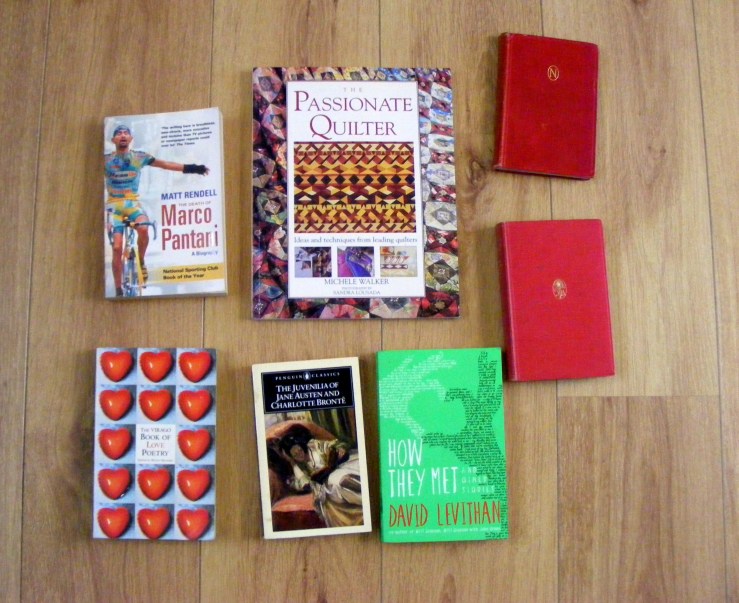
The fruits of an afternoon's research
The fruits of an afternoon’s research

I have always bought books in charity shops, and, so long as charity shops, books, or I continue to exist, I always will. There wasn’t much spare money around when I was growing up, and besides, I have a perverse liking for things that are out of print.

In terms of books, charity shops are good for:

  • things I have a vague idea that I’m collecting (for example, Blue Peter annuals, or John Buchans in the red Nelson edition, which is the only thing that fits on the second shelf of my big bookcase);
  • last year’s bestsellers;
  • impulse buys.

Charity shops are not so good for:

  • things that have only just been published, though you occasionally get lucky;
  • rare or specific books, though you occasionally get lucky;
  • things you need within a tight timeframe, though you occasionally get lucky.

I spend less time in charity shops than I used to, mainly because there are none within walking distance of my office – at least, not if I want to get out and back and spend a reasonable amount of time actually in the shop all within my lunch break. However, there are always Saturdays. I’ve lived in Cambridge for getting on for three years now, and have explored a reasonable portion of the city in that time. There are two streets in particular that have an abundance of charity shops: Burleigh Street and Mill Road.

Charity shops fall into two broad categories. There are the carefully curated, and the undiscriminatingly chaotic.

The latter are, of course, by far the best for books. You never know what you’re going to find; you pick up things you’d never heard of because you are intrigued by the picture on the spine or because the title reminds you of something you were looking for six months ago. You never find what you’re actually looking for, but the chances are you’ll find something else worth reading.

In the carefully curated category, by contrast, you will find two stingy shelves of books, whose contents will be unremittingly boring, and suspiciously similar to those in every other carefully curated charity shop in the street. If you’re looking for last year’s bestseller, this is the place to go. If not, it won’t take you long to scan the shelves and decide there’s nothing to keep you there. (You will also find some inoffensive and deeply boring clothes, and the ones with an ‘Atmosphere’ label will probably cost a pound more than they were originally sold for in Primark.)

A more promising subset of ‘carefully curated’ is the specialist charity bookshop. There are two of these in Cambridge – the Oxfam bookshop on Sidney Street, and Books for Amnesty on Mill Road. The great advantage of these is the fact that the books are arranged in a coherent and logical fashion, and, if you know what you’re looking for, you can be in and out within three minutes.

However, the chances are that you’ll pay a similar price to those charged by specialist second-hand dealers. Which is good for the charity, of course… up to the point where you don’t buy the book because you didn’t want it that much. And of course, if you don’t know exactly what you want, the choice can be somewhat overwhelming.

My two favourite shops on Burleigh Street are Oxfam and the RSPCA. Oxfam has  a vast range of all sorts of stuff over two floors. The books are helpfully arranged by category, and there are plenty of categories, and there is plenty of variety within those categories. The last thing I got in there was a book of poems by Luci Shaw, and the thing before that was A Murder Is Announced. It’s also, so my father informs me, good for Ordnance Survey maps.

The RSPCA doesn’t have such a wide selection, but what it does have is of good quality. I picked up the bulk of my Buchan collection there. The British Heart Foundation tends to have interesting books. Like all BHF shops, it’s crammed full of too much stuff, both second-hand and the hideous ‘new goods’, but it can be worth fighting your way to the back left-hand corner. I wouldn’t go out of my way to any of the others, and have resolved never to give books to the Scope shop, which sends them (so one assistant told me, at least) for pulping if they haven’t sold after only a fortnight on the shelf.

Mill Road has the Sally Ann, which is a spacious shop with a lot of stuff in it, and another Oxfam, this one affably scruffy. The YMCA is comparatively new. It has hardly any books, but I did get A Book of Escapes in there.

It is worth going beyond the railway bridge, if only for the RSPCA bookshop. This is less like a charity shop and more like something you’d find in Hay-on-Wye. Books everywhere, stacked on the top of shelves, on the floor. Penguins, Pelicans, Viragos, old hardbacks, old paperbacks… It’s wonderful.

I don’t recommend going round all the charity shops in one day. There are, after all, only so many books that can be loaded into a bike basket before the steering goes all skew-whiff.

We’ll turn it around

dscf9952

I’ve spent quite of lot of 2017 being ill. The boomerang virus has hit me three times since New Year’s Eve. At the moment it’s manifesting in a hacking cough, set off by a) singing anything longer than a bar and a half in one breath; b) laughing; c) breathing in cold air. Previously it’s made itself known in extreme lethargy, fever, sniffles tending to nosebleeds, headaches, lack of sleep, a sore throat, and a cough. Not, fortunately, all at once. Or, at least, not for long.

Consequently, I’ve spent quite a lot of 2017 wrapped up in a blanket and occupying myself with things that haven’t needed much energy. In what is perhaps not a coincidence, I have fallen hard for Yuri!!! on Ice, which is a very sweet and optimistic anime about figure skating. This despite my having had no prior interest in either anime or figure skating. It just seems to appeal to the same part of my brain that likes epaulettes and grand opera and dark chocolate. And Ruritania.

It’s probably also significant that Yuri!!! on Ice takes place in a universe where there’s no homophobia and where the sport system can be trusted. By contrast, I have spent the last year writing in a universe where sport chews you up and spits you out, and several years before that writing in a universe where homophobia is depressingly and devastatingly real. So perhaps I just needed a break.

There are parts of my brain that think it is absolutely appalling of me to be watching anything at all light and fluffy (not to mention admitting to it in public) when As We All Know The World Is Going To Hell. (There are other parts of my brain that don’t like my admitting to liking anything at all, including epaulettes, grand opera, and dark chocolate, because that’s really embarrassing, apparently. And another one that’s pointing out that I promised myself several years ago that I’d never apologise for my reading or watching material, because if an English Lit degree doesn’t give you the right to read what you like without feeling guilty about it, what does? Brains, eh?)

The thing is, it’s not as simple as that. In the same way that one can’t (at least, I can’t) read The Prisoner of Zenda and Rupert of Hentzau without reflecting that Rudolf V is actually a pathetic excuse for a king who deserves everything he gets, and wondering whether there’s a Ruritanian Communist Party, it’s difficult to watch Yuri!!! on Ice without acknowledging that, sadly, Russia doesn’t work like that, and China doesn’t work like that, and probably skating doesn’t work like that either. Which makes for some genuinely interesting fanfic; but I’ve been reading a lot of fluff, too.

It’s a constant push and pull: between escapism and realism (but how real is the realism?), between optimism and pessimism; the tension between the world as one would like it to be and the world as one fears it is; the question of what truth looks like in fiction. I feel the urge to complicate the simple stuff; and to give the miserable stuff a happy ending; to question whether an ending that an author clearly intended as happy is as happy as all that; and to equip other people’s characters with the tools to get out of the mess they were left in. It’s a question with which a consumer engages as much as a creator. Actually, I find that the lines are blurred, and that I’m arguing with something with everything I write: some other book, something someone else said, adding another layer to the debate.

On which subject: I’ve got back into the editing process for A Spoke In The Wheel this week, after spending all of January too knackered and too scared to look at it. It turns out that it’s neither as bad nor as miserable as my mind had made it out to be. (Again, I say, brains, eh?) And I find myself wondering, now, where it falls on that continuum between realism and escapism. I’ve tried to set it in the real world, where zero hours contracts and sexism and burnout exist. I’ve got a friend checking it at the moment for errors in my portrayal of the notoriously dreadful UK disability benefits process. It’s fairly cynical about sport, or, at least, the narrator is.

But I find, re-reading it, that on the whole it’s hopeful. And I’m glad about that. Apart from anything else, it occurs to me that if we can’t let ourselves imagine a better world, we’re unlikely ever to get one.