November’s become very busy for me, and I’m not quite sure how it happened. From ‘absolutely nothing’ I’ve suddenly got two or three things in my diary on some weekends. And I’m having to write KEEP FREE in large letters across the other weekends, because otherwise I’ll be an exhausted sobbing mess before we get to Stir-Up Sunday.
One of the events that I’d really have liked to attend had I not already got something in the diary is Weston-Super-Lesfic, which is coming up on 21 November. However, I’ll be there in spirit, in the form of my short story The Sisters’ House, which appears in the Weston-Super-Anthology.
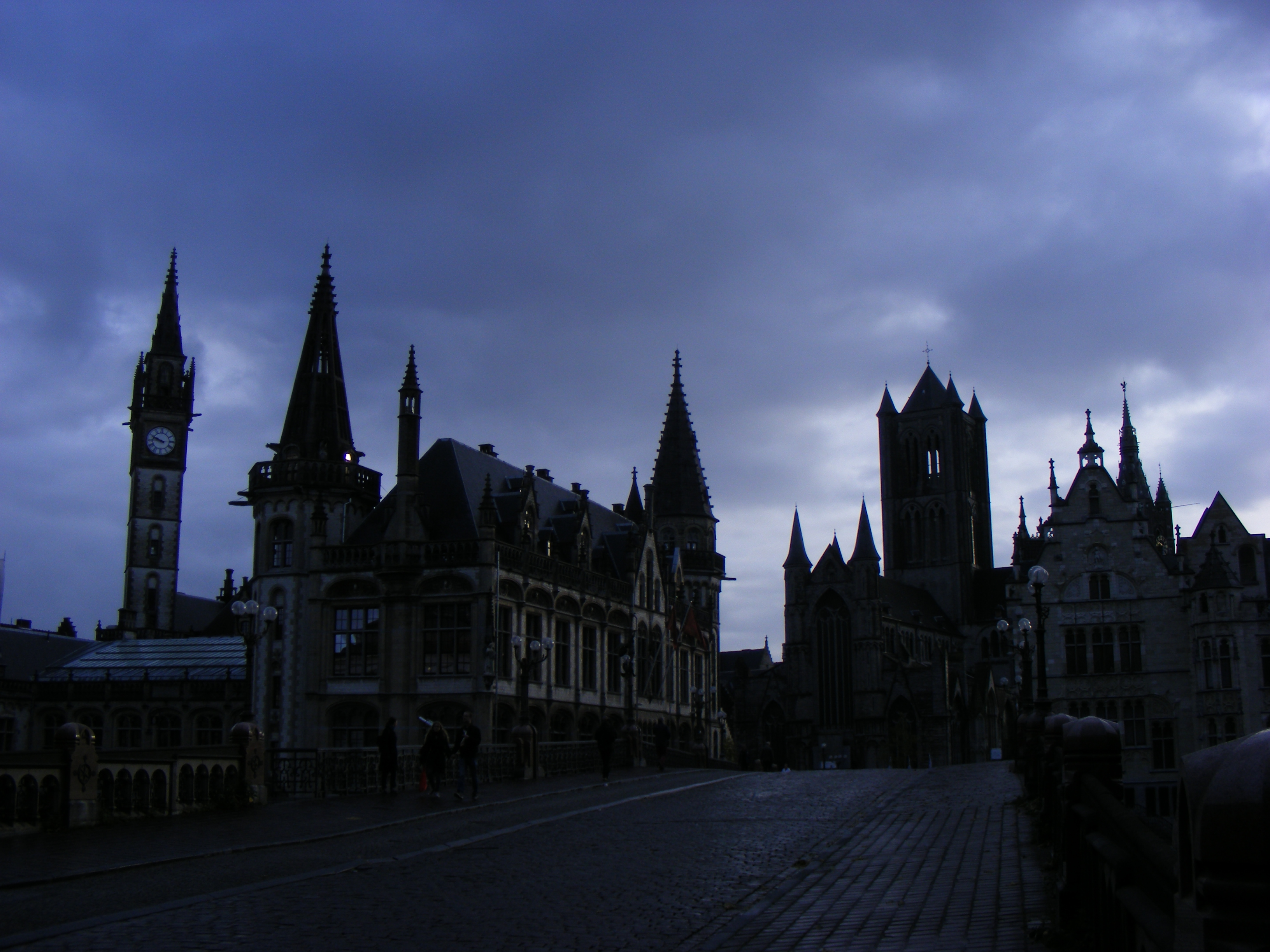
There’s a broad range of forms and genres represented in the anthology. Mine is a fantasy story set in a landscape inspired by the flat ground and watery cities of Flanders. (That’s Ghent in the picture, standing in for my fictional Drakenrey.) There are warrior women, a commune, some ill-advised magic, and a dragon.
I know there are going to be hard copies on sale at the event, raising funds for North Somerset LGBT Forum. I’m not sure whether those will be available more widely. You can, however, get an ebook edition from Amazon.
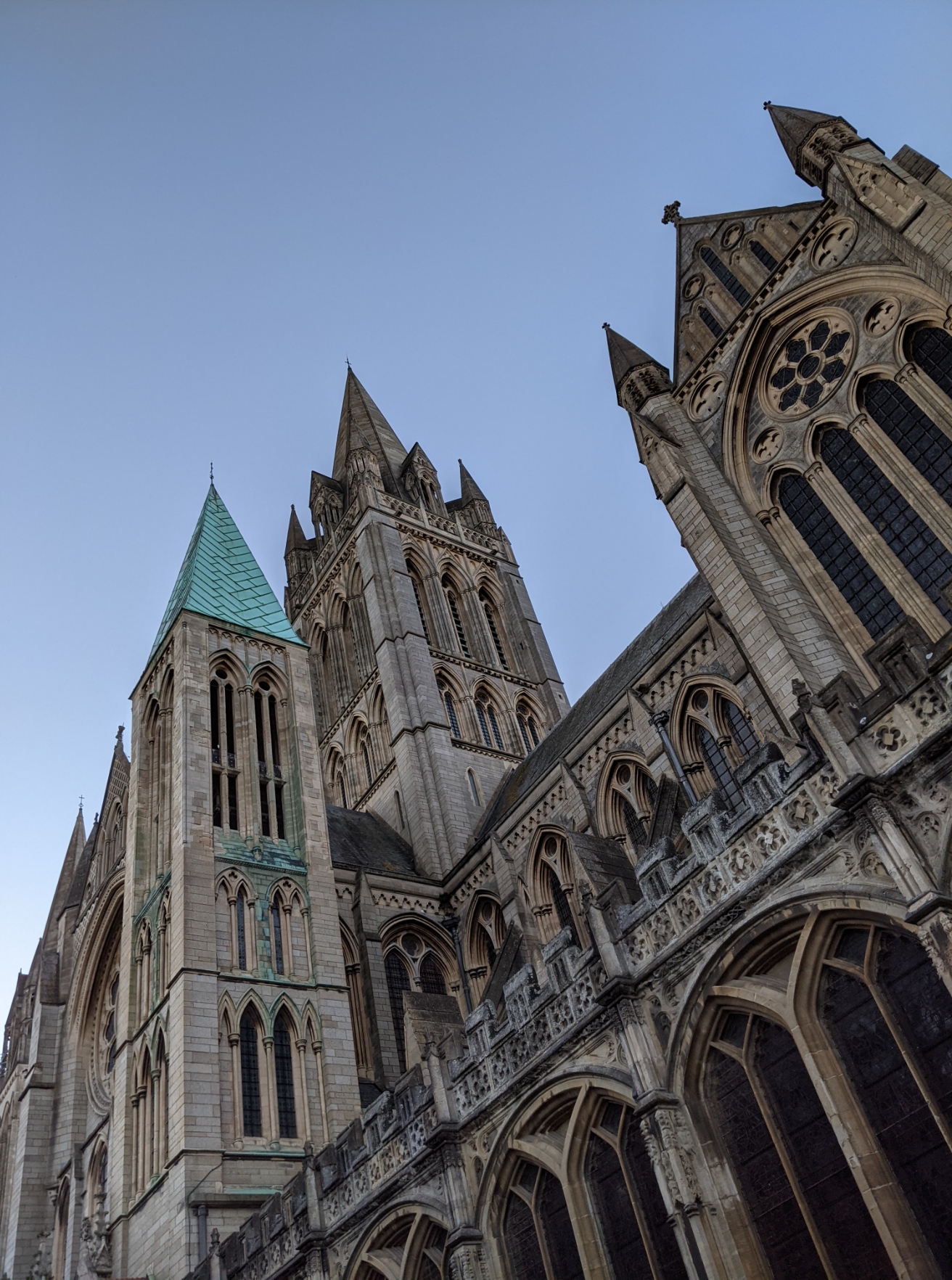
I read this in Truro, where we were staying above a pub. I started it in bed, and finished it in the beer garden, with the gentle sound of a little river running past, and the cathedral towering up above the trees, just the other side.
And I was thinking what a pity it is that Susan Howatch, who when she was writing wrote about unconventional clergy relationships like nobody else, never got round to the Bensons.
There are a few plausible reasons why not, of course. Firstly, I’m not sure that anybody would believe in the Bensons if they appeared in a novel. They’re really quite incredible in real life. (Edward White Benson was the first Bishop of Truro – this was why they were on my mind – and later became Archbishop of Canterbury. He proposed to his wife when she was twelve. After his death she set up home with the daughter of a different Archbishop of Canterbury. All the children were as queer as their mother, in every sense. No need to bolt invented polyamory onto the facts here. But even Susan Howatch might not have got away with the Bensons.) Secondly, she writes very heterosexual books. So she was probably never going to take on the Bensons.
Anyway, I was in the mood for something that took a queer, religious, character, that took both the queerness and the religion seriously, and was prepared to delve deep into the psyche of that character.
In This Small Spot hit that, er, spot about eighty per cent of the time.
This isn’t anything like a Howatch. It doesn’t have the snobbery, the psychics, or the daddy issues. And it isn’t so tediously straight. It does have the ‘can’t do anything, got to finish this book’ thing that Howatch manages to do over and over again; which is why I had to finish it in a pub beer garden before we could see any more of Truro. And it was almost but not quite exactly what I wanted.
“Here, the true you is most often magnified, for better or for worse.”
Abbess Theodora
In a world increasingly connected to computers and machines but disconnected to self and others, Dr. Michele Stewart finds herself drowning in a life that no longer holds meaning. Searching for a deeper connection after losing her partner, Alice, she enters a contemplative monastery, living a life dedicated to prayer, to faith in things unseen. Though most of her family and friends are convinced that she has become a nun to run away from her life, she finds herself more attuned to life than she has been in years. Stripped of the things that define most people in the outside world – career, clothing, possessions – she rediscovers a long forgotten part of herself. But sooner than she expects, the outside world intrudes, forcing her to confront doubts and demons she thought she had left behind. The ultimate test of her vocation comes from the unlikeliest source when she finds herself falling in love again. As she struggles to discern where she belongs, she discovers the terrifying truth of Abbess Theodora’s warning. For better or for worse.
I don’t think I’d argue with anything in that blurb. I bought the book on the strength of it, and I wasn’t disappointed. It wouldn’t be getting its own post if I hadn’t enjoyed it. The calm rhythm of the religious life, the complex relationships between the novices, the developing tension between Sister Michele and another nun, made for an absorbing read. It wasn’t perfect, though, and there were a couple of things that left me wanting to argue.
Firstly, the pacing was a bit off, or the plot. An overuse of ‘Later, Mickey would…’ built up a suspense that was never quite delivered on. Things developed sequentially, one event leading to another, and tending to evolve from characters’ desires and personalities. This suited the setting, but there sometimes seemed to be a reluctance to commit at key points. I said above that I was looking for something that would delve deeply into a character’s psyche. I think that often it didn’t delve deeply enough.
At one point Mickey reflects that the enclosed nature of the abbey makes trivial events take on an inflated importance. Actually, I found the opposite to be true: there would have been space to take much more time to explore the personality clashes and emerging trauma that grew from and drove events.
And then it takes an unexpected turn into melodrama.
Major spoilers follow the picture of Truro cathedral.
Mickey sustains serious injuries rescuing her love interest from a fire, a combination of events which results in both of them asking to be released from their vows. Mickey returns to medical life. Having both taken time to reflect, the two of them set up house together.
And very shortly afterwards Mickey dies.
Yeah.
In fairness, it didn’t strike me as a stereotypical ‘bury your gays’. There was too much of a sense of the bigger picture for that. The happy ending had already been earned and obtained; in fact, I’d have been perfectly contented had the book ended just a few chapters earlier. What we got, however, was an ambitious ending, and one that I don’t think the author managed to pull off. She didn’t quite earn Anselma/Lauren’s revelation that ‘The tragedy would have been never to have known her at all’. It might have worked, given some more space; as it was, it felt glib.
It was intensely readable, however, and I’ll be buying the sequel. I want to know more.
My apologies for this unintended hiatus in our literary travels. I was planning a visit to Ullathorne. I reread Doctor Thorne, to discover what I’d forgotten: that the doctor spends the entire book at odds with his Ullathorne relations and never go there. (Still, I went to the trouble of getting a photo of the nice cloth-covered library copy, so here you go.)
I eventually tracked the place down to Barchester Towers and decided, very reluctantly, that if I’d excluded Netherfield and Qualling on the grounds that they were stately homes rather than settlements, I couldn’t really make an exception for Ullathorne. Or could I? After a generous description of Ullathorne Court, we get this:
The picturesque old church of St. Ewold’s stands immediately opposite to the iron gates which open into the court, and is all but surrounded by the branches of the lime-trees which form the avenue leading up to the house from both sides. This avenue is magnificent, but it would lose much of its value in the eyes of many proprietors by the fact that the road through it is not private property. It is a public lane between hedgerows, with a broad grass margin on each side of the road, from which the lime-trees spring.
And then I just ran out of steam. I’d like to say that I’ve spent the last six months frantically looking for fictional places beginning with U, but it wouldn’t be true. I just got stuck in a not reading/not posting circle, at least as far as this series goes.
John Buchan, however, is always helpful, so let’s fall back on a trip to Unnutz ‘in the Tirol’. Or maybe not:
You’d simply loath it. A landscape like a picture postcard. Tennis and bumble-puppy gold and promenades, all in smart clothes.
Such is Alison Westwater’s assessment of the place. But what about the geography?
Above the Waldersee, in the Firnthal?
(Also fictional, both of them. But those are both plausibly Tyrolean, and I had to Google to make sure.)
Unnutz was mainly villas and hotels, but there was an old village as a nucleus – wooden houses built on piles on the lake sure, and one or two narrow twisting streets with pumpkins drying on the shingle roofs. There was a bathing-place there very different from the modish thing on the main promenade, a place where you dived in a hut under a canvas curtain into deep green water, and could swim out to some fantastice little rock islets.
Alison is out of there by the end of the chapter (see K, T, M, and E for where), so that, I’m afraid, is all I can offer for U. See you for V. When we get there.
Books mentioned in this post
Barchester Towers (and Doctor Thorne), Anthony Trollope
In my lunch hour today I went to the British Library and looked at an exhibition of tiny books. (These are not from there; the British Library frowns on people taking photographs in their galleries of precious books. These are the tiniest books that I have in the house.)
Charlotte Brontë was thirteen when she wrote this. Jane Eyre was several years in the future. Even if she could have foreseen the millions of cheap paperback copies of that, I don’t think she could have dreamt that after a couple of centuries the stories of Angria and Gondal and Gaaldine would have prompted scads of scholarship, books, fanfic, and a small moral panic. And going by this, I’m not sure she’d have cared.
Your Waves Go Over Me: an installation by Mark Reed at Norwich cathedral
There is plenty wrong with the world at the moment. (There always has been. I tend to find this comforting; you may not.) And much of it is the big stuff, the kind that needs big solutions. Bigger than me.
The actions that I can take are small. There is very little that I can control, and not much more that I can influence in any meaningful way. And yet I keep taking small actions. Not as many, or as often, as I’d like to. But some. Why?
I am one, but I am one of many.
I work for a trade union, so it’s perhaps easier for me to remember this than it is for some others. It does help, working with people who share many of my values and many of my ideals. We don’t always agree on the best way to achieve change, or even what a particular change should look like. It can be a slog: there’s an awful lot to do. But every so often we manage to change something for the better, something we wouldn’t have managed on our own.
My brother tells me that the reason he stopped flying was that I stopped flying. (And the reason that I stopped flying was that I read a news article – well over a decade ago now, since I haven’t flown since 2007 – about some bishop or other giving up flying.) We have more influence than we think we do. Not much more, perhaps. But some.
It can affect the big stuff.
In this category I’d place things like writing to my MP. If it’s just me writing to her, she probably isn’t going to act on it. If tens or hundreds of her constituents do, she’s more likely to. She might still not do it. But at least I’ve made it that little bit more difficult for her to tell herself she’s doing what her constituents want.
Maybe I’d put things like buying fair trade under this header, too. The 30p difference between the fair trade option and the not fair trade option doesn’t make much difference to me, and it probably doesn’t make much difference to the farmer either. But across millions of customers and thousands of farmers it adds up.
It made a difference to that starfish.
Have you heard that story? I came across it when I was just old enough to get the point and just young enough not to find it unbearably cheesy. Some small actions do make a big impact, depending on the perspective you’re looking from.
Picking up three pieces of litter doesn’t do much about the great Pacific garbage patch (which in any case is mostly made of fishing nets, not plastic straws, please stop banning plastic straws), but it can make a path look visibly more attractive; and if I’ve put one can in the bin then that’s one hazard taken out of the way of the local wildlife.
It made a difference to me.
In my office most of the doors are decorated with the sort of quotations that are usually described as ‘inspirational’. (I avoid the word ‘inspirational’ where possible, but it’s probably the appropriate one here.) One of them is from Joan Baez, one of the few artists I have gone out of my way to see live, and it says: Action is the antidote to despair. I mention this one – I remember this one, in contrast to all the other doors in the building – because in my experience it is true. I am very prone to despair. It seems to come along for the ride with depression, whether as cause or symptom I’m not sure. And yet doing something (a tiny something: taking the compost out, telling somebody they’ve dropped their ticket, passing on some unwanted plates to a neighbour who does want them) has a disproportionately cheering effect. Assuming I can get that far in the first place.
It helps me. Does it help anyone or anything else? If I’m honest, if I’m at the point where I’m worrying about that, I’m not actually in a place where I care.
I just do.
Do something (or don’t do something) for long enough, and it shades into sheer habit. My mother has been boycotting Nestlé since the early nineties; consequently, there’s a whole shelf of chocolate bars that I just don’t see. Does that make any difference to Nestlé’s bottom line? Well, no, because I was never their customer to start with. It’s just habit now. It doesn’t really make any difference to me, either. I’ll have a dark Chocolate Orange, if I can find one. (Do they even still make them?)
Because I am a person who does this.
This is where it can get deeply philosophical. How far is what I am determined by what I do?
I don’t always. Up until yesterday, I hadn’t written to my MP about anything for months. For all I know she was wondering if I’ve died or moved away. Now she knows I haven’t. And that I feel strongly enough about the Elections Bill to tell her how strongly I feel about it.
Choosing hope, and choosing hope by taking an action, over and over again, becomes at once a symbolic and a physical act of resistance. It becomes almost a praxis, an observance. For me, it’s an outworking of my religious faith, but I don’t think it has to be. Challenging my natural propensity for gloom changes the world – or, at least, the world I live in. And that’s the only world that I can do anything about.
I went to my local homes and gardens shop the other day, looking for a lint roller. The man on the till explained that they did not stock them, as the peel-off sticky bits can’t be recycled. He offered me a clothes brush instead. I said that so long as it would get cat hair off the sofa that was fine with me.
I publish my paperbacks through Lulu. It can be a massively frustrating process, but I have yet to hear of any other print-on-demand service being noticeably better. There are two ways to get your books out there. Or one and a half, really, I suppose. You can sell them through the Lulu bookstore. You can also choose ‘global distribution’, which makes it available through all the big retailers.
The snag – and this has become much more of a snag in the five years since I started doing this – is that the big retailers also wish to take their cut along the way. Which is fair enough. But printing costs have gone up, and so, I think, has the cut, and the gap is getting wider and wider.
Take The Real World. The minimum I can sell it for on Lulu is £6.90. If, however, I want to put it in for global distribution I have to whack the price all the way up to £13.72. Which is a silly price, so I put it as £13.99.
So I was in the slightly ridiculous situation of having to charge four pounds more than I considered reasonable for a paperback in order to sell the item on a platform that made me feel skeevy (because it was almost always Amazon) to make a few pennies on the sale.
And then nobody was buying them. Quite reasonably. I wouldn’t spend fourteen quid on a paperback. (OK, I do spend thirteen quid on the Girls Gone By reprints of the Marlows series: but have you seen how much they go for second-hand?)
One solution would have been to dump Lulu and go with KindleDirect Publishing. Or go with both. I couldn’t face wrangling a third platform, so ‘both’ was out. And going exclusively with Amazon would have made me feel very skeevy indeed, and probably also have lost me a few sales.
(I don’t avoid Amazon entirely, but if I can get a book somewhere else, I will. For variousreasons. And it does make a difference as to whether I get it in the first place. There are a couple of authors who’d be instabuy for me if only they weren’t Amazon exclusive. As it is, I only buy the books that really, really, really appeal to me.)
Anyway, I was fretting about this for months. Then Lulu emailed to say they were putting their prices up. And I realised: I could pull my books from everything except Lulu.
I know, I know. It doesn’t seem fair to react to ‘Lulu putting their prices up’ by ‘removing my books from everything except Lulu’. But see above. Lulu drive me up the wall, but they don’t make me feel skeevy. And actually, a company being honest about the true costs of something was surprisingly refreshing. Stuff does cost money, and if we’re not paying for it, chances are someone else is.
So. The best place to get paperback copies of my books is now Lulu. It’s worth waiting until they run a 10% or 15% sale, which they do quite frequently; this ought to go some way towards covering the cost of postage. (Alternatively, my mother has six copies of The Real World which I got sent to her address and then forgot to sell when I was there, and then forgot to take away with me. Sorry, Ma. Do you want to post them?)
The ebooks of the two Stancester novels are on Smashwords, from which you can download them in every format I’ve heard of and some I hadn’t. I have made my peace with their not being on Kindle: when these ones sell, it’s usually because someone’s enthused about them on Weird Anglican Twitter, and the denizens of WAT tend to be sufficiently net-savvy to track them down. A Spoke In The Wheel is still on Kindle. I have no idea why the others broke and this one didn’t, but for the moment I’m going to let well alone.
But what of my principled local homes and gardens shop? Well, I didn’t buy a lint roller. I didn’t buy a clothes brush, either, but only because I phoned home and discovered there was one on order. I did buy a garlic press, a potato brush, and an ash bucket in which to keep the dried cat food. The cat meanwhile, has decided that she prefers sitting on the windowsill, which is much easier to sweep.
This is Port. As of last Monday, she lives with us. She has spent most of the intervening week sleeping, eating, mewing for attention, being generally gorgeous, and climbing up to high places. It is very good to have a cat around the house; previously we have had to make do with talking to other people’s cats. Which is not the same thing at all.
In other exciting cat-related news, the Kickstarter for the latest Bikes In Space anthology is now live, and the theme of this edition is CATS, and I have a story in there. In Miss Tomkins Takes A Holiday it’s some time in the 1930s and a union organiser sets out on a well-deserved cycling break, accompanied by her cat Aster. Trouble follows them, but the two of them are very well-equipped to deal with it.
There are ten other sci-fi/fantasy stories in there, all featuring cats and bicycles, and all looking like they’re going to be a fun read. The Kickstarter offers all sorts of combinations of formats and rewards, depending on whether you prefer paperback or ebook or fancy getting a T-shirt or sticker as well. Have a look.
When a friend reported that she’d been invited to “respond creatively to Living in Love and Faith“, my immediate response was, “I’m not writing another bloody novel.”
Living in Love and Faith (LLF hereafter), for those who haven’t come across it, is the Church of England’s latest contribution to the LGBT+ debate. I use the word ‘debate’ deliberately: it’s still ongoing and LLF is explicitly a set of resources designed to provoke discussion. My last church (look, you try moving churches during a pandemic; it’s harder than you’d think) did it as a Lent course this year. I didn’t take part due to a combination of the following reasons: a) moving on from that church; b) having led the 20s/30s group through the previous two Lent courses and needing a break; c) having seen it all before.
I wasn’t entirely accurate. I am writing another novel. In fact, I’m writing two. What I meant was I’m not going anywhere near church discourse in either of them.
While I have a vague idea of how the Stancester gang deal with the Covid year(s), I don’t really have a plot to hang that idea off so if I were to write it now it would just be Georgia and Natalie making Frankenstein recordings of the Pergolesi Stabat Mater and Peter worrying about his family in London while Lydia waits for the other shoe to drop. Anyway, Catherine Fox has already done the coronavirus ecclesiastical liveblog novel. More to the point, I just can’t face it. In some ways, The Real World already was a creative response to LLF; I just wrote it before the fact rather than after. (There was a reason it came out on the same day: I thought people might like something different to read. Actually, I’m not sure that was great for sales, particularly after the year we’d all had, but it’s easy to be wise in hindsight. My novels tend to take me a couple of years to write, and I couldn’t have known in 2018 that I’d really need to be releasing something light and fluffy in late 2020.)
At the moment I really don’t feel like doing it again. And at the moment I’m just writing things that I feel like writing, regardless of whether they feel worthy, or how deeply they engage with current affairs. (One of them does, albeit obliquely; the other is set in the early 1920s.)
Moreover, I seem to have no interest in writing in response to any particular call for submissions. Part of that is not wanting to be left with a very specific story with no obvious market beyond the one that’s just turned it down, but that’s not all there is to it: one particular outlet has accepted the last two pieces I submitted, but their current call isn’t generating so much as a spark. (Caveat: if a new, compelling idea attacks me overnight and results in 5000 words by Tuesday I shouldn’t be at all surprised. The thought experiment that goes I’m not writing this, but what would it look like if I did? has always been an effective one for me.)
Anyway, that’s where I am at the moment. I’m not writing another bloody novel; I’m writing two. I’m taking them both very seriously but also doing exactly what I feel like. I’m writing a lot, one sentence at a time, but none of it is engaging creatively with LLF. And you’ll see the results… sometime.
I’m continuing to work my way through the #EU27 project in a desultory fashion. It tends to get as far as looking at a book, wondering whether it would fit, reading the blurb, and then putting it down again. Very handily, my work book club decided to read Nada, by Carmen Laforet, which, at the time of posting, I can count for Spain.
It’s a marvellously gothic book, with mysterious relations, sinister servants, and a decaying apartment. It’s an apartment rather than a house, because this is very much urban gothic: the narrator, Andrea, has moved to Barcelona to study English. I’ve never been to Barcelona, but by the end of this I felt as if I had. There’s a very compelling sense of place: windswept squares, cramped alleys, the scent of the sea. I’d like to reread when I’m more in the mood for descriptive prose.
I found Andrea a rather frustrating, passive, character, to whom things happened, or didn’t. That felt entirely plausible, however; I remember being in my late teens and early twenties and just waiting to find out what was the next thing that was going to happen to me. Actually, it reminded me more than anything of Hilary Mantel’s An Experiment In Love (mind you, that was also a book club pick).
What I completely failed to get was how deeply the book was affected by Franco’s Spain. Part of that is an artefact of having been written and published there: apparently there was a lot of censorship going on. Actually, it felt much more recent than that. I don’t know whether that was a quality of the translation or of the original, whether the absence of contextual detail set it free from time and place, or whether I was just missing a whole lot of clues. Quite possibly it was the latter.
I’m glad I read it, anyway, and will probably read it again. Hurrah for book club. Next time they’re reading The Count of Monte Cristo. Which is fine by me, though I can’t count it towards this challenge. As to that, it’s either going to be Mrs Mohr Goes Missing (Poland), The City and the Mountains (Portugal), or Inlands (Sweden). You’ll find out here. Sooner or later.
It is warm! It’s ten to ten at night and I’ve just been out in the garden, watering plants. This photo is from last year; the self-seeded offspring of this love-in-a-mist flower are merrily blooming away without my having done anything about them. That’s my kind of gardening.
In similar vein, I have a couple of book promotion things to mention that have happened without my having done much.
iReadIndies lesfic giveaway
Firstly, iReadIndies.com, a community of independent ff/wlw/lesfic/etc authors are running a giveaway over on Facebook, and The Real Worldis one of the titles on offer. To be in with a shout, you need to be a member of their Reader Central group; you’ll find the giveaway poll under Announcements.
In all seriousness, iReadIndies is doing some excellent work pulling together a somewhat underrepresented group of writers, and I do recommend taking a look if you’re into books about women loving women.
A Spoke In The Wheel, on sale
Secondly, Amazon seems to be doing that thing it does from time to time and knocking an arbitrary chunk off the price of the paperback of A Spoke In The Wheel. At the time of posting it’s down to £7.12 (from a list price of £10.99). So if you’re after a paperback this is a decent chance to get it at a discount. (They don’t knock it off my cut!)
I should say that I’m rethinking my relationship with Amazon (longer post to come on that in the next few weeks) but it’s too hot for anything drastic. In the meantime, I hope you’re all staying cool and have some good books to read.