A meeting of the Lac Scene Coven

A relief map of Switzerland

I’m feeling quite a lot better today. Well enough, in fact, to face with equanimity the prospect of not being entirely well for quite a long time yet. I suppose it makes sense: the first few days, you couldn’t do much more than flop on the sofa even if you wanted to; after that, you have to put significant effort into not doing very much.

To be clear, my operation went well, my wounds seem to be healing, and I’m no longer blown up like a balloon. Everything is as it should be. I am coming to terms with the surgeon’s advice not to do any heavy lifting (i.e. more than 5kg – about a third of the weight of a toddler) for the next four to six months, which came as something of a shock, not having been mentioned before the day of the operation. I am coming to understand that in a few more days I will be feeling fine and having to put significant effort into remembering not to lift anything heavier than 5kg.

In the meantime, I’m playing with the idea of convalescence.

And the last few years have shown us that society does not place any value on recovery time, and so I will need to be aware of external and internal pressure to get better, now, and resist it.

Not for the first time, either. When I caught Covid for the first time in 2022, it took me ages to get better. I didn’t get long Covid, but it was several months before I could go for a walk without needing a lie-down afterwards. It was some time in that spring that I plugged convalescence into an anagram generator, and got back, among other delightful possibilities, lac coven scene. (This is yet another technique I have borrowed from the ever-excellent Havi, who has in fact just been writing about it.)

Back then, it sounded vaguely Arthurian to me, and I decided that I rather liked the idea of going to sleep under a hill until the country needed me. Now, having read the whole Chalet School series one and a half times through in the last eighteen months, it is clearly an exhortation to take a rest cure in a female-dominated environment in Switzerland, to prioritise my health, and to take the time I need to get better.

Lest anyone was in any doubt, I cannot literally go to Switzerland at this moment. It would take a lot of money that I have earmarked for other things and effort that I could better use on recovery. This does not matter. Never going to Switzerland did not stop Elinor M. Brent-Dyer from setting well over half the books there. She travelled via Baedeker instead.

I also don’t have the option of doing nothing any more. I have a toddler. This is where the coven comes in. My mother has been staying this week and has helped me work out a number of strategies (purchase of a little set of plastic steps to facilitate access to highchair; getting down on the floor with the child as an alternative to picking her up… ) More generally, I am just going to have to get used to the idea of getting people to do things for me. It takes a village. Or at least a coven.

I began my virtual stay in Switzerland yesterday, before I’d even remembered about my lac coven scene, by watching Alpine Train at Christmas. Most of my friends who have seen this programme report an immediate desire to take the Bernina Express, but I am too tired to plan train adventures, and just enjoyed watching the snowy mountains go by (and got depressed about the receding glaciers).

What else might I do, in pursuit of not-doing? I could get Switzerland’s Amazing Railways down from the shelf and become very interested in spiral tunnels. I could re-read or re-watch On Her Majesty’s Secret Service (nothing like watching James Bond be energetic when you’re not feeling particularly so yourself). I have got stuck on A Chalet Girl from Kenya but, now I can eat fatty foods again, rather fancy something involving ‘featherbeds of whipped cream’, and, indeed, most of the Chalet School diet. But I do find myself moved to revisit whichever Sadlers Wells book it is where Ella has a term at finishing school. I could find more slow travel videos – mountain railways, or steamers on the Alpine lakes (we saw the New Year in watching the P. S. Waverley sailing up the Clyde). Either way, a retreat to the sofa seems indicated. I shall rejoin the coven at the lac scene. See you all later.

Week-end: South Yorkshire edition

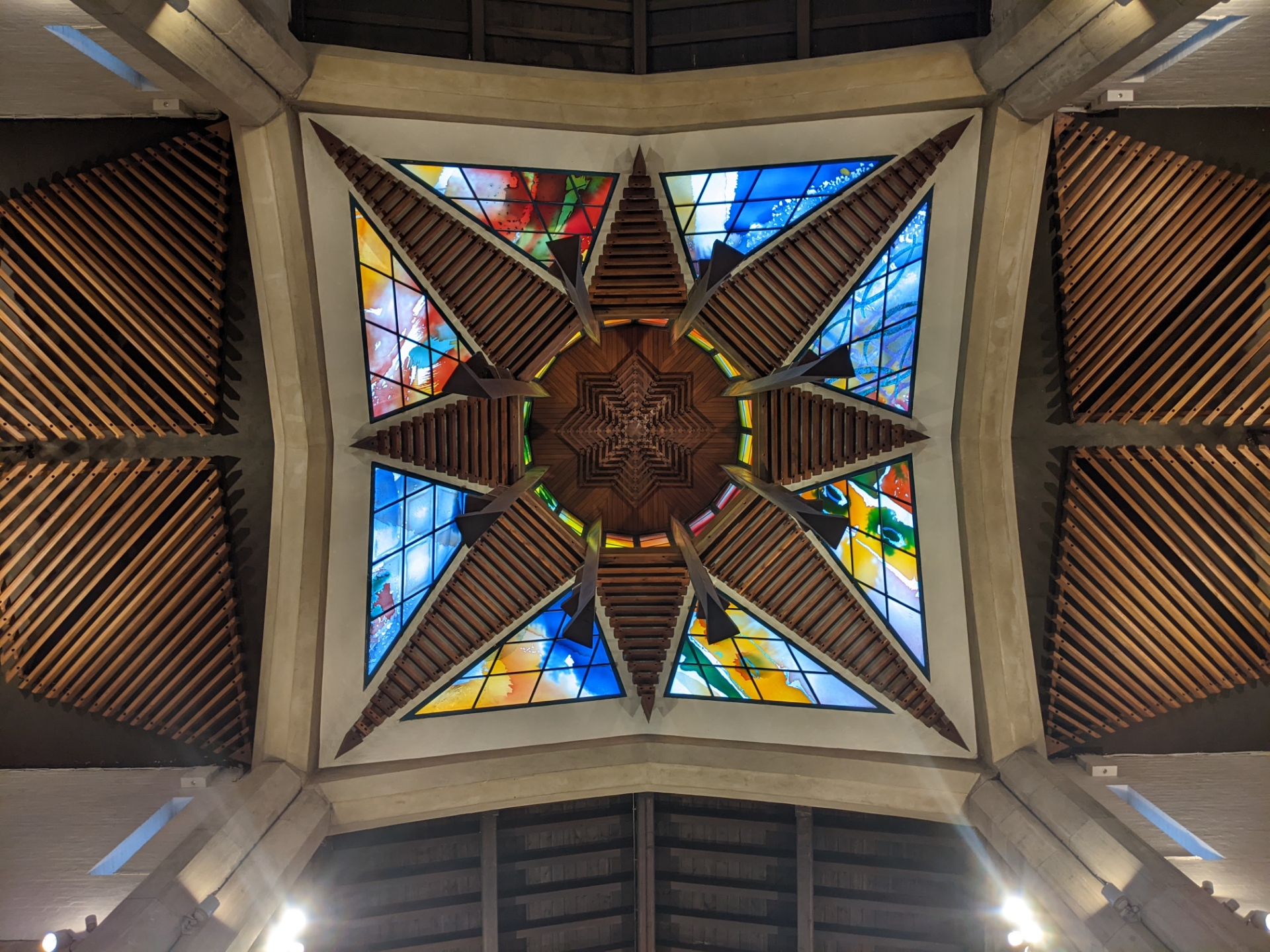
Looking upwards into a church ceiling where wood and concrete form an eight-pointed star, with the gaps filled with blue, yellow, green and red stained glass

About time I did one of these again…

The good

A trip to Sheffield for the annual Ultreya GB. I missed last year’s, though I hadn’t intended to (in retrospect, my ideas of what would be possible with a small baby were somewhat unrealistic), and it was good to be back. It was quite a different experience: I was very tired (see below) and also I don’t usually spend the event climbing up and down all the available steps in the cathedral. But it all came together for me in the last hymn – a very lively Amazing Grace – with the banners lined up and the baby clapping along in delight.

Some delightful fellow passengers and some railway staff who may in fact have been angels.

The difficult and perplexing

A month’s worth of interrupted sleep has trashed my immune system, the nursery germs have pounced, and I was very wobbly earlier in the week. And I’m not a nice person when I’m ill and tired.

Two hours and forty minutes on a train, each way. The way back was more trying than the way out.

What’s working

Sloggi long pants. Do they make me feel about a hundred and two? Yes, particularly the beige ones. Is it worth it to make bare legs bearable in hot weather? Absolutely. (Yes, I am aware of the Snag ‘chub rub’ shorts. Quite apart from the hideousness of the name, I can’t see that synthetic material next the skin would help in any way, however much I like their tights.)

Reading

Quite a bit! Having read She Who Became The Sun earlier in the summer, I picked up He Who Drowned The World (Shelley Parker-Chan) when it was on offer a few weeks ago. Equally fun (in its extremely dark way); the magical realism has more of an active influence on the plot this time round. I wasn’t convinced it stuck the landing, but the overall experience was sufficiently enjoyable to render that largely irrelevant.

Also on offer recently was Sea of Tranquility (Emily St John Mandel). This was a bit of a disappointment. I read Station Eleven early in 2020 and was very struck by how vivid and alien the post-apocalyptic world was. Sea of Tranquility, by contrast, all seemed extremely twenty-first century in terms of the way that the characters thought and spoke, with the different settings just so much window-dressing. The time travel plot also didn’t work for me; I think the aim was to subvert the usual clichés, but it just felt like a cop-out.

And Kobo also suggested Consider Phlebas (Iain M. Banks) for 99p, so I decided it was probably time I tried the Culture series.

Yesterday I started One Pair of Feet (Monica Dickens) which is very entertaining so far.

Then today I picked up N or M (Agatha Christie) because it was on the floor. I am less fond of Tommy and Tuppence than I am of most of Christie’s other series detectives, so missed this one on last year’s epic re-read. But I breezed through it and then picked up Postern of Fate to remind myself what happened to the family afterwards.

Writing

Nothing to speak of, though I have been doing a little worldbuilding in my head.

Making

One ridiculously huge baby sock, and now most of one more sensible one. I also converted a little binder into an earring holder (I will try to remember to post pictures of this).

Watching

The Paralympics, on and off. I was pleased to catch Sarah Storey’s umpteenth win, as Channel 4 also showed a decent chunk of the race. (I have found both the BBC and Channel 4 very frustrating in their tendency to show fragments of an event that have a Great British Medal Hope and nothing else. But it’s probably just as well this year, because I’ve had very little telly time.)

Looking at

Ely Photographic Club’s exhibition at Babylon Arts. There were a few pieces there that made me smile, and several that were clearly very technically skilled even if not really my thing. Also, Sheffield cathedral.

Cooking

A very hot vegetable curry: the veg box contained a bag of Padrón peppers, every single one of which was the ‘really quite spicy’ variety, so unsuitable for serving as a main/side dish in the usual way. Not one of my most successful dishes, though I’m pleased with it as a creative response to a problem.

Eating

This year’s fancy Magnum flavours, an impulse buy when they were on offer in Co-op. I’m still not entirely convinced that ice cream and popping candy is a happy combination, but it’s different, I’ll give it that.

Moving

We continue our WalkRuns (being runs that are in fact mostly walks).

Noticing

Loads of dragonflies this year. Or possibly damselflies. They don’t stay still long enough for me to be able to tell the difference.

In the garden

Ripe apples. I’ve pruned all the apple trees bar one. The next job is to take out the dead box (or was it privet?) bushes that got eaten by beetles last year.

Appreciating

Cursillo. It’s totally bonkers, but there is space in there for people to be Christians and also themselves, and that is something I was missing for a long time and something for which I continue to be grateful.

And, needless to say, every night when I get to sleep before midnight and get to wake up after six.

Acquisitions

I found a little makers’ cooperative shop in Sheffield and picked up a fabric patch (to join the several I have still to sew on), a sticker, and a pair of teal stud earrings.

Line of the week

Monica Dickens, weighing up her options:

The Land Army? One saw oneself picking apples in a shady hat, or silhouetted against the skyline with a couple of plough horses, but a second look showed one tugging mangel-wurzels out of the frozen ground at five o’clock on a bitter February morning.

This coming week

The emerging routine is slightly disrupted by a committee meeting, and then at the weekend there’s an exciting sea voyage. And that’s the last excursion for a little while, and that’s probably just as well. I might even update this blog more.

on a personal level

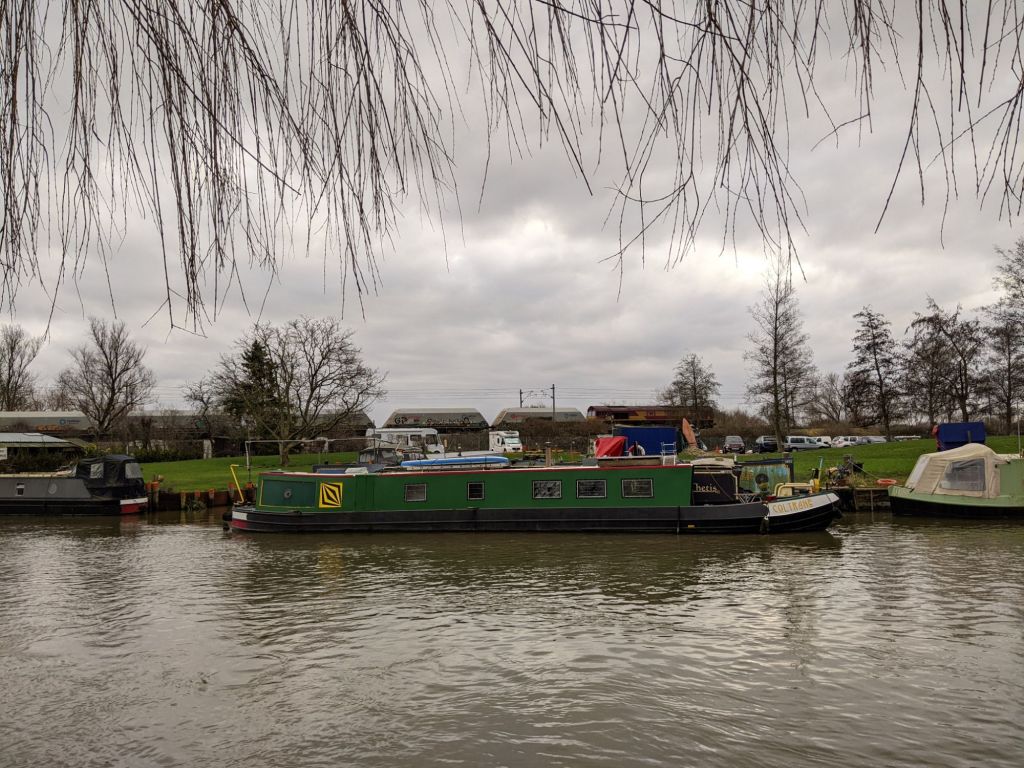
A freight train crosses the back of the picture on a grey day; in front of it, a narrowboat is moored on a river.

Drink red wine from a tumbler.

Add three spoonfuls of sugar to black coffee.

Write a sentence longer than most people’s paragraphs.

Talk to a railway man.

Quote some dreadful Victorian slush.

Try to persuade the nearest soprano to sing some dreadful Victorian slush.

Photograph some buses.

Tell everyone you prefer trains.

Look at three different maps of the same place, none current.

Take the baby to look at trains.

Take a beermat home with you. Take six beermats home with you. (Or: be pleased that the beermat collection has gone to someone who appreciates it.)

Join the Friends of King Alfred Buses. (I have been meaning to do this for ages and have at least/at last managed to print off the application form.)

Yell ‘Trolloper!’ at the cat. (I didn’t, because it was five in the morning and the rest of the household was more or less asleep, despite the noise of the cat/waste paper battle.)

Read the lesson at Mattins. (I get one opportunity per year. I am on the rota.)

Remember the date. Tell people why it’s meaningful on a personal level. Although probably not in those terms.

(Two years without Pa, six months, nearly, with the little one.)

(Thanks to Havi for the concept of SMOPL.)

Week-end: l’on y danse

The surviving arches of the bridge at Avignon, on a bright winter day)

The good

We are on holiday! We are staying in Avignon and visiting other towns in the vicinity as well. There is a great deal to see and the food is excellent. Also, the sun has mostly been out, and getting more sun was the object of the exercise.

The mixed

There is, inevitably, not enough time to do everything and see anything, and I am compiling a mental list of things we didn’t get round to this time/that were closed for the winter/would have needed a car/etc. So we will just have to come back and take slow trains along the Côte d’Azur/see the Pont du Gard/look for flamingoes in the Camargue.

The difficult and perplexing

It is cold. The place we are staying at is called La Vie de Bohême and my hands are doing the Che manina gelida bit. The mistral is blows straight through me. Just like home, really. But why do all the hand driers in the public lavatories insist on getting in on the act?

What’s working

Trousers over tights. Having a lie-down in the afternoon. Accepting the fact that really any establishment with a menu outside will feed me adequately and will be happy to do so.

Reading

I forgot to mention Winters in the World (Eleanor Parker) – following the cycle of the early mediaeval year and quoting a lot of literature along the way. I’m really enjoying it.

On the e-reader, I have These Violent Delights (Chloe Gong) – Romeo and Juliet, except older and more jaded, in 1920s Shanghai, with monsters and possession (sort of). I’m enjoying the story; the prose tends towards the clumsy (but see below). I’m also continuing with Death in Cyprus and returned to The Master and Margarita (the latter has now shown up). I’m not sure I’m really getting it.

Looking at

Lots of Provençal monuments! We went around the Palais des Papes, and out as far as you can along the famous bridge (there was an exhibition, with quite an interesting film about how they have worked out where the rest of it originally was). This morning in Nîmes we went around the Roman arena and I learned a lot about gladiators, and into the Maison Carrée. This afternoon in Arles we looked at the outside of the Roman arena (two in one day seemed excessive) and through the railings at the theatre.

My favourite thing, though, has been the crib scenes in the churches. The one in the cathedral at Avignon is currently showing a Candlemas scene; the one in Saint-Trophime in Arles is a magnificent multi-level edifice occupying an entire chapel and featuring locals in traditional dress coming to visit the crib. It even has a windmill at the top of the hill.

Eating

I said there’d be pancakes. There have, in fact, been three: one with chilli con carne at My Old Dutch (Chelsea) on Wednesday night; one with ham and Gruyère and an egg on top yesterday lunchtime, and one (‘crêpe Mont Ventoux’) with chestnut and whipped cream and chocolate sauce for pudding yesterday night. That may be enough to be going on with. I have also eaten onion soup (very, very effective when I was tired and cold the night we arrived), lamb stew, and quiche with leeks and bacon. It’s all been delicious.

Moving

Climbing up and down a lot of steps of various antiquity.

Noticing

A set of gallopers with black bulls alongside the usual horses. Young men with a shopping trolley full of puppies (I don’t know why; I hope they meant them no harm). Goats in a garden next the railway. Snow on the ground as we crossed the middle of France on the TGV. Two swans and a cormorant in the Rhône.

Appreciating

Having an apartment to ourselves. The SNCF app (when it’s been working). The friendliness and patience of pretty much everyone we’ve spoken to.

Acquisitions

Badges for my camp blanket (though not, so far, one saying Avignon).

Hankering

I keep passing shops full of soap and hats and shoes, and haven’t gone into any of them. Yet.

Line of the week

One really good one from These Violent Delights:

He was born with pride stitched to his spine.

This coming week

A little longer in France, and then home. I have quite a lot to sort out before next weekend, the beginning of a very busy February.

Anything you’d like to share from this week? Any hopes for next week? Share them here!

Week-end: lounging

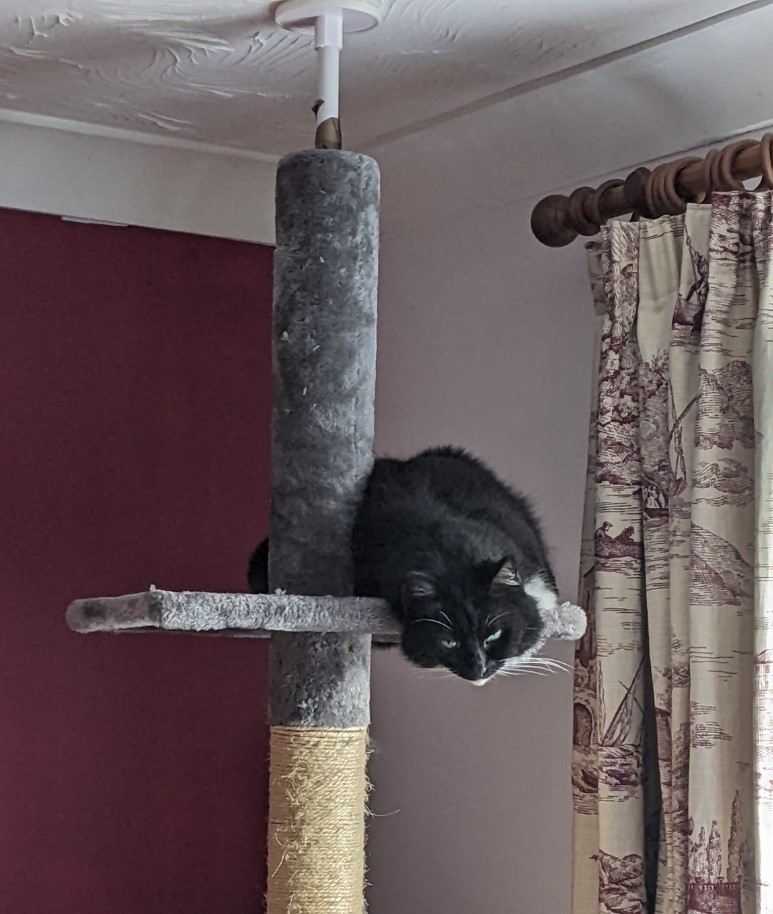
A fluffy black and white cat sprawls across the top platform of a floor-to-ceiling grey plush cat tree, like a lazy gargoyle

The good

Two days off! And another one on Monday. I have been napping, writing, watching figure skating, planning a holiday and getting my hair cut. It’s much less straggly now, although if I don’t blow dry it then it still curls the wrong way at the bottom. Also the plumber came and replaced the kitchen tap. The new one doesn’t drip. It’s wonderful.

The mixed

I have the time to write. Where is the energy? And the motivation? I’m doing my best to trust that all this napping and skating-watching (and napping while skating-watching, sorry again Roman Sadovsky, though since that free skate turned out to have dropped him out of the medals when I woke up again maybe he’d rather I didn’t watch it) is going to get me to a place where I can write enthusiastically and freely, but that’s advanced practice.

The difficult and perplexing

Still tired.

What’s working

Well, the new kitchen tap. The shower is still temperamental, though cleaning the head with vinegar has helped a little.

Reading

I started The Paris Apartment (Lucy Foley) on the train home from York (did I say that last week?) but haven’t got any further with it. I got slightly irritated by the sheer profusion of unnecessary cliffhangers (oh no! she has been hit by something heavy and sharp! two chapters later, it turns out to have been a cat jumping on her!) but will probably pick it up again on another train journey sooner or later. I’ve been dipping into Atlas of Imagined Places (Matt Brown and Rhys B. Davies), which is great fun, even if it’s making me painfully aware of my lamentable lack of pop culture knowledge. This is bound to feature as a Reader’s Gazetteer special when I’ve done a bit more dipping. And, in Sunday afternoon Christian reading, I’ve just begun Intimate Jesus: the sexuality of God incarnate (Andy Angel).

Writing

I finished the first draft of Starcrossers. Hurrah! It’s three and a half thousand words too long and I could easily make it longer. Oh dear. I’m going to let it sit for a month and see what’s to be done about it in December.

I also began a blog post about the Belgian Coastal Tramway, which I’m hopeful you’ll see sometime in the next few weeks.

Making

Return of the mystery patchwork (finally remembered to look in the fabric box in daylight, allowing me to cut out the last six patches and the wadding.

Mending

Darned some different bits of my black jeans. And one of Tony’s T-shirts.

Watching

The Sheffield Grand Prix. One of my friends got tickets to be there in person. I’m very jealous.

I would say, Twitter imploding, but actually I’ve only been following it at a distance. I haven’t really enjoyed being on Twitter since 2016 or so: this may be a prompt to step away. My favourite time on the internet was really round about 2009 or 2010 when LiveJournal was still thriving and Dreamwidth was just taking off so there could be two versions of the exact same post with two equally interesting conversations happening in the comments, and when blogs were still where it was and nobody had yet invented the algorithm. You can probably tell.

Cooking

I made a really good macaroni cheese on Friday. Using actual macaroni helps: it has that lovely squidgy schlick-schlick texture, which you just don’t get with penne. (I usually use penne, but I picked up a packet of macaroni from the side of the path a few weeks ago – I would be disowned if it ever came out that I left good food lying on the ground – and have been working my way through that.)

At the moment I have a turkey carbonnade in the slow cooker. I can’t see that this is any different from an idiosyncratic bolognese sauce, but never mind that. We’ll see how it tastes in a couple of hours. I have made polenta to go with it.

Eating

Our corner shop has become a Co-op and stopped selling plain Bounty bars. Disgraceful. It does, however, sell rather good orange chocolate.

Noticing

A flock of gulls flying overhead in a shallow V-formation.

In the garden

My Japanese anemone is attempting to bloom!

Appreciating

Lie-ins. Naps. Sleep in general, basically.

Acquisitions

Tickets to Avignon (on y danse, on y danse). The idea is that we get a bit of winter sunshine when I really need it, and in the meantime it’s something to look forward to.

And Molke had a sale so I’ve ordered some more bras.

Line of the week

We’ll be taking the TGV to Avignon, but I enjoyed Slow Travel: Europe by Train in the January 2008 issue of Hidden Europe.

We really mourn the passing of Eurostar’s old route into London where the train crept through Brixton on an ancient viaduct, screeched round tight curves past Battersea’s back gardens and trundled through a metroland full of bourgeois comforts: shiny Ebbsfleet will surely never be a match for Penge East, Sydenham Hill or sedate Shortlands.

Sunday snippet

From the end of Starcrossers:

We went beyond the farmland. We went all through the delta down to the sea, and then turned towards the moonrise until we caught sight of the high mountains. Then we returned to the city, Crew and Containment alike talking of where we might go next, and all of us were welcomed into the homes of our new acquaintances, where those who’d stayed at home were eager to hear what we’d seen.

This coming week

Another day off. Two days of tech support. Thursday, an appointment in Ely and a night at the opera in London (the appointment was scheduled two days ago and has stymied my beautiful plans, but I can still do both). And that’s as far ahead as I care to think for the moment.

What about you? Anything you’d like to share from this week? Any hopes for next week? Share them here!

Week-end: return to Yorkshire

A pedestrianised shopping street on a rainy day. Neon lights strung across the street read: Dear Leeds, we are your people/Past present and future

The good

I’m writing this on the train home from York: I’ve had a lovely weekend, using the fact of delivering training in Leeds as an excuse to stay with my friend A (and spare my employer the expense of a night in a hotel). We’ve been drinking tea and chatting and playing board games.

The mixed

Still very tired. But it could be worse: it could have been long COVID, and it isn’t. Another couple of months and I’ll start feeling more human. In the meantime there’s the sofa and a blanket and the cat.

The difficult and perplexing

The awkwardness of mistaking a traffic light for a bus stop and trying to get through a crowd of people who, it turned out, were also trying to get off the bus…

What’s working

New standing desk thingy, though I’m spending some of the time seated, with everything moved down a shelf or so.

Reading

It’s been a week for finishing books. Coastliners (one of those books that took a while to get into and then got gripping); Sisters of the Vast Black (continued to be excellent all the way through; a book about doing the right thing despite everything including the futility of it all; had to spend a few minutes staring into space when I got to the end); Changing Planes (Ursula Le Guin; a Gulliver’s Travels for the jet age; started ages ago, but it’s more a collection of vignettes than a single narrative, so bore dipping into). Then I reread The Moving Finger on the train up to York on Friday evening.

Writing

None, but I’m counting the Leeds excursion as research for the Romeo and Juliet thing.

Making

Secret patchwork things.

Watching

Eurosport. Mostly skating.

Looking at

Hear My Voice: an exhibition of art by refugees at Ely cathedral.

Cooking

Spaghetti Vesuvio.

Eating

Half a Fat Rascal (apparently a Yorkshire thing, maybe specifically a Betty’s thing: a sort of spiced scone with dried fruit and almonds on the top). Just the thing for a Sunday breakfast. Today we went to Trinacria on Bishy Road for lunch; I had an extremely large pizza Vittoria (fennel, tomatoes, sausage, mascarpone).

Playing

Pandemic. We made a pretty good team.

Noticing

Fireworks in the sky as I looked back over Leeds, with a sunset squashed under black rainclouds. Square grey stone housing and elaborate Victorian red brick Gothic. Rainbow in the east. Deer in the fields outside Ely.

Appreciating

Seat reservations. Friends.

Line of the week

From Changing Planes:

The people sing at the campfires, and the quiet singing hovers in the darkness between the little fires and the stars.

This coming week

A couple of days of work and then a few days off. Maybe I’ll do some writing. Maybe I’ll catch up on sleep.

Anything you’d like to share from this week? Any hopes for next week? Share them here!

Week-end: the higher the brow the harder they fall

A stone sill a great height over a city has arrows and town names and distances carved into the it; one of those is '230 - Londen'

The good

The Kickstarter for Bicycles and Broomsticks is live and is nearly half-way funded only a few days in. I have written a story! My story will be published! People will read my story! In a year when I have more writing-imposter syndrome than usual, this is a good feeling.

We had a lovely time in Belgium, with a further two and a half days in Brugge, an hour people-watching in Brussels, and the comparative glamour of Standard Premier class on the Eurostar home.

Today, by contrast (but equally good), I’ve cycled ten minutes up the hill and slightly less down again (eating croissants and discussing questions of theology in the middle), and walked 5km in one hour, and watched Filippo Ganna cycling 57km in one hour, and pottered in the garden, and generally had a nice quiet day.

The mixed

Home trains. We got off the Eurostar to find that nothing was running to Ely, so we got on a slow train to Cambridge, then discovered that the next train to Ely was in fact running. And on Tuesday I miscalculated my tickets and had to buy a single to go with my super off-peak which I’d left it too late to use. Plus the fact that as things turned out I didn’t really need to go to London on Tuesday after all, except by the time I knew that I’d booked tickets to something I actually did rather want to go and see, so…

But! The Ely-King’s Lynn line is finally fixed, and the timetable restored, so I can get a train straight through to work in the morning, and I have two through trains per hour in the evening. Which is all marvellous.

The difficult and perplexing

My RSS reader came up with an error for Cate’s Cates this week. Catherine was a joyous, kind, witty, and eclectic internet presence; she died very unexpectedly earlier this year; and now a little more of what was left is gone.

Being eaten alive by mosquitoes in our room at Brugge. The bites are fading now, but at one point I had three on my right cheekbone. Fortunately the place also had a very flattering mirror and I could pretend it was a tripartite beauty spot, a mark of distinction, rather than untimely acne. The ones on my arms and feet were really itchy, though.

And I continue to be a zombie outside daylight hours.

What’s working

Well, not doing things outside daylight hours, but that gets increasingly difficult. I’m not even doing terribly well during the daylight hours, though Radio 3 is helping.

Promising myself I’d do an hour of admin and then stop (and setting a Forest Focus tree to enforce both).

Snag tights (the only snag, ha, is that all my other tights are infuriatingly ill-fitting by comparison). I was particularly pleased by the white-fishnets-over-black-opaques combination.

Reading

Very intellectual this week. I had put The Master and Margarita on my e-reader some time ago, and began that on the Eurostar home; I’m about a quarter of the page count and two decapitations in. Then I finished Art and Lies yesterday. Very good, impressionistic, visual, disquieting. (Note: all the content notes.) I couldn’t quite face going back to The Master and Margarita and more potential decapitations, so I started Sisters of the Vast Black (Lina Rather) which is delightful so far. (Nuns! IN SPAAACE!) Last night I was feeling too exhausted for anything new at all, so put on my pyjamas and lounged on the sofa with The Fellowship of the Ring (and the cat on my lap). I’m pretty sure I fell asleep like that.

Sewing

I got five badges (see Acquisitions, below) onto my camp blanket despite the best efforts of the cat.

Watching

Today, Filippo Ganna’s Hour Record, the end of the Lombardia, and highlights from the Singapore Grand Prix. At other points in the week, the keyboard finals of the BBC Young Musician of the Year, Star Trek: Lower Decks, and quite a lot of quiz shows from BBC iPlayer.

Looking at

Art in the Groeningen Museum in Brugge. I will never now be able to unsee The Judgement of Cambyses. There was some Bosch in there too, about which all I can say is ‘it was smaller than I expected’. But there were also things that I remember and enjoyed looking at: St Luke Drawing The Virgin Mary, for example, where the poor Madonna is trying to feed the baby Jesus, who is distracted by St Luke in the way that babies are. And a couple of really striking late nineteenth-century landscapes.

Then on Tuesday I went to see the Fashioning Masculinities exhibition at the V and A. A few of my friends had been to this and enthused. And it’s closing soon, and I can’t get to the V and A and back in a lunchtime (I’ve tried), so I thought that since I had to go to London to pick up my laptop, I might as well make an afternoon of it. And a fascinating afternoon it was. Although in some ways it was just as interesting looking at the other exhibition-goers; some of them were dressed very strikingly indeed.

Cooking

Caldo verde, sort of, and an attempted Black Forest sponge pudding from the remains of a chocolate tray bake and the end of a jar of cherry jam. I think I might have done better to bash the cake up more and mix in a little milk. But it was perfectly edible.

Eating

The most delectable waffle I have ever tasted. It was most beautifully light and it came with cream, ice cream, and kirsch-soaked cherries. I ordered a pot of coffee alongside it and that came with a macaron and a hard almond biscuit. This was at a café in Brugge called Carpe Diem.

We also ate some mussels and shrimp croquettes, and I had a thing called Croque Boum Boum for lunch on our last day (it’s a toasted cheese and ham sandwich with bolognese sauce on the top), but it’s that waffle that I’ll remember.

Drinking

Beer. I am a bit thrown by the way Belgian menus don’t tend to include the alcohol percentage, and tended to stick with known quantities for that reason. I did, however, risk a Tripel Karmeliet knowing that it was going to be pretty deadly.

And a lot of coffee.

Moving

I climbed the belfry at Brugge. Over three hundred steps. On the whole I prefer the one at Ghent, which has dragons, but I’m glad to have done it. I ended up at the top when the carillon was going for the hour, which was quite a thing. Couldn’t help but think of The Nine Tailors

Noticing

Golden sunlight and long shadows, and the sharpness of the demarcation. A tiny two-spotted ladybird landing on my hand. The stars, when I went out to pick some rosemary last night.

In the garden

Apples, loads of them. Pears, quite a few of them. Today I pruned one of the apple trees and cut a load of wisteria and the vine back.

Appreciating

The fluffiness of the cat. The honesty and curiosity of the Way of Breakfast group. A weekend in which I don’t have to do anything much.

Acquisitions

I was very pleased to find cloth badges for Oostende, Wenduine, De Haan, and Littoral Belge at a flea market stall in Brugge. Then, in a souvenir shop, I found a Brugge badge that I preferred to the one that I’d already got, so I bought that one. Anybody want a Brugge badge?

Picked up Susan Sontag’s Notes On Camp from the V and A.

Hankering

More Snag tights. And I am still thinking about jeans. (Both my pairs of jeggings have worn through, too.)

Line of the week

I said last week that it ought to be Art and Lies. This week it is, although it was hard to find a single best line; so much of it is short, bright, fragments that don’t look like so much on their own, but cumulatively are utterly dazzling. However:

The crescent curve of the train mows the houses as it passes, the houses disappear behind the moon metal blade of the silver train.

This coming week

I have finally got all the ducks lined up in a row for a work project that’s needed doing for a long time. On Monday I’m beginning another writing stint. Saturday we’re going to see friends. I want to have the energy to enjoy all those things in their different ways.

Anything you’d like to share from this week? Any hopes for next week? Share them here!

Sixteen years (without driving)

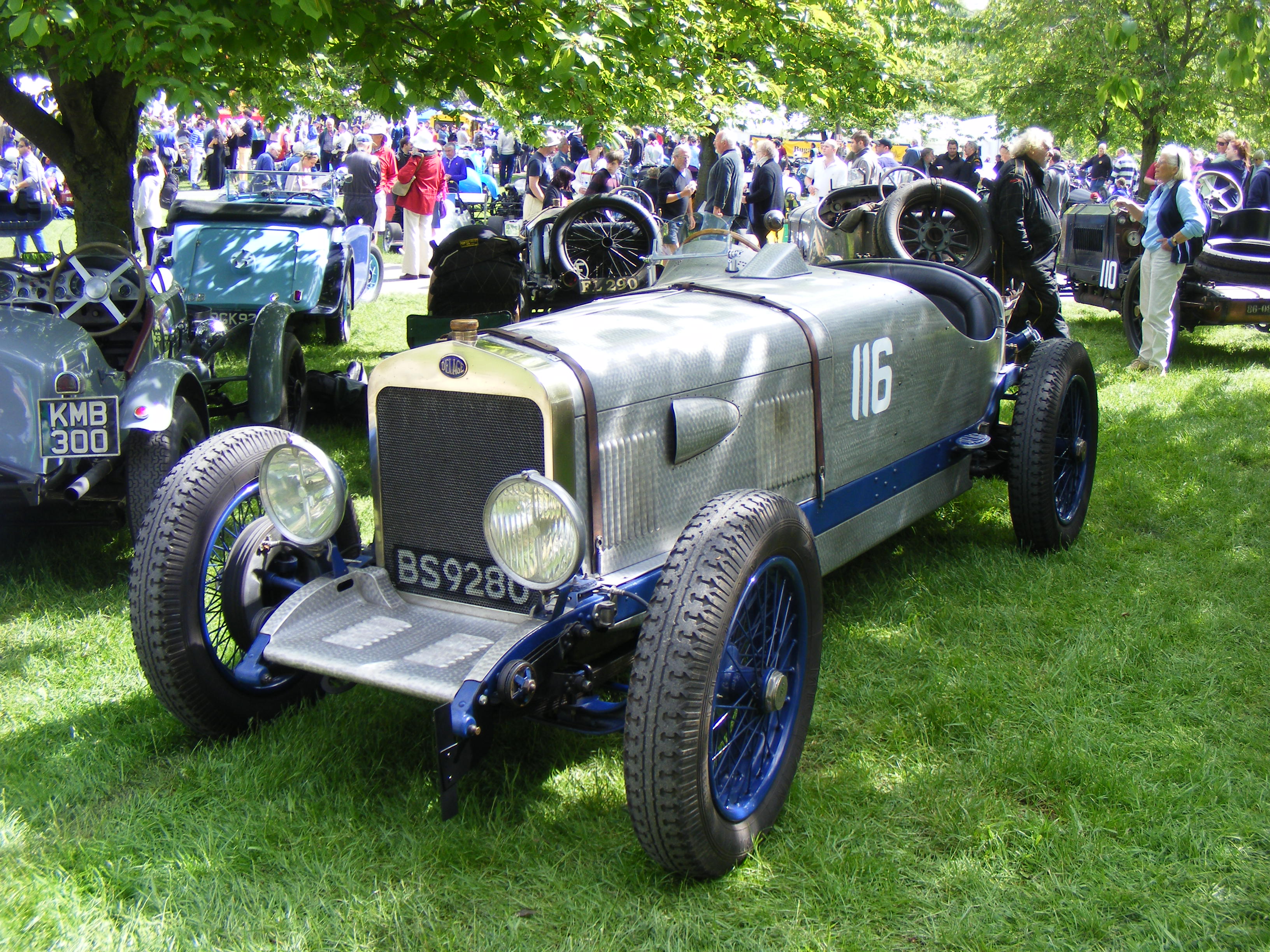
A vintage Delage car with the number 116 painted on the side
A car I have not driven. Lovely, though, isn’t it?

Today it is sixteen years since I last drove a car on the road.

That wasn’t deliberate. I only remember the date because it was the day before my graduation, and how could I forget that such an occasion happened on quatorze juillet? I failed my second driving test the day before I graduated, therefore I must have driven for the last time on the thirteenth of July. (In actual fact, I drove a Routemaster around a field a couple of months later, but that’s another story.)

I hadn’t meant that to be the last time I took my driving test. But I was moving out of the city where I’d learned to drive, and that meant that for the next test I’d have to learn a whole new set of test routes. And I’d just graduated and I didn’t have a job, and I never got round to sorting out lessons. My grand plan that year was to walk to Santiago de Compostela, and I didn’t need a car to do that. Then I spent two months in Germany and was thoroughly spoiled by the public transport system.

At the end of all that, seventeen months after failing my second driving test, I moved to Guildford. This is a notoriously expensive place to live and, even though I was living in a horrible bedsit, and even though I signed up with a temp agency fairly promptly, I didn’t have the money to spare for driving lessons.

I moved in with my fiancé. He had a car. I never drove it, though. I think I probably assumed that I would, sooner or later, but money was still tight. He was a PhD student and I was a temp, and we were living in Guildford.

I inherited a car from my godmother, but I swapped it for a piano. (The piano was left to my mother, but she already had one. The car ended up with my father, I think.) I couldn’t drive and I couldn’t play the piano, either.

We moved to Woking, which was marginally cheaper than Guildford, where I was still working. We managed to move everything except the piano in (or, in the case of the double bed, on) the car. Not long after that move, Tony started a different PhD. In London.

Nobody drives into London. Not without a very good reason – disability, say, or actually living there. We did not have a very good reason to drive into London. In fact, we had no good reason to drive at all. I could take the train to Guildford. Tony could take the train to London. We could go pretty much anywhere else we fancied by train, because Woking, while not terribly interesting in itself (unless you’re a Martian invader), is very well-connected. And the car was sitting on the road costing us £600 a year before we’d even put fuel in.

The car went to a couple of affable blokes from somewhere in Wales. Looking back, that was probably the moment that confirmed my non-driving path. Up until then, driving occupied a slot in the ‘get around to it some day’ filing cabinet in my head. If I ever needed to, I’d told myself before, I’d learn to drive. Now I had to ask myself: but what? Tony could, and did, hire a car if he wanted to go somewhere off the public transport network. That wouldn’t have worked for me, because I didn’t have the familiarity with driving that would let me leap into a strange car and go somewhere safely, and now we didn’t have a car I wasn’t going to get it.

We adjusted very smoothly to life without a car. We walked to the shops. We commuted to work by train. We visited family by train. We started getting a veg box delivered. I bought a trike and started cycling. Tony had been cycling for years. We didn’t need a car. Not in Woking, anyway. It would have been a different story in the place where I grew up (a mile to the nearest village).

Not being able to drive might have been career limiting, but I was never terribly interested in the career track that would have required it. (A decade older and a billion times more confident, I think now that I wouldn’t have made a bad stab at it, but I don’t think it would ever have been my ideal future.) That problem disappeared when I moved to my employer’s head office and a job where nobody expected me to drive.

If we didn’t need a car in Woking, we certainly didn’t need one in Cambridge. (That move involved six months in separate temporary addresses, and Tony moved all the furniture except the piano in a hired van.) It is only slightly more advisable to drive into Cambridge than it is to drive into London. And I told myself that if I didn’t start riding a standard, two-wheeled, bike in Cambridge, I’d never do it at all. I did. Suddenly I could get to everything I needed to.

Life works perfectly well for me without driving. Of course, that’s because I’ve managed – first by luck, and later by design – to set it up that way. If I were still in a tiny hamlet in the Marches, I think I’d probably have to drive, or else get used to a very limited existence. As things are, we choose places to live based on walking and cycling distance from the amenities, and we are fortunate enough for that to be financially and logistically feasible.

More recently, I’ve developed intermittent vision loss (very occasional, but inconvenient in its very unpredictability) which makes me wonder whether I’d actually be safe behind a steering wheel. I don’t much like the thought of being suddenly unable to see out of my right eye while bowling down a motorway. Though I’ve heard of someone with the same thing who just pulls over when he notices it coming on.

Not driving does make it harder to visit other people. I have friends whose house I can see from my morning train, yes, but I have family in villages where the bus comes twice a week, or never. There is no point in our getting a National Trust membership, because the great and the good tended to build their stately piles a long way from anything so plebeian as public transport. And I might have been on a retreat in the last decade if so many retreat houses were not buried deep in the countryside with no bus service. (To be fair, the last retreat I went on was a five minute taxi ride from Godalming station, so it may also be that I just haven’t got around to it.)

I fret a lot about Putting People Out. Usually they are lovely and think nothing of going five miles out of their way to get me home. It turns out that five miles isn’t all that far, in a car. Or, in the case of my husband, hiring a car. Of course it does get awkward sometimes, if I’m very tired and would rather be by myself on a nice quiet train. More often, though, I get to know them a lot better, and, as someone to whom socialising doesn’t come naturally, that’s very valuable.

Of course, the longer my not driving goes on, the more it becomes about the environment. I came across The Jump a few months ago, and found it a lot more encouraging and less annoying than a lot of climate rhetoric. It identifies six broad ‘jumps’ (lifestyle changes, I suppose you could call them), one of which is ‘get rid of your personal vehicle’, but is very reassuring about not expecting perfection. Well, the cars we hire these days are electric, and if we ever do buy one (and my eye stops playing up and I learn to drive) it’ll be electric, but there’ll still be cobalt in the battery and rubber particulate to fret about. I fret less these days – or, rather, I have a more realistic sense of my own ability to effect large-scale change and consequently a more realistic sense of my own responsibility – but, having accidentally forged a lifestyle in which I don’t drive and don’t have to, it seems a bit silly not to keep it going.

And it’s gone on a long time. Next year my existence as a non driver will be old enough to drive.

The Reader’s Gazetteer: N

DSCF8578

This is a surprisingly difficult letter. I struggled. Wikipedia’s List of fictional countries and List of fictional towns in literature both look hopeful, but a closer inspection of the N sections reveals that most of the locations either appear in a medium that I’m not including, or don’t pretend to exist in the world as we know it.

The exception is Norland, in a short story by Sir Arthur Conan Doyle, which has little identifying detail beyond a sufficiently substantial submarine division to be a credible threat in the early 1920s. Even Thomas Hardy’s Wessex can only come up with Narrowbourne, in a short story I haven’t read. Novel-length works featuring settlements beginning with N? The internet fails me.

Why? New and North between them ought to yield plenty of plausible towns. I wonder whether calling anything fictional ‘New’ is a bit too much of a lampshade for something that’s meant to be set in the world as we know it. Perhaps it draws attention to the fact that the place has existed mere months, or, at the outside, decades, in the author’s head. (Or, conversely, one or more fictional Newports is slipping past me because I’ve mixed them up with the real ones.)

However, my father was able to point me at North Bromwich, and so it’s back to the fictional West Midlands, perhaps a little bit further west of where we were last time. He has a lovely set of blue-and-gold Francis Brett Young hardbacks, which no doubt I’ll read my way through at some point, but in the meantime Project Gutenberg came up with a couple. Of these, I’m reliably informed that The Young Physician spends the most time in North Bromwich, so off I went.

In fact, most of the first half of the book finds our hero, Edwin, at school in Sussex, with occasional visits home. And there’s a lovely train journey to get him there, which I can’t resist including at length, even though the Home Counties and Victoria and Paddington stations and Reading and Oxford are real enough. I’m going to say that it’s the careful positioning of the fictional place with reference to the real ones that makes it work:

By this time the region of downs had been left far behind.  They were gliding, more smoothly, it seemed, through the heavily-wooded park country of the home counties.  Stations became more frequent, and the train began to fill with business people hurrying to London for their morning’s work.  They settled themselves in their carriages as though they were confident that their seats had been reserved for them.  They were all rather carefully, rather shabbily dressed: the cuffs of their coats were shiny, and the cuffs of their shirts fringed, and one of them, a gentleman with a top-hat half-covered by a mourning-band, wore cuff-covers of white paper.  They all read their morning papers and rarely spoke; but when they did speak to each other they used an almost formal respect in their addresses which implied that they were all respectable, God-fearing people with responsibilities and semi-detached houses.  Edwin they ignored—not so much as a wilful intrusion as an unfortunate accident.  He began to feel ashamed that, by starting from the terminus, he had occupied a corner seat to which the gentleman with the paper cuffs had an inalienable right.

In a little while the villas from which this population had emerged began to creep closer to the track, and by the seventh station their backs were crowding close to the embankment with long, narrow gardens in which the crimson rambler rose seemed to have established itself like a weed.  The houses, too, or rather the backs of them, grew more uniform, being all built with bricks of an unhealthy yellow or putty colour.  Soon there were no more buildings semi-detached.  The endless rows seemed to be suffering some process of squeezing or constriction that made them coalesce and edged them closer and closer to the railway line.  Soon the gardens grew so small that there was no room in them for green things, only for a patch of black earth occupied by lean cats, and posts connected by untidy pieces of rope on which torn laundry was hung out to collect the smuts or flap drearily in a night of drizzle.  Then the gardens went altogether; and the beautiful and natural love of green things showed itself in sodden window-boxes full of languishing geranium cuttings or mignonette.  The very atmosphere seemed to have been subjected to the increasing squeeze; for the mild air of the downs had here a yellow tinge as though it were being curdled.  To complete the process the train plunged, at last, into a sulphurous tunnel, emerging amid acrid fumes in a sort of underground vault where the door was opened by a ticket-collector with a red tie, tired already, who shouted “Tickets, please.”

None of the respectable suburban gentlemen took any notice of him, for by purchasing season tickets they had rendered themselves immune from his attentions; but he glared at Edwin, and Edwin passed him his ticket, which was handed on as if it were a curiosity and a rather vulgar possession by the gentlemen on his side of the compartment.  The door was slammed.  The man with the top-hat placed it carefully on his head and adjusted the paper cuffs.  Others folded their morning papers and put them in their pockets.  One, apparently recognizing a friend who was sitting opposite to him, for the first time, said “Good-morning,” and the train passed amid thunderous echoes under the arch and into Victoria Station.  All his fellow-passengers were adepts at evacuation, and before he knew where he was Edwin was alone in the carriage.

He was very lonely and yet, somehow, a little important.  Usually, at term end, he had crossed London with Widdup, whose westward train also started from Paddington.  He hailed a hansom, and one that was worthy of its name: a shining chariot, all coach-builders’ varnish, with yellow wheels and polished brass door-handles and clean straw that smelt of the stable on its floor.  The cabman was youngish, mahogany-complexioned, and ready to be facetious.  He called Edwin “My lord,” and Edwin hardly knew whether to treat him seriously or not.  “Geawing to the races, my lord?” he said.  The Lord knew Edwin had had enough of races for a bit.  He said “Paddington.”  “Ascot or Newbury?” said the cabby, climbing to his seat.

It was a great moment.  The movement was all so swift and luxurious, the hansom so delicately sprung that it swayed gently with the horse’s motion.  The polished lamps on either side were filled with wedding rosettes.  Inside on either hand were oblong mirrors in which Edwin could almost see his own profile: a subject of endless curiosity.  There was even a little brass receptacle for cigar-ash.  A Cunarder of a cab!  The cabby whistled “Little Dolly Daydreams” with a ravishing tremolo.  The cab, which had jolted a trifle on the setts of the station-yard, passed among a flight of feeding pigeons out of the iron gates into the bowling smoothness of the Palace Road.  My word, this was life. . .  .  …

The streets were so wide and clean, the green fringe of the park so pleasant: through the railings he could see men and women on horseback taking an early ride, enjoying, like him, the coolness of the morning air.  He wondered at the great white stucco houses of Park Lane, standing back from the wide pavement with an air of pompous reticence.  Before one of them, remnant of a summer dance the night before, a tented portico, striped with red and white, overstretched the pavement.  Edwin did not know what kind of people lived in these houses, but in the light of this morning it seemed to him that theirs must be an existence of fabulous happiness, all clean and bright and shining as the morning itself or the rubber-tired hansom, spinning along with its yellow spokes beside the neat park railings.

Once again the resorts of elegance were left behind.  The hansom, heaving heavily, was checked on the slope of the gradient descending to the departure platform at Paddington.  Opposite the booking-office it stopped, and Edwin was released from this paradisaical loosebox.  The cabby, wishing him the best of luck at Goodwood, patted his horse, whom he had christened Jeddah, and climbed up again to his seat whistling divinely.  Edwin was disgorged upon the long platform at Paddington that rumbled with the sound of many moving trollies below a faint hiss of escaping steam, and smelt, as he had always remembered it, of sulphur mingled with axle grease and the peculiar odour that hangs about tin milk-cans.  He was thankful to be free of it, sitting in the corner of a third-class carriage opposite a stout woman with eyes that looked as if she had been crying all night, and a heavy black veil, whose hat was surmounted by coloured photographs of the Memorial Theatre at Stratford and Brixham Trawlers waiting for a Breeze.

This train ran out of London more easily than the other had entered it.  The area of painful constriction seemed more narrow, and in an incredibly short time he found himself gliding along the Thames valley with the ghostly round tower of Windsor Castle on his left.

At Reading, where the sidings of the biscuit factory reminded him of teas which he had “brewed” with Widdup, the woman opposite took out a crumpled paper bag, and began to eat sandwiches.

The sun, meanwhile, was climbing towards the south, and the railway carriage began to reflect the summery atmosphere of the green and pleasant land through which the train was passing.  It made golden the dust on the window-pane at Edwin’s elbow and discovered warm colours in the pile of the russet cloth with which the carriage was upholstered.

It was a country of green woods and fields of ripening mowing-grass from which the sound of a machine could sometimes be heard above the rumble of the train.  It all seemed extraordinarily peaceful.  A cuckoo passed in level flight from one of the hedgerow elms to the dark edge of a wood.  In the heart of the wood itself a straight green clearing appeared.  It reminded Edwin of the green roads that pierced the woods below Uffdown, and he remembered, poignantly, the walk with his mother in the Easter holidays when they had reached the crown of the hills at sunset… another sight fell upon his eyes and filled him with a new and strange excitement: a small cluster of spires set in a city of pale smoke, and one commanding dome.  He held his breath.  He knew that it was Oxford.

This, then, was the city of his dreams.  Here, in a little while, he would find himself living the new life of leisure and spaciousness and culture which had become his chief ambition.  This was his Mecca: “That lovely city with her dreaming spires,” he whispered to himself.  It was indeed merciful that the vision of his second dream should come to cheer him when the first became so perilously near extinction.

Yes, you say, but what about North Bromwich? We’ll get there, I promise.

“This rack is intended for light articles only.  It must not be used for heavy luggage.  This rack is intended for light articles.  Only it must not be used for heavy luggage.  While there’s life there’s hope.  While there’s life there’s hope.  While there’s life there’s hope.”

So, in the pitiful whirl of Edwin’s brain, foolish words re-echoed, and in the end the empty phrase seemed to attach itself to the regular beat of the train’s rhythm as the wheels rolled over the joints in the rails.  Mesmerised by the formula he only dimly realised that they were now roaring, under a sky far paler and less blue, towards the huge pall of yellowish atmosphere beneath which the black country sweltered.

Soon the prim small gardens told that they were touching the tentacles of a great town.  A patch of desert country, scarred with forgotten workings in which water reflected the pale sky, and scattered with heaps of slag.  A pair of conical blast furnaces standing side by side and towering above the black factory sheds like temples of some savage religion, as indeed they were.  Gloomy canal wharfs, fronting on smoke-blackened walls where leaky steampipes, bound with asbestos, hissed.  The exhaust of a single small engine, puffing regular jets of dazzling white steam, seen but not heard.  A canal barge painted in garish colours, swimming in yellow water, foul with alkali refuse.  A disused factory with a tall chimney on which the words Harris and Co., Brass Founders, was painted in vertical letters which the mesmeric eye must read.  Another mile of black desert, pools, and slag heaps, and ragged children flying kites.  Everywhere a vast debris of rusty iron, old wheels, corroded boilers, tubes writhen and tangled as if they had been struck by lightning.  An asphalt school-yard on a slope, with a tall, gothic school and children screaming their lungs out, but silent to Edwin’s ears.  Endless mean streets of dusky brick houses with roofs of purple slate and blue brick footpaths.  Dust and an acrid smell as of smoking pit heaps.  More houses, and above them, misty, and almost beautiful, the high clock tower of the Art Gallery.  A thunderous tunnel. . . .  The clamour of the wheels swelled to an uproar.  “While there’s life there’s hope.  While there’s life there’s hope.”  Under the gloom of the great glass roof the train emerged.

The art gallery gives us the clue to the real-world equivalent of North Bromwich. Later we discover that the Mayor has presented it with an ‘unrivalled collection of Madox-Jones cartoons’. I went on a school trip to Birmingham Art Gallery, to look at the Pre-Raphaelites, and the Botanic Gardens, to look at plants, when I was twelve. I don’t remember much about it, except for a rather magnificent Lady of Shalott (not that one, a different one) who was on loan from somewhere else. Since then I’ve only ever been through Birmingham on the train, or changed at New Street. (By the way, the obvious London station to leave from would be Euston; I’m not really sure why Edwin goes via Oxford. Any ideas?)

As Edwin settles back in, and starts shuttling between his home of Halesby and the city of North Bromwich, we get to know it better, from, shall we say, various different points of view:

The city of iron stands upon three hills and its valleys were once watered by two rivers; but since the day when its name was humbly written in Doomsday these pastoral features have disappeared, so that the hills are only known as tramway gradients that testify to the excellence of the Corporation’s power station, and the rivers, running in brick culverts, have been deprived not only of their liberty but even of their natural function of receiving a portion of the city’s gigantic sewage.  The original market of North Bromwich has been not so much debauched from without, in the manner of other growing towns, as organised from within by the development of its own inherent powers for evil.  It is not a place from which men have wilfully cast out beauty so much as one from which beauty has vanished in spite of man’s pitiful aspirations to preserve it.  Indeed, its citizens are objects rather for pity than for reproach, and would be astonished to receive either, for many of them are wealthy, and from their childhood, knowing no better, have believed that wealth is a justification and an apology for every mortal evil from ugliness to original sin.

The narrative is quite concerned with water and where it goes, and what goes into it. Earlier in the book Edwin meets a labourer who’s working on the pipeline getting water from Wales into North Bromwich. (This, too, sparks vague childhood memories for me. I think we had a picnic next a Welsh reservoir somewhere.) Now:

the rain of the Savaddan watershed, which geology had destined for the Wye and later for the Atlantic, must now traverse eighty miles or more of conquered territory, and after being defouled by the domestic usages of North Bromwich, must find its way into the Trent, and so to the German Ocean, as the Romans thoughtlessly labelled the North Sea.  “Water,” said the Mayor, who was also known as Sir Joseph Astill, the brewer, “water is one of the necessities of life.  It is our duty to the public to see that they have it, and that they have it pure and unadulterated.”

Actually, I think he has a very good point. People need water. This fictional city, overlaid on a real one, needs its fictional plumbing and fictional sewers (not to mention its fictional railway lines) to make it function.

Books mentioned in this post

The Young Physician, Francis Brett Young

Danger!, Arthur Conan Doyle

Life’s Little Ironies, Thomas Hardy

ABCDEFGHIJKLMNOPQRSTUV