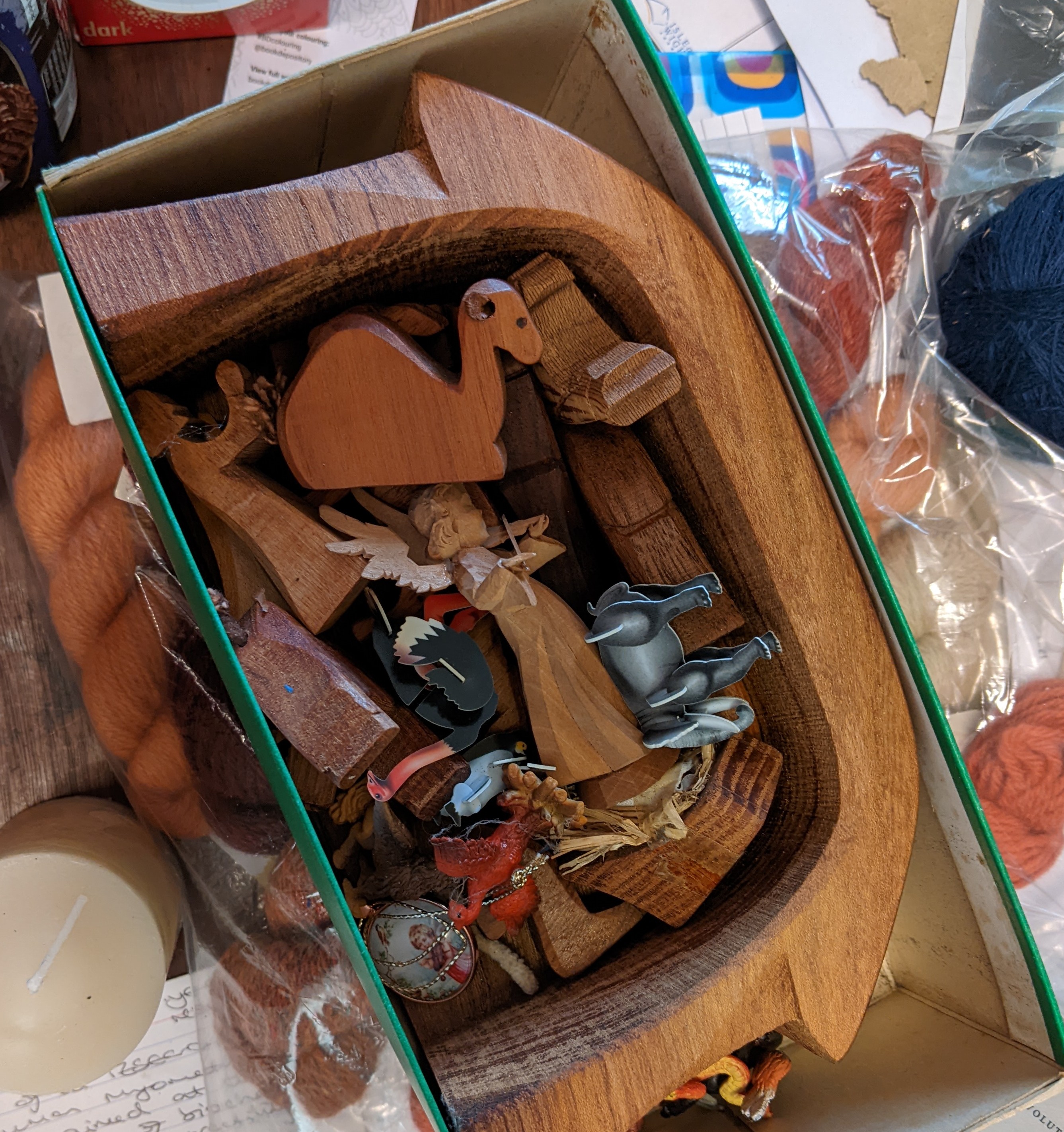
I’m visiting family at the moment. Mine not to reason why, but the shoebox containing the Christmas crib was on the kitchen table, so here it is.
This olive wood Nativity scene was a fixture of childhood Christmases, and I’ve yet to find one that I like quite so much. Oh, there’s always a bit of a debate about which of the Magi should actually be a shepherd, and baby Jesus is sellotaped into the manger, but next to this all the sets on the market seem tacky, juvenile, or both. (Not a word against my Playmobil set, which is, after all, a toy.)
There have been a few additions over the years. The violinist angel came from my aunt in Germany. One or other of my brothers added the ostrich and the elephant. And I think the phoenix and the dragon that you can’t quite see down the side of the stable were my fault. When it comes to it, our commitment to tasteful understatement tends to come second to a slightly childish sense of humour. But after all, why shouldn’t there be an elephant?
This little angel has been sitting up on top of the bookcase ever since last Christmas – well, last Epiphany, I suppose, when we took the tree down.
She was waiting to be mended: she’s a ceramic bust attached to a plastic cone, with the joins covered up by her robe, and the glue had failed. Since her head is quite a bit heavier than her body, she was tending to tilt alarmingly.
She’s done very well, considering what we paid for her. I can’t remember what we paid for her. Less than what I spent on St Etheldreda, certainly. She came from one of those fantastic shops that sell all sorts of tat extremely cheaply and also do mobile phone repairs. This one was called Circle 7 and was on the market square in Woking. The delightful innocence of its staff can be evidenced by the fact that I once found furry handcuffs displayed in the toy section, along with the cowboy hats and water pistols. I didn’t buy any of those things. I was probably looking at stickers. I’d imagine it’s no longer there: I think that whole section of the town has been redeveloped in recent years. We left in 2013, which makes this little angel at least nine years old, possibly more.
I finally got around to fixing her on Monday evening. Lately I’ve been enjoying fixing things. Darning, mostly. There’s something rather satisfying about transforming a garment from ‘unwearable’ to ‘wearable’. But I’ve fixed the angel, too. Just a bit of superglue put her head securely back on her body.
It’s St Andrew’s day, so it seemed appropriate to share the most authentically Scottish decoration in my possession. (Plus, this one is robust enough to be floating around the Christmas boxes without wrapping, and it’s a long time until we actually put a tree up.)
This bauble depicts the paddle steamer Waverley under way in a body of water that I can’t identify. It came in a hamper of Waverley goodies which was a present from my father a couple of years back. There was a tin of shortbread. I now use the tin for storing herbal teabags. There was a tube of biscuits. I now use the tube for storing pencils. There were probably other things with less durable packaging. And there was this bauble.
As a family, we’re very fond of the Waverley. (My great-grandparents were shipwrecked on their honeymoon when the paddle steamer Empress struck a pier at Calais. They survived the experience, as perhaps may be inferred from my existence. It hasn’t bothered later generations.) We’ve gone round the Isle of Wight and along the Dorset coast on her. You can go down and watch the engines pumping and pumping, and the smell is just glorious. I’ve dashed across London to see her steaming up the Thames under Tower Bridge. There’s something immensely moving (pun not intended) about this grand old ship still doing the thing she was built to do, seventy years on. Something that was built to serve, still serving.
The St Nicholas decorations are great fun, very beautifully made, and rather expensive. Expensive, I think, because they’re beautifully made, but nevertheless outside what I think of as a sensible price for a Christmas tree ornament. I bought several of the Alice in Wonderland ones a couple of years ago, week by week, and had to write them into my budget.
However! I went into the cathedral shop several months ago, and there was an Etheldreda in the sale, so I bought her.
St Etheldreda was a princess of East Anglia and, after a vow of chastity, two marriages, and no children, founded the monastic house that became, several hundred years later, Ely Cathedral. Of course it’s difficult to pick one’s way between histories and hagiographies, and this is the period of English history where plenty of rulers ended up as saints. I’ve devoted very little time to research, but I get the impression that she was a formidable woman. All her sisters ended up as saints. I think they must have been quite formidable, too.
I’ve lived in a few cathedral cities in my time – Winchester, Exeter, Guildford (look, I’m not going to be picky), and now Ely. We left Winchester before I could read, and almost every time we’ve gone back it’s been to ride on buses. In Exeter, I lived most of my life on the university campus. Guildford’s only had a diocese since the twentieth century, and the cathedral is somewhat set apart, up on a hill.
In Ely, though, I get the sense of a city that exists because of its cathedral and because of its market. Ely is tiny as cities go: it can’t get much bigger because most of the land around it is below sea level. The big expansion has happened fifteen miles south, around Cambridge. In Ely I get the sense of a city that exists in very much the same way that it has for centuries. These days the cathedral brings in tourists as well as pilgrims and the market… well, the market attracts people wishing to buy stuff, some of which the medievals would have recognised and some of which they wouldn’t.
In some ways, Ely feels like everywhere I’ve ever lived, all at once: the rich light on old stone of Winchester and Exeter and Cambridge, the proximity to agriculture (tractors!) of the Welsh borders and the Isle of Wight, the excellent rail connections of Woking, the hills and the cobbles of Guildford. In others, it feels like nowhere else.
Etheldreda wouldn’t recognise the lush farmland and the complex system of drainage ditches that supports it. She’d be completely boggled by the railway, the fact that I can get to London in little more than an hour. She’d be bewildered by my bicycle, come to that. But there’s not much you can do to that big wide sky. Contrails aside, she’d recognise that.
One last thing: it took me a little while to catch on to the fact that St Etheldreda was also, later, known as St Audrey. St Audrey as in St Audrey’s Fair. St Audrey as in tawdry. The absolute blinginess that the designers have endowed her with her is really rather fitting.
While I’m on the subject of cathedrals, I loved Dr Eleanor Janega’s latest piece. (Even if she doesn’t talk about Winchester, Exeter, Guildford or Ely.)
This year for my Advent blog series I’m going with an idea that’s intrigued me for a while: I’m going to pick one decoration every day, and write about it. Having got all the Christmas boxes down from the loft (causing some damage to the loft hatch) yesterday, I am at least confident that I have far more than twenty-four of the things.
Of course, this may not be the best timing, since this year we’ve acquired a cat with an unshakeable conviction that anything sparkly, trailing, or both, is hers to chase and destroy. In previous years, we know, she has shredded an angel and made herself sick eating lametta. Also, I’m not at home all the way through December so may have to skip or improvise a few days. But we’ll see how it goes. (I think we’ve got rid of all the lametta, for a start.)
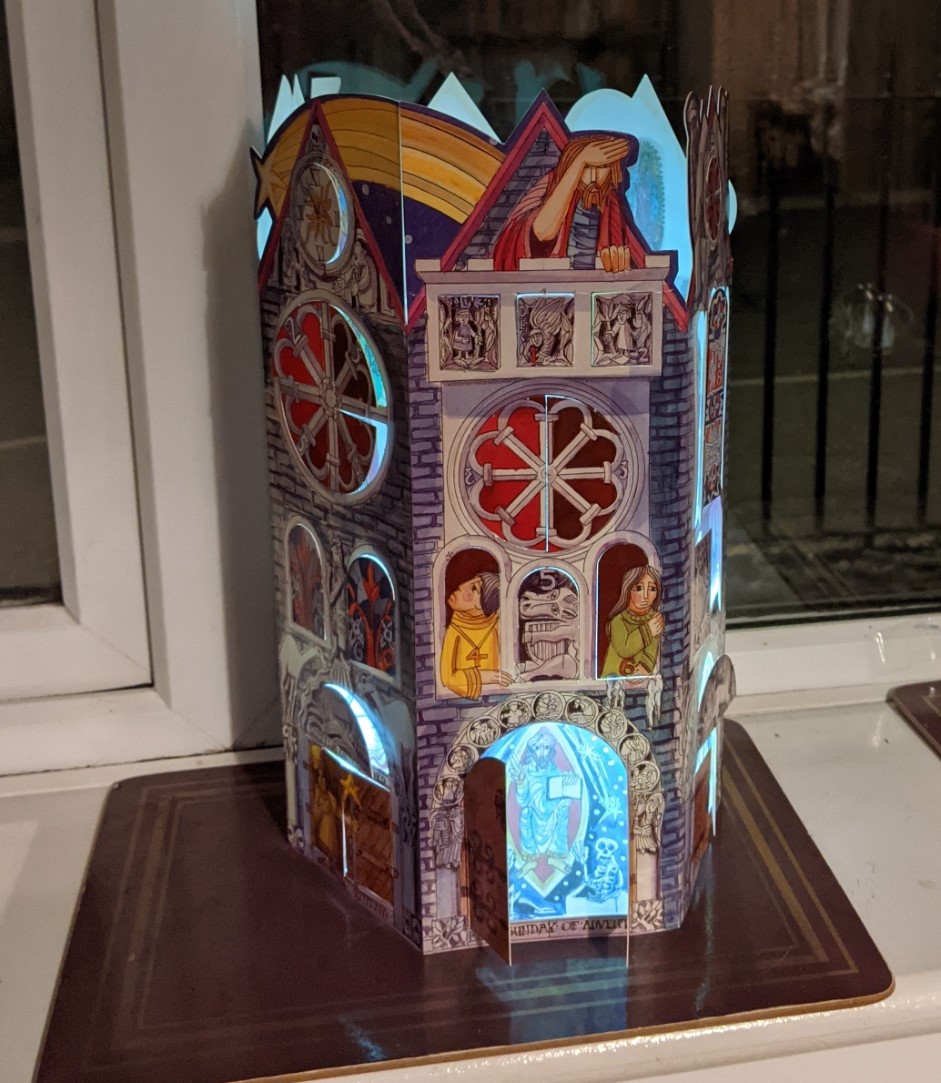
This object might be familiar: I’ve certainly featured it in previous Advent series, and usually early on in the season. Every January I close all the doors again and flatten it carefully and put it away for next year. It isn’t exactly a decoration, though it’s certainly decorative. It has a title (not sure I’ve ever come across an Advent calendar with a title before): Fling Wide The Doors. It’s an Advent calendar, but it runs all the way to the Baptism of Christ. It’s designed for children, but I find it helpful even after several years’ consecutive use. It looks fabulous with a light inside (after some experimentation, I’ve taken to using a USB bottle-stopper light in an empty gin bottle; very Anglican, I know). It engages with some heavy subjects (see the skeletons at Our Lord’s feet?) but in such a way as to make me always want to open the next day’s door, or doors. (There isn’t one for tomorrow, though. It picks up with St Andrew on the 30th.)
Anyway, I love Advent, with all its glory and terror and anticipation, and this calendar gets all of that. To a surprising extent, considering it’s just made of cardboard and tracing paper.
(Incidentally, if you watch the Advent Procession at Ely Cathedral, you get to see me reading the second lesson. Purple coat, 28 minutes in.)
I love the moment when it turns out that the book I’m working on is, in fact, going to turn out to be a book.
The first time this happened to me was with Speak Its Name. That was my first book and I didn’t really know what I was doing. I had the backdrop (student politics) and I had the characters (students) moving in front of it, occasionally affected by it, but never affecting it. It was flat. Boring.
Then I realised that what I needed to do was to get my most political character involved in the politics.
It sounds so simple. Perhaps it was. All I can say is, it took me a very long time to realise, and it changed the whole book for the better. It turned it from two dimensions into three, like inflating a bouncy castle, or sewing a pair of trousers together. It wasn’t just that my characters were now joined to the background at the point where one of them decided to involve the Students’ Union. It joined all sorts of other bits together, and it made the whole thing neater, more coherent. More interesting. It made the whole book work.
A Spoke in the Wheel and The Real World were, so far as I can remember, better behaved. Oh, getting The Real World nailed down was rather like wrestling an octopus that was also Tam Lin, but it always felt like something, well, real, if I could only get a handle on it. And with A Spoke In The Wheel both characters and plot landed more or less fully formed, bar a giant hole in the middle that I had to work out how to fill.
This time it happened at about the 50,000 word mark. No, I’m not doing NaNoWriMo, but I decided to take advantage of the general #AmWriting mood to make some progress on the Ruritanian thing. This is the project that I’ve been working on, off and on, for the last three years if not more. It seems to prefer being a side project. It modestly shuffled out of the way to let me concentrate on The Real World. It refused to be written at all earlier this year, and only started cooperating when I got swept off my feet by the historical thing. Nine months further on – nine months in which I’ve been trying to add a sentence to each project each day – it’s suddenly taking itself seriously.
Now this, being a Ruritanian thing, requires plot. It requires plot on a level that I’ve never contemplated before. There are double-crosses and Chekhov’s guns and timetables. The action of the last book happens over the course of a year. The action of this book takes place over the course of five days. I discovered the other day that I had my main character drinking five coffees between midnight on Saturday and Sunday lunchtime. I’m counting the espresso martini here, but still.
Of course, that’s easily fixable. I’ve already turned one of those coffees into a slice of cake. The real challenge has been getting the characters to do the things that are needed for the plot to happen in ways that make sense for them. Because if the characters don’t work, then the plot doesn’t work.
When I’m stuck on a book, one thing that helps me is writing down why I’m stuck. Sometimes I like to make an occasion of this. This time, I was just on the train. (Not that taking the train isn’t an exciting novelty these days.) I wrote down the things I needed to invent or research. Then I wrote down the thing that was bothering me, the thing I knew I’d have to fix sooner or later:
George shouldn’t be involving his untrained relations and he knows that.
Or, as paraphrased for Twitter,
Bringing Milly back makes George looks like a callous dimwit.
And yet Milly has to come back (she’s the narrator!) and George has to be both decent and competent. That’s the whole point of his being in this book at all.
So I kept writing.
He doesn’t have a choice with Amelia. But he needs a damn good reason for Milly to come back… There’s got to be more to it than ‘it might come in useful’.
I went down a couple of dead ends. Something that Amelia tells George that Milly doesn’t know about? Something that brings in a couple of other characters? My brain was working faster than I could write, so it wasn’t coming out as great prose.
Milly is the only person who has seen several key players by sight, so it makes sense to keep her on the spot. But that’s what’s putting her in danger. Sending her home is for her own safety.
I kept writing. Half a page later, it hit me.
Hang on. What if they do get Milly to share – and then don’t act on that? Yes. Milly spills the beans and thinks it’s all cleared up. George arrives, wants to find out more. Milly is the obvious candidate to find out more.
Bingo.
That adjusts the stakes just enough to make everyone’s actions plausible. It makes sense for Milly to come back. It makes sense for George to let her.
A (really encouraging) bonus: I now have a much better idea of at least one of the villains. And the [plot goes here] bit in the antepenultimate (there’s a good word) chapter.
Of course it’s going to demand a whole lot more changes – because most of the 54,000 words I had down were written on the assumption that Milly didn’t share – but I don’t care about that. It makes the whole thing work.
I emailed David at Licence To Queer several months ago to see if he’d be interested in a post about the religious imagery in the Bond books and fans and what that means for me, as a bisexual Anglican Bond fan.
It took me so long to rewatch everything and write about it that it got to the point where I thought I might as well hang on for No Time To Die (which, by the way, I recommend wholeheartedly), in case it contradicted all of my points. (It didn’t, really.) So there are a couple of spoilers in there, if that bothers you.
Apart from that, there’s a lot about Bond’s religious background, such as we get of it, and more about Bond’s relationship with MI6, and what that has to say to the Church of England. There’s my own experience of vocation as a queerness (and what The Night Manager had to say to me about vocation). There’s the sublime Bond Responses.
I had a good deal of fun revisiting the Bond canon and writing the post, and I’d like to thank David for the space to explore this somewhat unlikely topic, and for his patience while I disappeared off the face of the earth to write it up.
November’s become very busy for me, and I’m not quite sure how it happened. From ‘absolutely nothing’ I’ve suddenly got two or three things in my diary on some weekends. And I’m having to write KEEP FREE in large letters across the other weekends, because otherwise I’ll be an exhausted sobbing mess before we get to Stir-Up Sunday.
One of the events that I’d really have liked to attend had I not already got something in the diary is Weston-Super-Lesfic, which is coming up on 21 November. However, I’ll be there in spirit, in the form of my short story The Sisters’ House, which appears in the Weston-Super-Anthology.
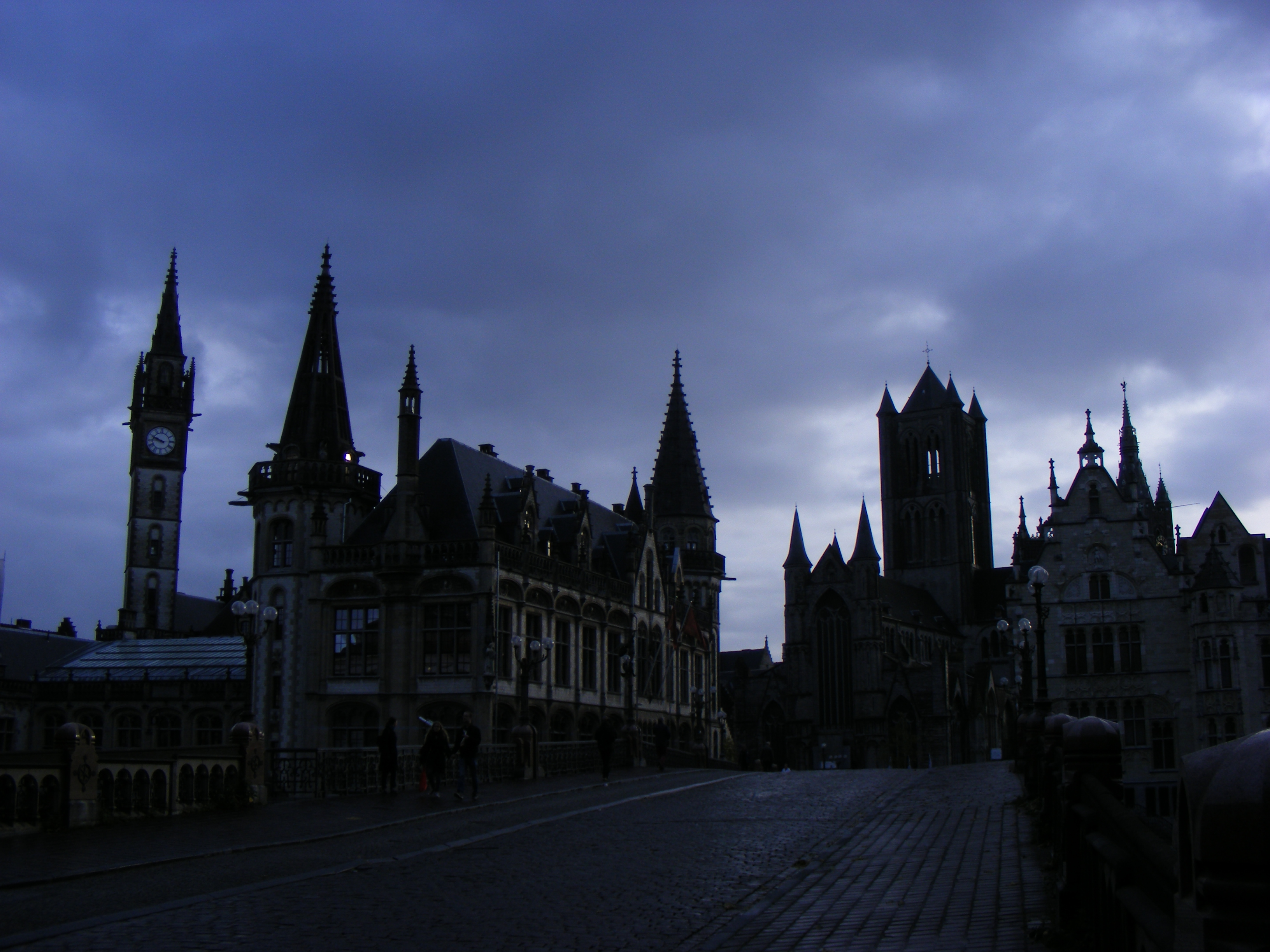
There’s a broad range of forms and genres represented in the anthology. Mine is a fantasy story set in a landscape inspired by the flat ground and watery cities of Flanders. (That’s Ghent in the picture, standing in for my fictional Drakenrey.) There are warrior women, a commune, some ill-advised magic, and a dragon.
I know there are going to be hard copies on sale at the event, raising funds for North Somerset LGBT Forum. I’m not sure whether those will be available more widely. You can, however, get an ebook edition from Amazon.
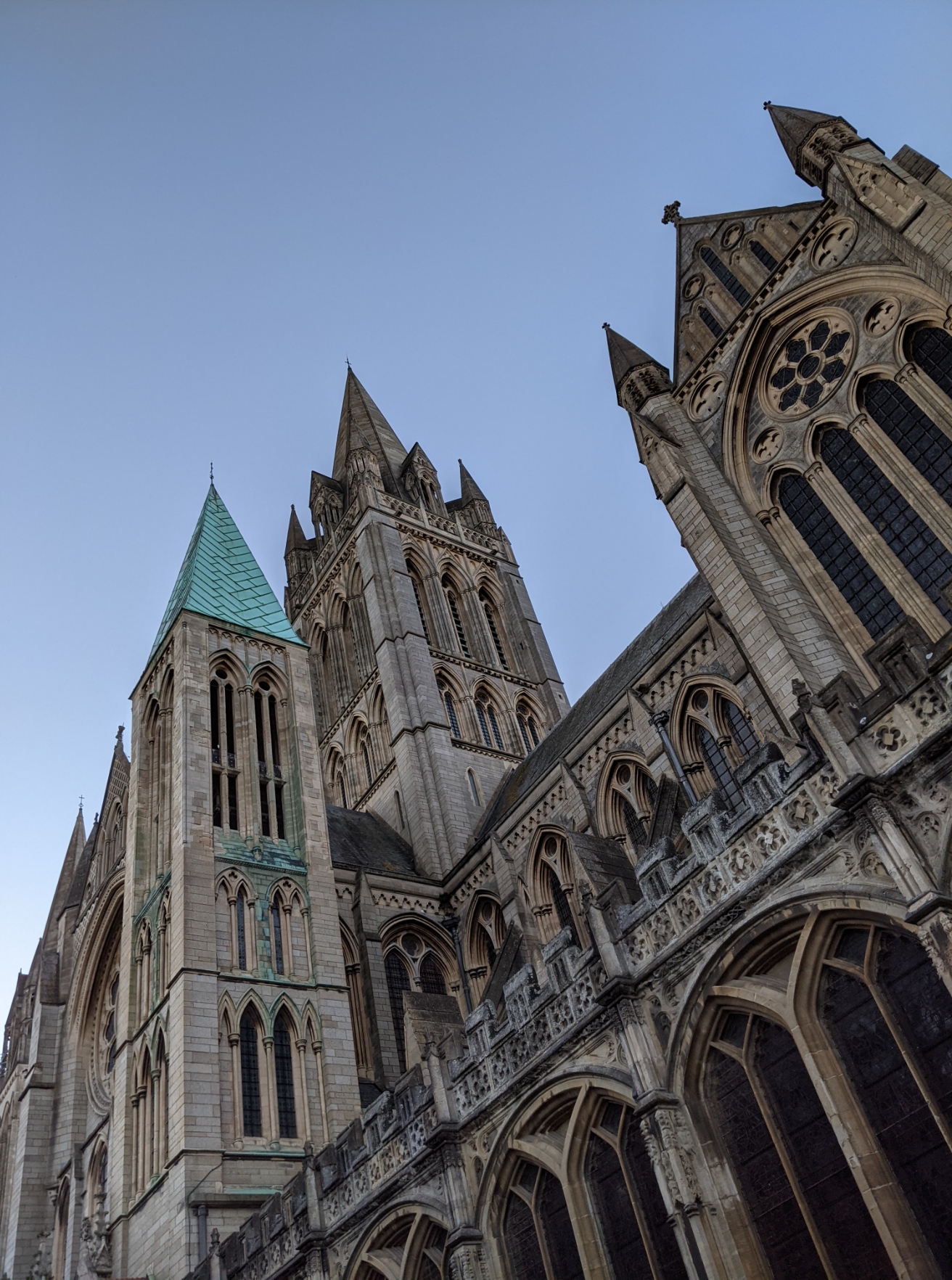
I read this in Truro, where we were staying above a pub. I started it in bed, and finished it in the beer garden, with the gentle sound of a little river running past, and the cathedral towering up above the trees, just the other side.
And I was thinking what a pity it is that Susan Howatch, who when she was writing wrote about unconventional clergy relationships like nobody else, never got round to the Bensons.
There are a few plausible reasons why not, of course. Firstly, I’m not sure that anybody would believe in the Bensons if they appeared in a novel. They’re really quite incredible in real life. (Edward White Benson was the first Bishop of Truro – this was why they were on my mind – and later became Archbishop of Canterbury. He proposed to his wife when she was twelve. After his death she set up home with the daughter of a different Archbishop of Canterbury. All the children were as queer as their mother, in every sense. No need to bolt invented polyamory onto the facts here. But even Susan Howatch might not have got away with the Bensons.) Secondly, she writes very heterosexual books. So she was probably never going to take on the Bensons.
Anyway, I was in the mood for something that took a queer, religious, character, that took both the queerness and the religion seriously, and was prepared to delve deep into the psyche of that character.
In This Small Spot hit that, er, spot about eighty per cent of the time.
This isn’t anything like a Howatch. It doesn’t have the snobbery, the psychics, or the daddy issues. And it isn’t so tediously straight. It does have the ‘can’t do anything, got to finish this book’ thing that Howatch manages to do over and over again; which is why I had to finish it in a pub beer garden before we could see any more of Truro. And it was almost but not quite exactly what I wanted.
“Here, the true you is most often magnified, for better or for worse.”
Abbess Theodora
In a world increasingly connected to computers and machines but disconnected to self and others, Dr. Michele Stewart finds herself drowning in a life that no longer holds meaning. Searching for a deeper connection after losing her partner, Alice, she enters a contemplative monastery, living a life dedicated to prayer, to faith in things unseen. Though most of her family and friends are convinced that she has become a nun to run away from her life, she finds herself more attuned to life than she has been in years. Stripped of the things that define most people in the outside world – career, clothing, possessions – she rediscovers a long forgotten part of herself. But sooner than she expects, the outside world intrudes, forcing her to confront doubts and demons she thought she had left behind. The ultimate test of her vocation comes from the unlikeliest source when she finds herself falling in love again. As she struggles to discern where she belongs, she discovers the terrifying truth of Abbess Theodora’s warning. For better or for worse.
I don’t think I’d argue with anything in that blurb. I bought the book on the strength of it, and I wasn’t disappointed. It wouldn’t be getting its own post if I hadn’t enjoyed it. The calm rhythm of the religious life, the complex relationships between the novices, the developing tension between Sister Michele and another nun, made for an absorbing read. It wasn’t perfect, though, and there were a couple of things that left me wanting to argue.
Firstly, the pacing was a bit off, or the plot. An overuse of ‘Later, Mickey would…’ built up a suspense that was never quite delivered on. Things developed sequentially, one event leading to another, and tending to evolve from characters’ desires and personalities. This suited the setting, but there sometimes seemed to be a reluctance to commit at key points. I said above that I was looking for something that would delve deeply into a character’s psyche. I think that often it didn’t delve deeply enough.
At one point Mickey reflects that the enclosed nature of the abbey makes trivial events take on an inflated importance. Actually, I found the opposite to be true: there would have been space to take much more time to explore the personality clashes and emerging trauma that grew from and drove events.
And then it takes an unexpected turn into melodrama.
Major spoilers follow the picture of Truro cathedral.
Mickey sustains serious injuries rescuing her love interest from a fire, a combination of events which results in both of them asking to be released from their vows. Mickey returns to medical life. Having both taken time to reflect, the two of them set up house together.
And very shortly afterwards Mickey dies.
Yeah.
In fairness, it didn’t strike me as a stereotypical ‘bury your gays’. There was too much of a sense of the bigger picture for that. The happy ending had already been earned and obtained; in fact, I’d have been perfectly contented had the book ended just a few chapters earlier. What we got, however, was an ambitious ending, and one that I don’t think the author managed to pull off. She didn’t quite earn Anselma/Lauren’s revelation that ‘The tragedy would have been never to have known her at all’. It might have worked, given some more space; as it was, it felt glib.
It was intensely readable, however, and I’ll be buying the sequel. I want to know more.
My apologies for this unintended hiatus in our literary travels. I was planning a visit to Ullathorne. I reread Doctor Thorne, to discover what I’d forgotten: that the doctor spends the entire book at odds with his Ullathorne relations and never go there. (Still, I went to the trouble of getting a photo of the nice cloth-covered library copy, so here you go.)
I eventually tracked the place down to Barchester Towers and decided, very reluctantly, that if I’d excluded Netherfield and Qualling on the grounds that they were stately homes rather than settlements, I couldn’t really make an exception for Ullathorne. Or could I? After a generous description of Ullathorne Court, we get this:
The picturesque old church of St. Ewold’s stands immediately opposite to the iron gates which open into the court, and is all but surrounded by the branches of the lime-trees which form the avenue leading up to the house from both sides. This avenue is magnificent, but it would lose much of its value in the eyes of many proprietors by the fact that the road through it is not private property. It is a public lane between hedgerows, with a broad grass margin on each side of the road, from which the lime-trees spring.
And then I just ran out of steam. I’d like to say that I’ve spent the last six months frantically looking for fictional places beginning with U, but it wouldn’t be true. I just got stuck in a not reading/not posting circle, at least as far as this series goes.
John Buchan, however, is always helpful, so let’s fall back on a trip to Unnutz ‘in the Tirol’. Or maybe not:
You’d simply loath it. A landscape like a picture postcard. Tennis and bumble-puppy gold and promenades, all in smart clothes.
Such is Alison Westwater’s assessment of the place. But what about the geography?
Above the Waldersee, in the Firnthal?
(Also fictional, both of them. But those are both plausibly Tyrolean, and I had to Google to make sure.)
Unnutz was mainly villas and hotels, but there was an old village as a nucleus – wooden houses built on piles on the lake sure, and one or two narrow twisting streets with pumpkins drying on the shingle roofs. There was a bathing-place there very different from the modish thing on the main promenade, a place where you dived in a hut under a canvas curtain into deep green water, and could swim out to some fantastice little rock islets.
Alison is out of there by the end of the chapter (see K, T, M, and E for where), so that, I’m afraid, is all I can offer for U. See you for V. When we get there.
Books mentioned in this post
Barchester Towers (and Doctor Thorne), Anthony Trollope






 Kathleen Jowitt