(Part 1: can’t you hear that whistle blowing?)
(Part 2: rise up so early in the morn: north and east)
(Part 3: I spent cities like a handful of change: south)
(Part 4: you’re so ambitious for a juvenile: west)
28 April 2018
As we climbed upwards and to the north, the stations became bilingual, with German added to the Italian. The frontier is at Brenner, at the pass that bears its name. I had some time to wait between trains, so I went out to the front of the station, bought an espresso in the café, and sat at a table outside, looking up at the snowy mountains.


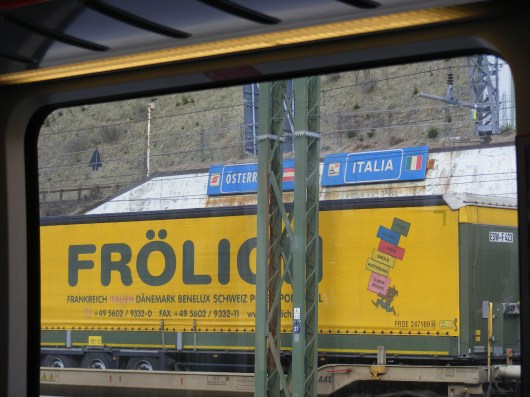
The journey down the Austrian side of the pass was equally beautiful, but I was tired. I felt faintly guilty for not appreciating the scenery, but, overall, relieved to get into Innsbruck.
It was a long, hot, sticky walk from the station to the youth hostel. The road crossed the river and then struck out through a never-ending residential area. Parts of it were being dug up, and I had to haul Hazel’s long-suffering suitcase across gravel and around plastic barriers. I’d probably gone less than half way before I regretted not taking a taxi.
The youth hostel had been built for the Winter Olympics of 1976, and indeed had a magnificently seventies feeling to it. There was a good deal of concrete about the outside and wood about the inside, and the dormitories were cramped. I was fourth woman into mine, which meant that all the lower bunks were gone and I had to climb up a frankly terrifying set of footholes cut into the board between the two sets of bunks. I decided against anything resembling heavy drinking that evening.
And it was already evening. By the time I’d unpacked my things and worked out the locker mechanism and had a shower, it was easily time to go out and look for some food.
The youth hostel was next to a petrol station, and next to the petrol station there was a Tyrolean cultural centre, which mostly looked like a tavern to me. This seemed the likeliest bet for food, and I got as far as going in and asking, ‘Kann man hier essen?‘ ‘Aber naturlich,’ said the man, but he didn’t explain how I should go about this, and wandered off before I could ask. I went a little way further into the building and sat down at a rare unoccupied table, but nothing happened, and the whole place was crowded and noisy, and after a minute or two I decided to seek food elsewhere.
There was a pleasant-looking path alongside the river. I followed it. I followed it for a good half hour without finding anything more promising than blocks of flats. One of them had a café on the ground floor, but it was closed. I kept on walking. The light was beginning to fade. Surely, I thought, there must be something soon. And yet there wasn’t. I kept walking and walking, getting more and more tired and more and more hungry, and it got darker and darker, and there was still nowhere to stop to buy food.
I became so miserable that I phoned Tony to whinge. Hungry, Angry, and Tired, I couldn’t do much about, but I could at least remedy the Lonely part of the HALT acronym. I walked as I talked, and explaining the whole horrible situation brought me as far as a bridge. I crossed it, hoping to find something open on the other side. Dark, empty streets – and then – under an arch of the railway, warm lights, and tables on the pavement, and people. I rang off and went to investigate.
I found myself among friends. Literally – I’d stumbled across a group of people who were just having a drink together in what I’d think of as their local – and they were incredibly kind to me. At first they wanted to direct me somewhere else, but when I managed to explain that I was tired and hungry and just wanted something to eat and drink, they put in the order for me, wrapped me up in somebody’s jacket and sat me down. Nobody there spoke much English, but I discovered that my German wasn’t actually all that bad. It was an evening of Wiener schnitzel, beer, plum liqueur, and, above all, kindness. At the end of it, they ordered me a taxi.
Back at the youth hostel, I phoned home again to say that things were much better, but that I thought it might be a good idea to take a day off trains. I worked out a schedule for the next few days. After playing with various possibilities, I booked two nights in the youth hostel in Zug, and one in the one in Interlaken.
29 April 2018
In the morning, I felt much better disposed towards Innsbruck. The standard continental youth hostel breakfast set me up for the day, and I even coped with the discovery that the reception staff had managed to lose my Youth Hostel Association membership card – which was going to be a problem when it came to checking into the Swiss hostels I’d got booked. We agreed that it was a good thing that it hadn’t been my passport, but suspected that if it had been my passport then it probably wouldn’t have got lost. On the practical level, a replacement membership card assuaged my concerns, and I checked out in a better mood than I’d been in when I checked in.
There was a taxi waiting at the entrance to the fuel station. I had learned my lesson. I took it.
I had the best part of the morning to play with. Having put my luggage into a locker at the station, I set out to explore Innsbruck. In daylight, this time. Mostly I followed my nose, with mixed results. On the one hand, I saw quite a lot of Innsbruck, working my way down one side of the river and back up the other, and then away from it and up the hill. It was a quiet Sunday morning; the streets were almost empty. I found the botanic gardens, and spent a peaceful quarter of an hour wandering around them, watching the goldfish in the ponds and the bees in the flowers, and a delightful, unexpected lizard scampering out on a rock.


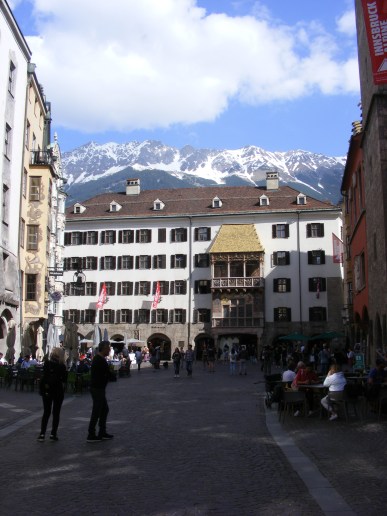
On the other, I ended up typically footsore and achey, and only found the stuff I was meant to be looking for, like the famous golden roof, at the very last minute. I strode through the old town and back towards the station, where I found that I had plenty of time to retrieve my suitcase and buy myself a poppy seed pastry and an iced tea (this transaction completed entirely and pleasingly in German) before my train left, because it was delayed. It proceeded to get later and later; but I was, eventually, able to leave Innsbruck.
This was one of the trains where I felt I really got my money’s worth. First class was spacious; coffee was ordered from a little menu; the view was spectacular. Human interest was provided by a small girl who asked all the other passengers, ‘Wie heißt du?’ several times over. Which, after my conversations the previous night, was a level of German that I could cope with easily.

Notwithstanding the delay, I reached Feldkirch, the last stop before Liechtenstein, at a sensible time for lunch. I didn’t have the right change for the luggage lockers, so I wheeled my suitcase into town with me. I sat on a bench in the square to eat my milk rolls and runny cheese, and felt rather jealous of all the people with ice creams. The ice cream shop seemed to be the only place that was open: it was at the opposite corner of the square from where I was sitting. I did not buy an ice cream myself: the thought of getting myself and my suitcase and my other encumbrances up the step and into the place and then out again with a dripping, sticky confection added to it all was just too much.
I got another train coffee instead. This was largely because Europe By Rail informed me that I could easily make one cup of coffee last for longer than it would take to cross Liechtenstein, and I thought I ought to test this statement. It was indeed the case. The coffee came with little milk pots with garish views of European landmarks, which seemed entirely appropriate.

Liechtenstein looked pleasant enough, green and mountainous, and I told myself I might come back and explore it properly some day. In the meantime it became the only country I would pass through on this trip without setting foot in it.
After Liechtenstein came Switzerland and passport checks. I became very conscious of the fact that I had no Swiss francs. This was not immediately a problem, but I was planning to spend several days in Switzerland, so it at least had the potential to become one, and I certainly wouldn’t be able to get any more coffee until I’d dealt with it.
Switzerland looked much like Liechtenstein and the Tirol: mountains, reaching up and up, with the trees wearing away to grey rock, with sometimes a heart-gladdening crown of snow; and flat-bottomed green valleys marked into neat fields. The passenger trains were white, with initials arranged in triplets: SBB CFF FFS. I saw a few locomotives with red paint jobs, the Swiss flag. Lakes came into the landscape as we approached Zurich.
Zurich itself felt big and intimidating. I thought that maybe I ought to leave the station and take a look around, but it all seemed like a bit much. I found a cash machine, and then, after wandering around aimlessly for a little, the train to Zug. This makes a lovely pun in German. It made a somewhat ironic one, given the fact that I was planning to spend an entire day and two nights in Zug, taking no trains at all.
I came out of the wrong side of the station, because I always do, looked at Google Maps, and went back through the station to emerge onto a quiet residential street and follow it onto a long straight road with a lot of office blocks. Stopping every few hundred metres to check my location, I made my way down this road (which seemed an unlikely location for a youth hostel, but then most of them had been) and then turned down a gravelly track. The youth hostel lay between the road and the railway, and beyond that was the lake.
I checked myself in. My dormitory was on the top floor, the other side of a set of double doors, so it took me a little while to find it and I felt foolish. Whether it was that, whether it was delayed stress from the day before, whether I just needed a rest, I don’t know, but I was feeling fairly down, and berating myself for failing to enjoy this once-in-a-lifetime trip to the fullest extent possible.
I took myself out to dinner to cheer myself up. A couple of minutes’ walk took me to the edge of the lake, and I followed the path clockwise around it into the town, in the teeth of a lively breeze. The first eating place was an Italian restaurant: I ate pizza and had a conversation with myself in my diary. I wrote,
So Zug is the only Zug I’ll be in tomorrow. After that – Interlaken. And, if I can get my act together, the rack railway up to Jungfraujoch. Because if I am having a once in a lifetime trip – which, incidentally, I feel I’m not, I’m doing research for subsequent adventures, though who knows whether they’ll ever come to pass – I might as well have a once in a lifetime experience, because that certainly would be.
I fretted a little about whether or not I’d managed to lock my locker properly, but as it turned out it didn’t matter: I had the whole dormitory to myself.
30 April 2018
For most of the day I had the whole youth hostel to myself. I wandered back into town along the lakeside, looking at waterfowl on the lake, and little Japanese deer in an enclosure, and pristine flowerbeds. It being a Monday, most of the things that I might have looked at were closed, but I didn’t mind too much. I bought a mobile phone charger to fit Swiss sockets, and then went back to the youth hostel to read. Then I went out again to get something for lunch, and then back again to read some more. I sat in the garden, watching the trains passing along the end of it, until it got too hot; then I sat inside, in the dining room. I booked myself tickets on the Jungfraujoch train, wincing a little at the price, and texted my brother to organise a stopover at Saint-Gervais, where he was working.
I finished The Mill on the Floss. I’d somehow never been spoiled for The Mill on the Floss, and found the ending pretty devastating. I read Passing Strange (beautiful and almost heartbreaking); I read a very long Carmilla fanfic in which Carmilla was an assassin and Laura was a journalist. I had the dormitory to myself that night, as well, and considered that I had got a very good deal.


1 May 2018
The next morning I left Zug to head deeper into Switzerland, and stopped an hour or so down the line at Lucerne. After some messing around with cash machines and change machines I managed to get my suitcase stowed in a left luggage locker and stepped out of the railway station to find myself in the bus station. This was a good place for transport nerds. There was a paddle steamer moored at the side of the lake, and there were trolleybuses with three pieces and two bends.

I left a message on my father’s answerphone. ‘I thought it was important that you should know,’ I said, ‘that there are tripartite bendy trolleybuses in Lucerne.’
I then walked along the covered bridge, and took a look into a church. Then I looked at my phone. Two missed calls. I called back. No answer.
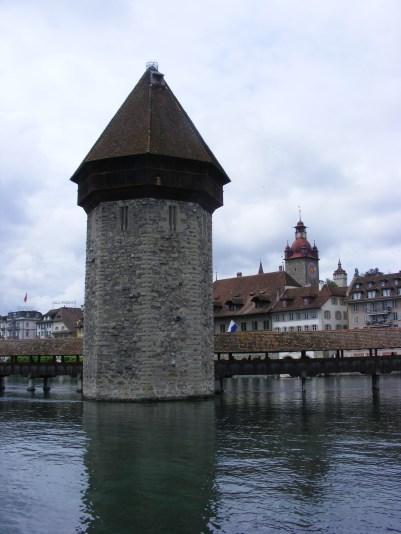
It began to rain. I considered my options. These included returning to the station to extract my umbrella from the left luggage locker, but I couldn’t quite face that. I looked at the outside of a museum about the canton of Lucerne, and thought that it sounded interesting but I wasn’t really in the mood for a museum. The one thing that I really wanted to see was the Lion of Lucerne. I consulted a handy map and set off through the shopping district to find it.
On the way to the Lion I passed a large cuboid building with a dome sticking out of the top. On the side it said, ‘PANORAMA. The French army at the VERRIERES. 1870-71 FRANCO-GERMAN WAR 1870-71. Painting of 6600 square feets.’ I wondered vaguely whether this was still extant.
I got to the Lion – a huge, sad, sculpture carved half-way into the wall of rock – got my phone out to take a picture, and found that the game of phone tag was ongoing.

My father and I eventually managed to be on the same call at the same time, and he recommended:
– that I look for the Lion (easy enough)
– that I look at the Panorama, which was Something To Do With The Franco-Prussian War;
requested:
– that I look for a flag of the canton of Lucerne, as my brother had sent him one of the canton of Geneva, and he wanted to start a collection;
and told me:
– that he had seen the Lion and the Panorama fifty years ago, and that his father had been to Lucerne and seen the Lion and the Panorama fifty years before that.
We also discussed the trolleybuses.
After ringing off, I investigated the nearest souvenir shop in search of flags. Besides Lucerne (white and sky-blue vertical stripes) I found Bern (a black bear on a yellow ground with red corners) and Uri (a black bull’s head on a yellow ground). I’d said that it was a pity that I hadn’t know about this new project before I left Zug; still, everything had been shut in Zug, and anyway it didn’t seem to go in for exuberant selections of tourist tat in quite the same way. Bern and Uri made up for it, though, and Zug would only have been stripes of white and sky-blue arranged horizontally rather than vertically.
Then I trotted back down the road to the Panorama.
It’s a quite remarkable painting. One stands inside a giant cylinder. Here, there are houses. There, a railway line. Over everything, snow, and, coming from all directions, soldiers in blue and red, wrapped up in sacks, riding on wagons or marching two by two. Context is provided by a voiceover in four languages, one after another, and an exhibition downstairs. I spent some time in there, looking at the tiny details in the huge display.
Then, because the ticket to the panorama also got me into the Glacier Garden, I headed back up the hill. The Glacier Garden was a delightful mixture of geology, history (while the lower floor of the building was devoted to glaciers and relief maps, the upper floor set out the typical household of a Swiss worthy) and frivolity. I went around the hall of mirrors twice, and saw white rabbits in the garden.


Lunch was a vegetable pastry eaten on the way back to the station. There I retrieved my suitcase and got myself onto the Zentralbahn for Interlaken.


This was a very pleasant narrow-gauge railway with lakes on the right and mountains on the left, and, ahead, what I thought were some impressively steep gradients. I had not seen anything yet.
If Hamburg had felt a little bit like Reading, Interlaken was almost overpoweringly reminiscent of Harrogate. It was that wide expanse of grass with the two churches that did it, combined with the sense of nineteenth century respectability. Hotel Victoria Jungfrau, for goodness’ sake. I wouldn’t have been surprised to meet the ghosts of my great-grandparents promenading down the Höweweg. I couldn’t help giggling at how weird it all was.

It only occurred to me the next day that on a clear day, with the Jungfrau dominating the skyline (or, indeed, visible at all) Interlaken would look nothing like Harrogate.
I’d had a dormitory to myself for the last two nights. It looked like I was on for a third at the time I went to bed. But I was woken at about half past eleven by somebody coming in. Her name was Ems, and she was Norwegian, she said; she was sleeping in the youth hostel as an emergency measure. I pointed out the things that it had taken me a while to figure out, like the light switch, and went back to sleep fairly swiftly.
2 May 2018
In the morning I heard more of her story, which accorded depressingly well with other things I’ve heard about the hospitality industry. Her boss had sacked her – illegally – while she was on sick leave. Even aside from that, he had been appalling. ‘There was only one person who liked him,’ she said, ‘and that was the guy who used to smoke weed with him.’
We wished each other well, and I went off to catch the train up the Eiger.
This turned out to be, like many mountaineering exploits, an impressive if possibly unnecessary feat of human ingenuity and perseverance. Not my catching it, I mean – that was very easy, because the youth hostel was just in front of the station – although I did check and double check and triple check that I’d got the right pass and that I was getting onto the right train.
No, I mean building a railway up inside a mountain. Why would you do that? ‘Because it was there’, indeed. Or so that tourists with prize money burning a hole in their pocket could ride on it a century later. So I did.
I checked my phone over and over, to make sure that the wallet app worked and that I’d got the right time and the right train and that I could flip the virtual tickets around to show the appropriate side.

It was a pity about the weather. The fog hung stubbornly around the mountains, hooding the tops. We climbed up, towards it. Changed at Grindelwald. Through it. Came to the snowline and kept on going. The lineside snowbank grew deeper and deeper. The chill crept into the carriage and I wondered for the first time if my shoes were up to the task. I reassured myself that I needn’t leave the platform.


We emerged through the top of one cloud to find ourselves a little way outside Kleine Scheidegg. Here we would change to the Jungfraubahn. Above us reared the Eiger.
I headed a little self-importantly towards the gate for those with reservations. Here technology failed me utterly: the sensor on the gate couldn’t read my ticket. A member of staff let me through, and I boarded the train and sat in lonely state in the reserved section.
After a wait of a few minutes the train left the station and headed across the snowfield towards the mountain. It sat at the next stop for a while, and I alternated between squinting at my first glacier and watching a couple of men unloading pallets full of supplies from the goods wagon ahead.

Then came the bit I’d really been looking forward to. We kept on up the mountain. Into the mountain. The next station was Eigerwand – the Eiger Wall. We didn’t stop there. A couple of squares of light showed where windows had been cut into the face of the mountain.
I thought of poor Toni Kurz, the last victim of the 1936 Eiger disaster, suspended on a rope that he no longer had the strength to climb, while the rescuers inside the mountain could see him but not reach him, and the spectators at Kleine Scheidegg could see everything and do nothing.
The record for the ascent of the north face of the Eiger is now less than two and a half hours. My train abandoned the attempt about halfway, and headed sideways towards the Mönch. It kept going, the track levelling off but remaining within the mountain, until at last it stopped in a lamplit station. We got off the train and climbed out and up into the Top of Europe building.
I didn’t much like it at the top; I felt wobbly and headachey, and very aware of the inadequacy of my shoes. So I put my head outside the door to feel the wind and see the snow, and then I came back down the mountain again. I reflected that on this trip I’d now been higher than ever before in my life, as well as further north and further east.
I went down the other way: the Wengernalpbahn. I associate Wengen with downhill skiing, catching the tail end of events when I’ve turned on Eurosport to watch figure skating or biathlon. For school story fans, it’s the location of the final iteration of the Chalet School. More to the point, it was absolutely stunning: a deep green bowl of a valley, with waterfalls plummeting hundreds of feet from the rim to the floor.

Back in Interlaken, I returned to the youth hostel to eat lunch (pasta al pomodoro) and retrieve my bags from the luggage room. I strolled back to the station once more, feeling very well-disposed towards the youth hostels of Switzerland – if still slightly bemused by Interlaken.
Just as I was leaving, the mist lifted off the Jungfrau.

The journey towards the French border took me through a series of monosyllables and a long tunnel. I got on a train bound for Brig, and got off it at Spiez. Then I got off the next train at Visp. The tunnel had taken me into French-speaking Switzerland: the languages were the other way round on the signs. I took a picture of what I thought might be the Matterhorn, and bought a rather fine postcard which was a relief map of Switzerland in moulded plastic. After all those huge relief maps in Lucerne it seemed appropriate; also, the geography was confusing me.
Martigny was where I had to change to board the narrow gauge train into France. The station felt a little run-down. I bought an espresso, a bar of chocolate and a little pastry tart in the stationer’s while I waited.
The narrow gauge train was named, rather optimistically, the Mont Blanc Express. I would not actually have wanted it to go much faster than it managed. Leaving the Rhône valley by the shortest possible route, it struck an ambitious upgrade and kept going.

I couldn’t believe how well I’d organised my railways: they’d just kept getting better and better. The Elbe valley, then the Semmering line, then the Adige valley and the Brenner Pass; the Inn valley, the Zentralbahn, Grindelwald and the Jungfraubahn, and then the Wengernalpbahn on the way down again. Now this. It might not go up inside a mountain, but clinging to the outside of one meant that there was all the more to be seen. I spent the journey peering out of the window, marvelling at how far up the mountains went, and how far down, the valleys. It had the feel of a working railway rather than a tourist line, reminding me as much of the FEVE along the north coast of Spain (itself one of Franco’s vanity projects, but well used by locals) as anything Swiss.

We crossed the frontier at Le Chatelard, and then bumbled on through Chamonix towards the terminus.
At St-Gervais-le-Fayet I stood up, collected my things, and immediately fell down a step that I’d forgotten existed. I picked myself up again and got off the train.
‘Did you see that?’ I asked my brother, who had come to the station to meet me.
‘See what?’
I explained.
‘No, you got away with that one.’
But I hadn’t. Over the course of the evening, through dinner, through the Champions’ League football game we watched, I was uncomfortably aware of a sharp pain in my right foot. When it came to going to bed, I could hardly get my shoe off. I crawled into bed and did my best not to wonder how I was going to get back across Europe in this state.
3 May 2018
I woke at some horrible hour of the morning in the sudden, awful, knowledge that my leg was about to cramp and that there was nothing that I could do to stop it. It did. I rolled around swearing and rubbing at my calf for a bit, and, finding the idea of standing up too much to contemplate, drifted back to sleep after a while out of sheer boredom.
I was able to limp to the lift, which meant that I at least got as far as breakfast. I even considered the forty minute walk to Saint Gervais-les-Bains before reluctantly deciding that it was a bad idea. John drove me there instead. We managed a coffee in a sports bar and half a circuit of the town before I had to admit that I was defeated and sit down on a kerb while John went to get the car. (A few weeks later, back at home in front of the television, I watched some of the great cyclists of our time take the same streets rather faster, in the Criterium du Dauphiné.)
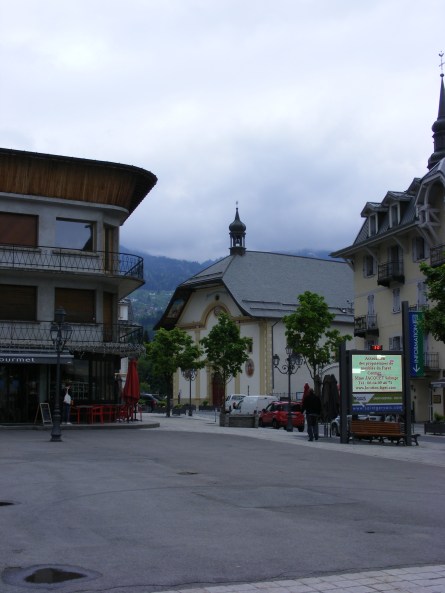
We trundled back to the town centre and ate lunch at a restaurant on the square. Mine was a ‘tarti’mlette’ – a satisfyingly hearty omelette stuffed with potatoes and cheese; John’s, a vegan burger, to his rather pleased surprise.
After that we returned to the hotel. I made it down the road to the Tabac to buy postcards and a cloth patch for my blanket, and then retreated to the hotel bar, where I spent the afternoon on a sofa, with my foot propped up on a pile of cushions and draped with a bag of ice begged from the bar, and read The Woman in White.

After dinner I joined the staff outing to the cinema, where we watched Avengers: Infinity War. This was probably not the ideal introduction to the franchise, but I’d seen enough fanfic headers to have a reasonably good idea of who was who, even if their motivations were a mystery; besides, reading the subtitles was useful French practice. And what else can you do in the French Alps with a dud foot?
(Next part: I’ll take you home again (north))