Welcome to The Real World

DSCF8266

I’ve been ignoring The Real World (my book, I  mean, not the actual real world) since October, in order to get a bit of distance. Last week I printed the manuscript out and (when I wasn’t standing in the rain for three hours waiting for a rail replacement bus) read it through and scribbled on it.

It isn’t bad at all. It isn’t done, but what’s there is OK. If all goes to plan, it will come out in September.

In the meantime, I wrote a blurb for it, and here it is:

Colette is trying to finish her PhD and trying not to think about what happens next. Her girlfriend wants to get married – but she also wants to become a vicar, and she can’t do both. Her ex-girlfriend never wanted to get married, but apparently she does now. Her supervisor is more interested in his TV career than in what Colette’s up to, and, of her two best friends, one’s two hundred miles away, and the other one’s dead.

Welcome to…

The Real World.

December Reflections 15: best decision of 2019

IMG_20191215_150311_443

I’ve made (or received) two fairly major decisions this year, but I don’t yet know the outcome of either of them, so it seems a bit premature to call either of them the best. Not least since they appear to be pulling in opposite directions… It’ll be interesting to see how that all works out.

Taking the first week of December as annual leave, and then doing absolutely nothing in it, is a very good decision, but it’s one I’ve made every year since at least 2014 now, so I’m not sure that I can really count it as a decision of 2019. It’s more a very longstanding tradition.

After growing my hair out to a bob last year, I got it cut short again in May, and immediately felt 500% more like myself. But I wouldn’t say it was the best decision.

Going to the work disco on Friday night was a good decision, since it meant spending the evening with a group of other despondent people, none of whom were going to attempt to tell anybody else to cheer up, but also being able to dance and dance and dance. And staying off Twitter and Facebook was also a good decision. Some people need a good rant/vent/whinge, and I respect that, but I find that listening to or reading other people’s ranting/venting/whingeing just gets me (even further) down, and actively gets in the way of my doing anything to improve matters. So I danced instead. Anyway, that feels too depressing to be the best decision of the year.

But in fact I have had a moment this year where the rightness of a thing seemed to sing and sizzle and settle: of course this is the right thing. And that was the evening when everybody was talking about ‘the real world’, about whether or not they lived in it, about whether or not other people live in it, about whether anybody really lives in it. And I realised that in fact this was the title of my next book. That’s my best decision of 2019. The Real World. More on that next year.

December Reflections 10: gold

IMG_20191210_212652_643

I’ve had a phrase wandering in and out of my head this year: the documented life. I spent a lot of time in the spring going back through diaries and journals and online spaces locked and unlocked, pseudonymous and otherwise, updates for friends and rambling for myself alone, looking for clues about new (but familiar) exciting (but daunting) developments in my head. There were more of them than I’d remembered. It seemed that over and over again I’d sidled up to these thoughts, and written them down, and shied away again, and forgotten.

If I didn’t write it down, I start to wonder, how can I know who I was?

Then I wrote more, trying to work through the new developments. I forced my realisations into fiction, and rewrote whole sections that suddenly didn’t seem true any more. In my own private writing, I risked more honesty than I remember managing in times past, finding it suddenly important to know what was going on, and what was really going on.

(It wasn’t just text. There were delicate conversations around pints of beer and tears over gelato. But a lot of it was text. Often I think I let people see more of myself in text. Often I think it’s easier to control what people do see.)

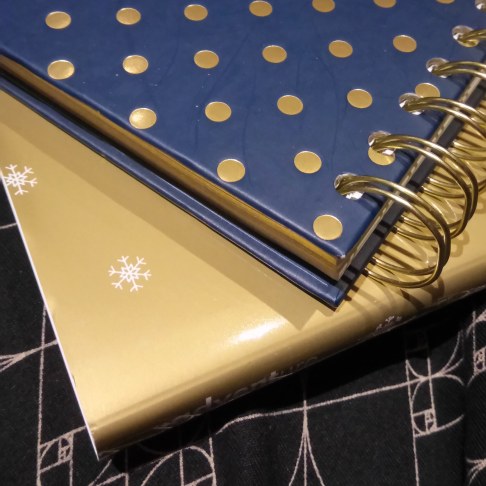
In May I started writing in this spiral-bound notebook, trying to collect all my thoughts on one particular subject all in one place. It has worked to a certain extent, though I keep having to retrace my steps across the internet and copy paragraphs, whole entries, sometimes, into an Evernote document. But most of what I have written since on this one particular subject is in this little blue book with the gold spots.


December Reflections 4: white

IMG_20191204_213637_387

Today I had to buy a box of tissues, as the cold which has been making me lethargic, despondent and irritable for the last two weeks has finally got to the ‘runny nose’ stage, which for me means nosebleeds too.

Actually, the current bug aside, 2019 hasn’t been too bad for me health wise. A slight iron deficiency got picked up in the summer when I attempted to give blood, and there was another bug which had all the symptoms of a nasty cold except the cough and runny nose, but I think that was about it.

Most excitingly, there was one morning this year when I woke up with the motivation, energy, enthusiasm, everything, squashed by depression, and managed to be kind to myself about it. This is revolutionary.

I think I know how it happened, too. I’ve spent a lot of time this year writing from the perspective of a character who spends much of the action becoming increasingly depressed. I have had to take care to differentiate between her perception of reality and actually reality. It’s hardly surprising if that has helped me get a bit of perspective myself, to remember that what’s really there is bigger than the space in my head. Even if that’s a little bit more difficult when that head is completely bunged up.

Two historical f/f fiction podcasts

isle-of-wight-coastal-path-looking-west-from-blackgang_7863516926_o

If you like having other people read you historical f/f fiction written by me, November was the month to do it. I don’t think there was any particular reason why it was November; it just worked out that way. But, because the internet is, if not forever, at least reasonably long-lasting, you can still listen to two podcasts featuring stories that I wrote:

  • Prima Donna featured on A Story Most Queer a couple of weeks ago:

Everybody knows why the great Signora Valli left the Licorne opera company. Everybody, that is, except Monsieur Perret, who has taken the brave—some would say, foolish—decision to cast her opposite rising star Delphine Vincent-Leclerc in Rossini’s Tancredi. But what everybody knows is only half the story.

It’s narrated by Julia Rittenberg and you can listen to it here (34 minutes). The story also appears in the anthology Upstaged from Supposed Crimes.

  • The Mermaid was the last of this year’s Lesbian Historical Motif Podcast fiction series:

Salvaging shipwrecks on the coast of the Isle of Wight in the eighteenth century can lead to unexpected treasure.

It’s narrated by Heather Rose Jones and you can listen to it here (18 minutes). You can also read a transcript here.

I’ve always been a bit hesitant about attempting historical fiction: so much to get wrong! So much more research! I don’t know whether I’d ever have the guts to attempt a full-length novel. At any rate, in both of these stories I found a way in through that old chestnut write what you know.

With Prima Donna, what I know is what it’s like to be an alto, to come to terms with the fact that even if you get really good (I never got really good, and also I have the acting ability of the average house brick) you’ll never get the biggest bouquets. It’s also the reading I did about the time when that wasn’t the case: the first few decades of the nineteenth century, when the castrati were dying out and the heroic roles that they had previously sung were now going to female singers. (Actually, those weren’t necessarily altos, either.) Signora Valli is one of those versatile sopranos who could play either hero or heroine. Delphine represents the new order (soprano heroine, tenor hero, villainous bass, and any other women relegated to confidante or crone) – or does she?

(I recommend Voicing Gender by Naomi André, by the way, if you want to know more about this period of opera – and you feel up to some fairly impenetrable academicese.)

Prima Donna

As for The Mermaid, what I know is the south coast of the Isle of Wight, the way that you don’t really trust the sea even on a calm day, the stories of wrecks and wreckers. This is a coast I’ve walked – except it isn’t, because the cliffs that Alice knows in my story will have long since crumbled into the sea. This is the Island before the tourists, before Queen Victoria, before Keats. This is the south west coast before the Napoleonic Wars prompted the construction of the Military Road, when it was even more remote from the rest of the Island, and anything could happen…

The Mermaid

How much is an honest review worth?

DSCF7736

There’s been some discussion recently about the fact that Publishers Weekly is now offering paid reviews to self-published authors – for $399 a pop.

No, I haven’t mislaid a decimal place. Four hundred – as near as damn it – American dollars.

As I remarked on Twitter, for that sort of money I’d expect wing walkers, and a solo extolling the merits of my book at the Last Night of the Proms.

Now, there are various schools of thought around paid-for reviews. I don’t buy reviews myself (except that one time when it was a friend trying to get a service off the ground), and, from the other side of the counter, I’ve recently resolved only to review books that I’ve bought with my own money. (Because a refusal often offends, but not nearly so much as the bad review that you would otherwise be posting.)

Actually, I do believe that most book bloggers are basically honest, and tend to say nothing at all if they can’t say anything nice. I’d recommend this pair of posts from Jo Linsdell and Lovely Audiobooks which debunks the myth that book bloggers are all rolling in free money. Which is hardly surprising, when most of them don’t charge.

And that’s the thing: whichever way you slice it, $399 is a lot of money. Do I believe that I’d get an honest review for $399? Perhaps. Do I believe that anyone else would believe it was an honest review? Perhaps not. To be blunt, the more an author spends on a review, the more flattering everyone else (and perhaps the author too) expects it to be.

But I think that what’s going on here is slightly more than paying for a book review (you can get them a lot cheaper on Reedsy or Fiverr or all sorts of other places, or so I understand) or even plain old advertising.

They’re selling credibility – or trying to. They’re offering you the chance to say, ‘This is my book, and a review of it has appeared in a Publishers’ Weekly supplement, therefore it must be good, right?’

The thing about credibility is that you can’t just rock up and buy it.  Sooner or later the reader is going to catch on to the fact that a Publishers’ Weekly review can be bought. Even if your book actually is as good as all that, the reader will look at some of the others (which, to be frank, are already looking a bit amateurish) and start to wonder… The lowest grade on offer is a C: that means that some truly terrible stuff is going to come out marked ‘average’.

You have to earn your credibility. And the way you earn it is by making your book good. As good as it possibly can be. Oh, it does appear that the review may include suggestions for things you could do better in the future. But you could spend your money on making your book good now, before you put it out into the world.

(The other thing about credibility is that it doesn’t, in itself, make any money. It takes credibility plus hard work. Actually, it’s mostly hard work.)

Here are some other things that a self-published author might – note, I don’t say should – do with $399:

  • get a really good cover… for the next few books
  • get a really good editor… for the next few books
  • get a really good typesetter, proofreader, publicist… oh, you get the idea
  • get really nice gin for the people who do those things for you but refuse actual payment
  • buy Facebook ads from here to kingdom come
  • buy a couple of dozen copies of the book from Amazon to push it up the sales rankings
  • buy a couple of dozen copies of the book and leave them on honesty bookshelves and railway station bookswaps (I have long wanted to do this, just for the hell of it)
  • go on a research trip for the next book
  • any other ideas?

I mean, don’t take financial advice from me. I’ve just spent a chunk of my most recent writing income on a rainbow skirt, but I think I’ll get a good deal more joy out of that. It cost me $35.00.

And yes, that decimal point is in the right place.


Q & A Tag: The Debut Novel

Good luck to everyone attempting NaNoWriMo!  I haven’t been able to make NaNoWriMo work for me since I started working full-time, and also I’m in the middle of a non-writing fortnight, so I’m not taking part. I’m reading instead.

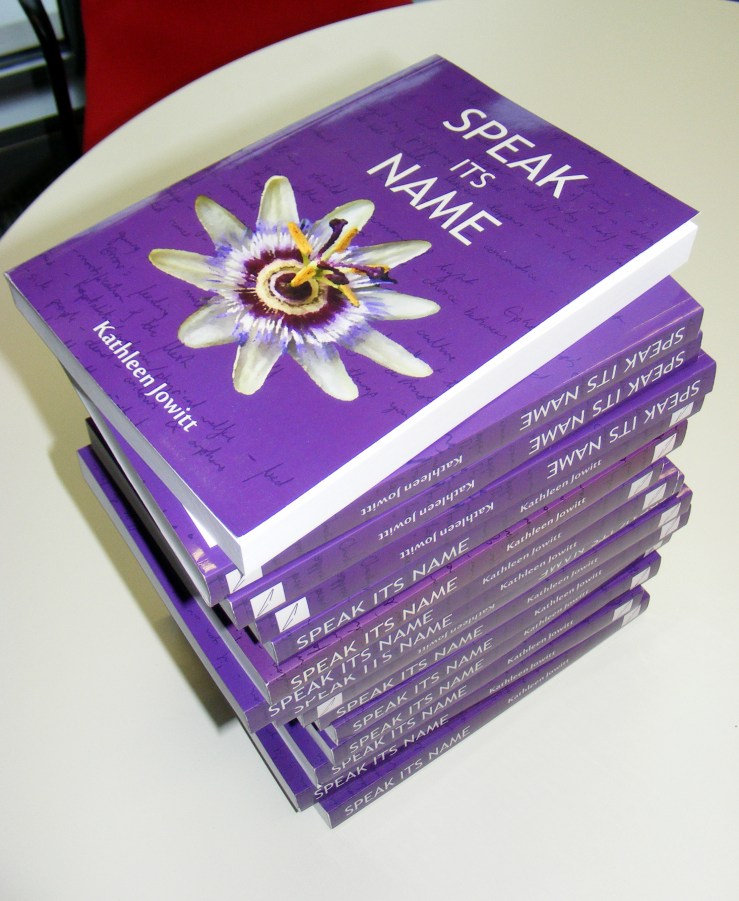
And what I have been reading, among other things (Ankaret WellsAnna Chronistic and the Scarab of Destiny came out yesterday, just saying…) is Speak Its Name. This is partly in search of details I’ve got wrong in The Real World (Rory never went to St Mark’s! Gabe has always had a surname, and it isn’t Murtagh!) but mostly because I happened to pick it up and start flicking through, and then decided I might as well keep reading…

Then I remembered that an early draft had an epic ecumenical argument about Hallowe’en, which might have made a good deleted scene. I couldn’t find it. I did find that all the early drafts meandered all over the place (which I had remembered) were quite unbelievably camp (which I hadn’t).

So all in all this seemed like a good moment to answer a Q & A that I’ve been meaning to do for a while: Niamh Murphy‘s ‘The Debut Novel’ Q & A tag.

DSCF0414

What is the title and genre of your debut novel?

Speak Its Name is a contemporary f/f novel about a Christian student finding her way out of the closet against a backdrop of student politics.

What gave you the idea to start writing it?

Originally I wanted to tell the story of an episode of the great Christian Union wars of the early 2000s. If you weren’t at university in the early 2000s, or didn’t get involved in student politics if you were, then you may well have missed these entirely, but they still crop up from time to time. There’s almost always more going on than makes the press. This was certainly the case in the kerfuffle that I got involved in, and I wanted to tell what really happened.

Unfortunately (or, perhaps, fortunately!) ‘what really happened’ was actually quite boring. Looking back, I feel like Lord Palmerston:

“Only three people have ever really understood the Schleswig-Holstein business—the Prince Consort, who is dead—a German professor, who has gone mad—and I, who have forgotten all about it.”

How long did it take you to finish?

A long time! I wrote the first word of the first draft in November 2007, having spent much of the summer planning. By the summer of 2014, I thought it was more or less done. I eventually published it in February 2016.

What was the biggest challenge you had when writing it?

The moment when I realised that actually the whole thing needed to be written in the point of view of a character who at that juncture had absolutely nothing. And who wouldn’t come out even to herself until half way through the book.

This development had its advantages, though: for one thing, it made it much easier to incorporate the political storyline. And it made the book much better overall, much tighter, and less susceptible to in-jokes and digressions.

How did you get it published, indie or trad?

After spending a summer trying to interest agents in the book, I gave up and decided to self-publish – a decision I’ve never regretted. Speak Its Name was shortlisted for the Betty Trask Prize in 2017, after which I did get some more interest from the traditional publishing world, but we decided pretty much simultaneously that it wasn’t an avenue that any of us wanted to pursue.

What was the most important thing you learnt from the process?

How to write a novel. That might sound flippant, but I’m serious. I started with a string of real life events and a handful of characters. Over the years I learned: to let my characters make their own mistakes; how to harness my own emotions to make my characters’ reactions convincing; how to get characters to drive plot; what to leave out; what to take out; how much I really enjoy editing.

What are you working on right now?

I’m working on the sequel. It’s called The Real World and it picks up the action about three years after the end of Speak Its Name. As the title suggests, the characters are having to adjust to life after graduation, and none of them have picked a particularly easy path (if such a thing even exists). There are difficult decisions to be made and challenging situations to work through.

But I’ve actually got to the stage where I put it away for a few months and try to ignore it, so that I can return to it with fresh eyes.

In the meantime I’m writing some shorter pieces, a couple of which are also set in Stancester. One is a prequel to Speak Its Name – Becky’s first term at university – which I’ll be offering as an incentive to sign up to my email newsletter, when I actually get around to setting that up. The other is more of a standalone, and I’m aiming to submit it to the Reconciling the Rainbow anthology.


Q & A Tag: The Debut

Degrees of stuckness

The Real World is currently sitting at 83,000 words. This ought to be enough words, but of course not all of them will end up in the final version.

At present I’m wondering whether I’ve got to the point where I put it away for three months. I probably have. At the beginning of the year I told myself that I was aiming to have a first draft in October, and, apart from a few [insert science fact here] notes, I’ve filled in most of the gaps.

In the meantime, I thought it might be interesting to compare it with its two predecessors – not in terms of word count (that wouldn’t take long) or in terms of what precisely I was panicking about, when (that’s a question for another post), but in terms of what you might call the emotional arc.

Thus far, I have always written about what one of my friends called ‘people sorting their heads out‘: characters who are stuck in their own assumptions, their own worldviews, and how they get unstuck.

What makes The Real World different is the fact that I show much more of the process of getting stuck.

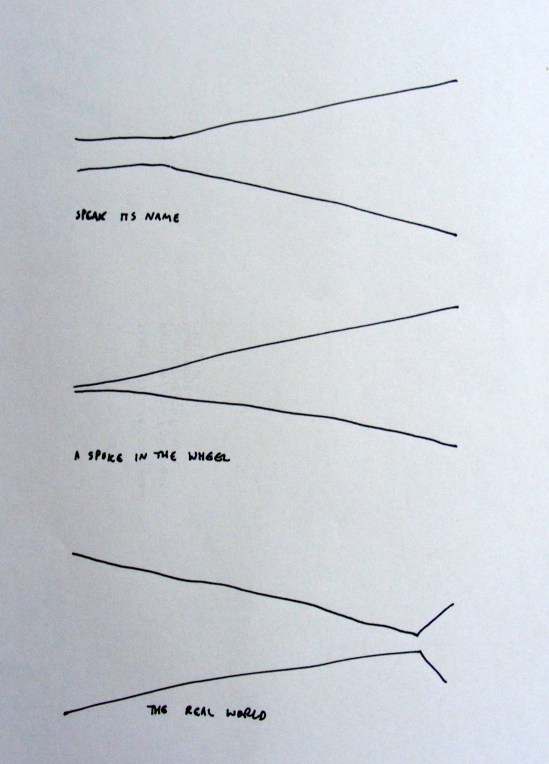
Here’s a diagram:

DSCF8516

Speak Its Name chugs along for the first hundred pages or so with Lydia operating within the same narrow constraints that she’s known all her life. When she takes a long, hard, look at herself, everything suddenly opens out – and keeps opening.

What we can’t see, of course, is how the increased exposure to people outside her own social group is affecting her without her knowing it.

In fact, all three diagrams show only what’s going on in the protagonist’s head, and only what they’re conscious of (or would be, if they thought about it). They don’t show the external circumstances or other characters’ decisions that are working on them. Nor do they show all the little accumulations and releases of tension that drive a story. Just the perceived stuckness, if you like.

In A Spoke in the Wheel, the most stuck part is actually before the opening of the book. When we meet Ben, he’s not quite at his lowest point: he’s just coming out of it; he’s made a major change in his life. He still has a very long way to go, and the process isn’t quite as smooth as the diagram implies, but the only way is up. Or, to put it another way, it’s all uphill from here.

The Real World starts out in Colette’s head with a reasonably broad worldview, and then compresses and compresses things until it’s almost intolerable. But, as you see, it finds a bit of space right at the end.

I’m a bit apprehensive about what people will make of it. Will it all be hideously depressing (or, worse, boring) – or will the increasing stuckness drive the tension up?

The answer is, I honestly don’t know, yet. It’s difficult to tell when I’ve been buried in the text. That’s why I’m putting it away until the new year. I’ll let you know.

The Page 69 Test

Messing around on Twitter a while ago, I came across the Page 69 Test. Apparently this has been popularised by John Sutherland’s book How To Read A Novel, and originates in advice from Marshall McLuhan:

Turn to page 69 of any book and read it. If you like that page, buy the book. It works.

But why does it work? I suspect that it’s because by the time you get to page 69 you’re past all the introductions and scene-setting, but not far enough to encounter any meaningful spoilers.

Actually, it’s often that section of the book that I find most difficult to write. There’s something about managing the transition out of the set-up that causes me a whole lot of trouble, and I end up with an awful lot of square brackets saying: [link] [expand!] [something about the parents] [but why?]

I was therefore a little hesitant to look up my own page 69s (pages 69?), but actually I was quite pleased with what I found.

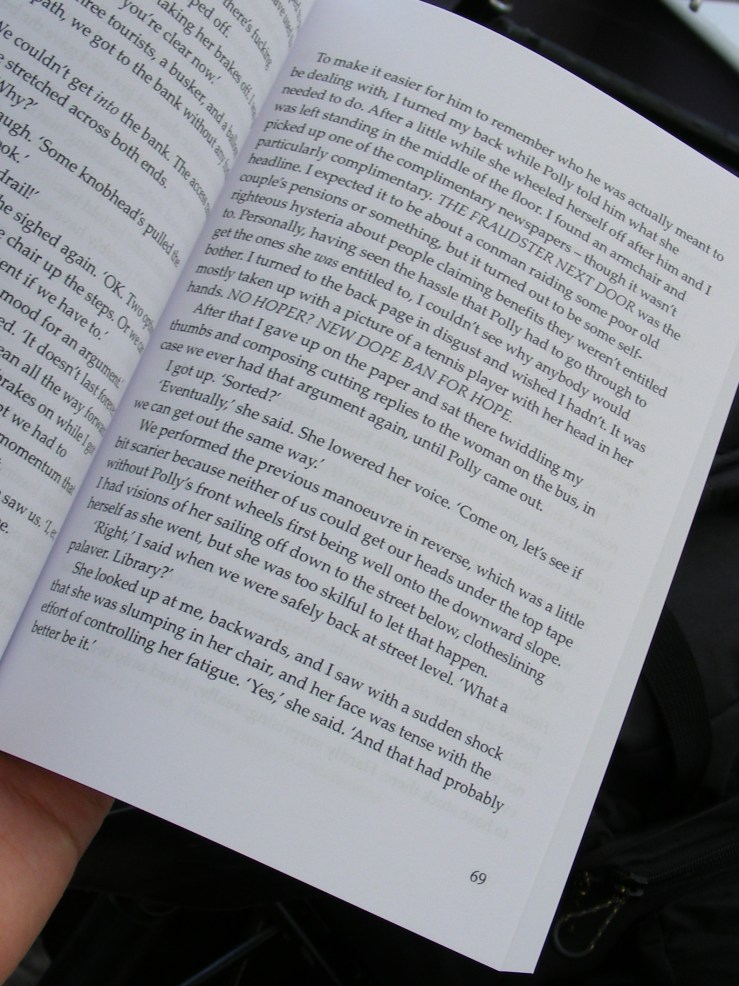
Here’s page 69 of A Spoke In The Wheel:
DSCF8513

To make it easier for him to remember who he was actually meant to be dealing with, I turned my back while Polly told him what she needed to do. After a little while she wheeled herself off after him and I was left standing in the middle of the floor. I found an armchair and picked up one of the complimentary newspapers – though it wasn’t particularly complimentary. THE FRAUDSTER NEXT DOOR was the headline. I expected it to be about a conman raiding some poor old couple’s pensions or something, but it turned out to be some self-righteous hysteria about people claiming benefits they weren’t entitled to. Personally, having seen the hassle that Polly had to go through to get the ones she was entitled to, I couldn’t see why anybody would bother. I turned to the back page in disgust and wished I hadn’t. It was mostly taken up with a picture of a tennis player with her head in her hands. NO HOPER? NEW DOPE BAN FOR HOPE.

After that I gave up on the paper and sat there twiddling my thumbs and composing cutting replies to the woman on the bus, in case we ever had that argument again, until Polly came out.

I got up. ‘Sorted?’

‘Eventually,’ she said. She lowered her voice. ‘Come on, let’s see if we can get out the same way.’

We performed the previous manoeuvre in reverse, which was a little bit scarier because neither of us could get our heads under the top tape without Polly’s front wheels first being well onto the downward slope. I had visions of her sailing off down to the street below, clotheslining herself as she went, but she was too skilful to let that happen.

‘Right,’ I said when we were safely back at street level. ‘What a palaver. Library?’

She looked up at me, backwards, and I saw with a sudden shock that she was slumping in her chair, and her face was tense with the effort of controlling her fatigue. ‘Yes,’ she said. ‘And that had probably better be it.’

This comes in the middle of a chapter in which Ben accompanies Polly on some errands, and begins to appreciate some of the practical difficulties of life with a chronic illness. I think it would work well as a representative sample. There are quite a lot of ableist microaggressions in this book, and if that wasn’t what somebody needed to be reading about (and I couldn’t blame them!) then page 69 would be a reasonable warning. It also gives an idea of Ben’s personality, a more sympathetic and probably more representative one than the first page (he’s had time to unstick himself a bit). He’s well-meaning but clueless, clueless but willing to listen.

And here’s page 69 of Speak Its Name:

DSCF8514

Tim Benton’s a Catholic, isn’t he, and nobody seriously tries to claim that Catholics are really Christian. I mean, they pray to Mary, that’s idolatry for a start…’

Lydia wanted to say that nobody was praying to Mary at the Vigil, but judged it best not to draw attention to her own attendance. Instead, she ventured, ‘I’m beginning to wonder, actually – whether any of us actually have the right to claim that somebody isn’t a Christian when they say they are…’

Ellie sent the surviving portion of the STANdard the same way as the Letters page. ‘Don’t be ridiculous. It’s perfectly obvious with some people, isn’t it? No, Lydia, the Devil is at work on campus. This isn’t the only sign of it. Jake told me last week that you hall officers won’t be allowed to live-in next year. It’s all very worrying. I think we should pray about this.’

‘We what?’ Lydia exclaimed in horror.

Ellie, intent on praying, did not answer. Instead, she shifted her chair so that she sat directly opposite Lydia and grabbed both her hands painfully tightly. ‘Father God,’ she intoned, ‘we see Your people under attack, we know that the Enemy is moving on this campus, we pray, Lord, we just pray for Your help and guidance today.’ Squeeze, squeeze. ‘We know that You are in control of all things and we ask that You would show Your power here today, Lord, we ask that You would reveal Your truth, that You would convince those who are doubting,’ squeeze, this time with nails digging in, ‘that You would complete Your great work at this university, so that every student here will know that You are Lord. Lord, we just ask this today. Lord, You said that whoever is not for You is against You. We ask You to protect us all against these attacks from Satan, by these people who claim to speak in Your name but who are working to undo the great things You have already done here. Amen, Lord, Amen!’

This one I’m not quite so comfortable with. It’s cringey, and it’s meant to be, and I suppose that it’s good for anyone with an active embarrassment squick to know that this passage exists. In fact, this is peak cringe. If the reader can cope with this, they can cope with the rest of the book. And it is a reasonably good picture of the dynamics in the wider book: Lydia advocating for a wider understanding of the word ‘Christian’, and experiencing a more violent pushback than perhaps she expects. Ellie doesn’t appear in The Real World: we’ve moved away from the (Evangelical) Christian Fellowship and on to the Church of England. I miss her. A bit.

One thing I can guarantee is that this will no longer be page 69 by the time The Real World comes out, but what the hell. This is Colette talking to postdoc James about his upcoming wedding, and, in its combination of marriage angst and science angst, it’s fairly representative. It’s missing the Church of England angst, though.

… they couldn’t get it in the right size for one of them, so the whole idea gets written off and we have to start all over again from square one.’

‘I suppose you couldn’t get away with having one of them in something different and calling it a contrast?’

‘I think that’s the point of the bride,’ he said drily.

Colette shrugged her shoulders. ‘Well, you’re the expert.’

‘Of course, the other problem is that they then have to get the flowers matched up with the dresses, and Giselle really wants irises, because it was her grandma’s name.’

‘That’s a really lovely idea,’ Colette said.

‘In theory, yes, it is. In practice, it’s yet another thing that we have to work around. Apparently it rules out a whole slice of the colour palette.’

‘Oh,’ said Colette, who had never thought about it.

The lab door opened with a gentle swish. Just in time, James closed the window on his computer with the Science Today story and maximised the one in which he was writing his own report.

‘Good morning,’ Barry said.

‘Morning, Barry,’ James said, in a remarkably natural way.

‘Morning,’ Colette mumbled.

He glanced at her. ‘You told me last week that you wanted to ask about something?’

‘Yes,’ Colette agreed, her mind blank. ‘I – I can’t remember what it was now.’

He looked distinctly unimpressed. ‘Hmm. Well, if you remember before about three o’clock, give me a shout.’ He disappeared into his office. James and Colette glanced at each other.

‘What did you want to ask him about?’ James asked. ‘Or can you really not remember?’

Colette wriggled uncomfortably. ‘I couldn’t put it into words in the moment. It was that weird [thing] that I asked you about…

As you see, I’m still in the [square brackets] phase. I’ll be back in a few months with the real page 69.

Titled.

DSCF8329

The sequel to Speak Its Name has been coming along very nicely in recent months. It’s now standing at 75,000 words, with only a few holes left to fill before I can move into the editing phase.

But I’ve been having to refer to it in just those terms, because I have had dreadful trouble coming up with a title for it.

At first I was thinking of it as Scandal and Folly, but I had to admit that this sounded too much like a bodice ripper. I thought of doing something with ‘don’t ask, don’t tell’, but no variation on that seemed to work. Later I came up with Truth and Power, but that sounded too much like a political thriller. In between times, I’ve just been calling it ‘the sequel’.

On Tuesday I had a rather varied evening. First I went to the pub with some people I used to work with, and a few people I still work with, and ended up spending most of the time I was there talking to the boyfriend of someone who’d only just started working with the people I used to work with. Then I dashed off to catch a train and then lead a session on the Holy Spirit with a small group from church.

And through the evening there was one phrase that kept coming up. The real world. Trade union employees tend to be pretty much resigned to the idea that people think they don’t live in the real world. One of the church group felt that it was very important to live in the real world. In actual fact, it’s a phrase that I’ve always been slightly uncomfortable with: unless this is the Matrix, all of us live in the real world.

Anyway, I was walking home at the end of the night and thinking how many times I’d heard the phrase the real world over the course of the previous few hours, and wondering whether it held any particular significance for me, or whether it was just coincidence.

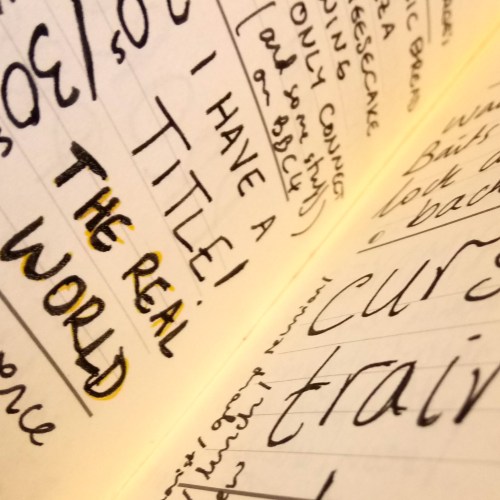
And I realised: that’s my title.

The Real World

It works across several of the themes of the novel (we are picking up the action about three years after the end of Speak Its Name, with the characters in their early twenties and trying to work out what they’re doing next) and it has a good few layers of irony, too. Not least, of course, the fact that this isn’t the real world at all. It’s fiction.

But nobody in it knows that.