#indiechallenge – Meant To Be Me (Wendy Hudson)

DSC_0031

The blurb

Trying to find “The One” is never easy and engineer Darcy Harris is finding it tougher than most. It doesn’t help she’s also dealing with a shadowy stalker trying to make trouble for her. But Darcy’s determined not to let anyone ruin her life.

Her loyal best friend and boss, Anja Olsen, is stuck in a strange conundrum, forced to question who she has become and who she wants to be.

Meanwhile, stranger Eilidh Grey’s first instinct is to run fearlessly toward chaos and love. But this time she’s on a collision course with fate.

A chance meeting on a snowy bridge in Inverness, Scotland, binds all three women together, creating an unexpected, tangled, love triangle. What happens when it all unravels?

A compelling, slow-burning, romantic suspense that will keep you guessing right to the end.

The author

Wendy Hudson is an award winning author based in Scotland.

Her debut novel “Four Steps” won a 2017 GCLS Debut Author Award, was a Diva Literary Award Finalist 2017.

Her second novel “Mine to Keep” was a 2018 GCLS Finalist.

All her novels are set in Scotland among the inspirational landscapes that first inspired Wendy to write.

In her spare time, Wendy has a love for travel, as well as camping, skiing, football, festivals and reading.

The publisher

Ylva specialises in lesbian fiction by authors from all over the world and across a wide range of genres.

The bookshop

Another one from Kobo.

The bingo card

This could count towards: ‘Genre fiction’, ‘A Women’s Press’, ‘Marginalised people’, or ‘LGBTQIA’.

My thoughts

Wendy Hudson is a colleague, and about a year ago we spent an enjoyable evening in the bar at one of the University of Warwick’s conference centres, drinking beer and talking about writing. She was working on this book at the time, and she told me what the twist was going to be.

And it didn’t matter at all. It was as much fun knowing what was coming as it would have been to be guessing. That particular twist was revealed about a third of the way in, after which I was on a level playing field with everybody else – and there was still a lot of suspense to come. Knowing something that the characters don’t is all very well, but I didn’t know when or how they would find out. And I kept on reading until they did.

Beyond that: it was a romance between two women, each with a complicated past, which was always haunted by the claustrophobic, effective, suspense plot. I’d have liked to see a little more of how that eventually plays out, but that would have made for a very different book.

#indiechallenge – The Luminaries (Eleanor Catton)

DSC_0026

The blurb

It is 1866, and Walter Moody has come to make his fortune upon the New Zealand goldfields. On arrival, he stumbles across a tense gathering of twelve local men, who have met in secret to discuss a series of unsolved crimes. A wealthy man has vanished, a whore has tried to end her life, and an enormous fortune has been discovered in the home of a luckless drunk. Moody is soon drawn into the mystery: a network of fates and fortunes that is as complex and exquisitely patterned as the night sky. The Luminaries is an extraordinary piece of fiction.

The author

Eleanor Catton was born in 1985 in Canada and raised in Christchurch, New Zealand. She won the 2007 Sunday Star-Times short-story competition, the 2008 Glenn Schaeffer Fellowship to the Iowa Writers’ Workshop, the 2008 Louis Johnson New Writers’ Bursary and was named as one of Amazon’s Rising Stars in 2009. Her debut novel, The Rehearsal, won the Betty Trask Prize, the Amazon.ca First Novel Award, the NZSA Hubert Church Best First Book Award for Fiction and was shortlisted for the Guardian First Book Award, the Prix Femina literature award, the abroad category of the Prix Médicis, the University of Wales Dylan Thomas Prize 2010 and Stonewall’s Writer of the Year Award 2011, and longlisted for the Orange Prize 2010. In 2010 she was awarded the New Zealand Arts Foundation New Generation Award. The Luminaries was the winner of the 2013 Man Booker Prize and the 2013 Governor General’s Literary Award.

The publisher

Granta Books is an independent publisher based in Cambridge, with a very long About page.

The bookshop

Downloaded, boringly, from Kobo.

The bingo card

This could count towards: ‘An author from another country’; ‘A new to you press’ (I think); ‘A press over 20 years old’; ‘An award winner’; and ‘Book that defies genre’.

My thoughts

I’ve often seen this in bookshops and charity shops and thought what a lovely cover it has (neither my ebook reader nor my photograph do it justice), but I would probably never have got around to buying or reading it had my office book club, which has a penchant for award-winners, not picked it for the September meeting. Since we were reading this one over the summer, there was time to tackle the nine hundred or so pages of it.

And I absolutely loved it. I’ve a weakness for nineteenth century doorstops, and this included many of the things I like about them: a twisty, turny plot full of mystery, melodrama, and the supernatural (the latter almost but not quite explained away); treasure hunts and missing documents; vividly-drawn characters; an omniscient but selective narrator.

But it also subverted them. It brought twenty-first century nuance to questions of race and, to a lesser extent, gender; it did something very interesting with chapter headings, and it gave almost all of the characters at least a moment in which they were sympathetic. There was a humanity and a generosity to it that kept me reading. Quite apart, of course, from its being a whole lot of fun.

The Duke Is Dead: a conversation with Ankaret Wells and Irene Headley

the duke is dead cover

It is seven years since the Cousins’ War ended. King Roald has brought peace to the Three Kingdoms and driven the last heirs of the king he deposed into exile. His brother Thomas, Duke of Wharram, is a man for whom loyalty is the greatest virtue and family the highest cause. So when his sister Josiane, Duchess of Bergomance, finds herself widowed, her beloved stepdaughter Ambrosia beleaguered by suitors and her late husband’s coffers mysteriously empty, who better to send than Thomas?

But the ghosts of old wars are waiting in Bergomance, and new threats are rising. Some see heresy everywhere, and others look to an Empire in the east that has suddenly begun seeking allies.

And into it all, a ship driven off course by storms brings a young man fleeing King Roald’s mercenaries and throws him into Thomas’s path. Nicolas ás Ithel, a man with dark eyes and a love of numbers, and an inheritance in his veins that could reignite the Cousins’ War.

Kingsblood.

The Duke Is Dead, say its authors Ankaret Wells and Irene Headley, is a story of love, danger, intrigue, blood magic, vast amounts of sarcasm and a pygmy hippo.

I invited them over to this blog to ask how on earth any of that happened…

Irene Headley: Really, we can all blame this on the city of Bath.

Also, Bourgogne, Quelle Histoire!, which I picked up whilst on holiday in Burgundy in an attempt to improve my French. (See also that child’s book of Hapsburg Empresses in German in order to…you can guess.)

Ankaret Wells: It was 2013, the remains of Richard III had just been discovered under a car park, and Irene and I were sitting together in a café in Bath talking about it. I think IH might have had some copies of The Ricardian?

IH: I have a somewhat complex relationship with Richard III, best exemplified by the time when I was ten, I was at a castle day out decorating Wars of the Roses themed biscuits, and my mother leaned down and gently informed me that if I put the Red Rose of Lancaster on any of them, I was walking home. I’m still not entirely sure whether she was joking.

AW: I just read The Daughter Of Time at an impressionable age.

IH: Oh, I did that too. It’s the only Josephine Tey I’ve gotten through without screwing my face up because I was too young to recognise the weirdness.

AW: We were talking about the size of the Richard III Society compared to the plucky but outnumbered Henry VII Society, and somehow (I don’t think we were drunk at this point?)

IH: I think this was the trip to Bath where it was bucketing it down, not the one where I drank an inadvisable quantity of Pimms in the blazing sunshine, and then got very emotional about the memorial plaques in the Abbey*. We kept choosing cafés based on their proximity to the place we’d just left. This particular cafe was filled with plants.

AW: We somehow came up with the idea that the way to reconcile Henricians and Ricardians was to unite them in outrage against Richard III / Henry VII slash.

(Actually I’m sure the vast majority of both societies are sensible people whose attitude to m/m fiction is either ‘Not my thing, but why would I care what other people read?’, ‘Only #ownvoices, thanks’ or ‘Bring it on!’)

We spent a while composing letters between Henry trying to wrangle his uproarious uncles and being comprehensively outfoxed by Elizabeth Woodville and Richard being Sensible. And then IH suggested we set it after the death of Charles the Bold of Burgundy.

IH: I have always felt incredibly bad for Mary of Burgundy, Charles’s only child, and Richard III’s step-niece, who was married to the Archduke Maximilian of Austria just over six months after her father’s death, and died five years later in a riding accident. (This is where Bourgogne, Quelle Histoire!, comes in! It has a picture in which Mary appears to be declaring her love to her horse) We already knew that a world in which Henry and Richard loved each other wasn’t going to end in Henry killing Richard, and had somehow ended up shipping Elizabeth Woodville/Henry, while I was refusing to be parted from my OTP of Richard/Anne Neville. And then we thought: what if that’s when they fall in love? They’re not technically enemies yet, and we get to find Mary a different husband. Win-Win!

AW: So, we got them as far as meeting in Bruges – there was a joke about Henry saying his name was Richmond and Richard, in a hurry, saying ‘Oh, you’re Dick too?’ – and then I threw a spanner in the works and Irene, may any entities up there bless her, didn’t turn around and murder me.

I said ‘I think this ought to be fantasy’. We started renaming dynasties and kingdoms.  For me at least, that was when the characters started coming alive. In particular, the cardboard cutout of Jasper Tudor, boorishly considering courting the much younger Mary, turned into Morcant as Ithel, unshakeably poetic about all the wrong things but practical about most of the right ones, a man who would no more consider offering himself to a teenage duchess than he would change his religion for profit, but who fell in love like a ton of bricks with the most inconvenient person possible.

When we started out, some of the characters (mostly Yorkists) were Irene’s and some (mostly Lancastrians) were mine, but by the end we were both writing everybody.

IH: Making it a fantasy also meant that we got to do a lot with the Richard II and Henry IV figures. Richard II became Queen Sidonia and stayed that way, Henry IV went through a few changes before becoming irrevocably Queen Julia. We also got to create the Kosmotic Empire, which I may at one point have described as ‘basically matrilineal Byzantium’, which led to the existence of Melissa and Richza, my favourite diplomatic duo.

The only problem was that we had to cut out a lot of dynastic backstory and sidestory, at which point we brought in the chapter headings so that the reader got an idea of what got everyone to this point. (Admittedly, a number of the chapter headings are written by authors so biased as to be actively misleading…) This also led to Ankaret’s love affair with the town of Foswich.

AW: We have a lot more planned for this world, and we really hope you enjoy your visit.  Watch out for the pygmy hippos.


*In my defence, Irene adds, there is a plaque raised by a widowed mother who had lost her son in the Napoleonic Wars and her daughter to a fever which says something about how her only comfort is that God clearly needed them more than she did.


The Duke Is Dead is available now from Lulu and other retailers.

Quality, revisited

DSCF8027

Another day on Twitter (it’s just about bearable these days if you use Tweetdeck, I find), another free and frank exchange of views on the question of whether it’s fair to make a principle of not reading self-published books.

In one sense, it’s a pointless question. One can’t, and shouldn’t, force people to read books that they don’t want to read, and their reasons for not wanting to read them are surely their own business. But I do want to take issue with the underlying assumption that self-published books are necessarily terrible.

(Mandy Rice-Davies voice: Well, she would say that, wouldn’t she?)

I would not deny for one moment that there are many appalling self-published books in the world. Earlier this week I read this thread from a professional editor with fascinated, delighted, horror. But, as I said when I shared it, there are plenty of traditionally published books that I’ve judged ‘Not bad, but could have done with a thorough edit’, and a few ‘This was so bad I couldn’t finish it’, as well as a lot more ‘Couldn’t be bothered’. The worst book I’ve read recently came from a small press. It was dire. It didn’t know which genre it was trying to be, and the worldbuilding was cowboy builder work. Needed a very thorough edit. Nor are the production values necessarily any better in conventional publishing. I still remember this horror with a certain sense of disbelief.

Conversely, the professionalism of self-published authors like Jane Davis and Ankaret Wells results in absorbing, enjoyable books that I look forward to reading and re-reading. And I know from my own experience that the choice to self-publish grants the great gift of control. I don’t have to put up with a terrible cover or a phoned-in edit. The power to improve things is mine. I make a point of never putting a book out until it’s as good as I can possibly get it. Quality is a subjective thing, of course. But it is not my judgement alone that puts my first novel on a par with some of the best of my generation; it was that of three authors whose writing I admire and who are big names in literature. It wasn’t lack of quality that meant I couldn’t get it published conventionally; it was the fact that there wasn’t a significant market for it. Too gay for the Christian market; too Christian for anything else. (I suppose I could have tried Darton Longman Todd, but then I don’t know what they’d have done with a novel with basically no religious content the next time round.)

Extrapolate from that, and one surmises that there are plenty of very good books out there that aren’t being published traditionally, and likely never will be, because the subject or the style just isn’t ‘in’ at the moment, or because the current trend is for debuts and the author didn’t hit the big time on their first attempt. I’d rather have the option of reading them. And I’d rather not be the one who puts that restriction on my reading material.

We all have our petty preferences, our likes and dislikes, both justified and unjustified. (Personally I’ve developed a violent hatred for that brushstroke calligraphy font that’s everywhere at the moment. I dare say that either my hatred or the fad will die off sooner or later.)

There are millions upon millions of books out there, and no human lifetime is going to be long enough to read all of them. We all have to find our own ways of prioritising. No matter what that is, we will inevitably miss something that we would have loved if we’d just given it a chance. Avoid books with predominantly pink covers, on the grounds that you don’t like chick lit? Miss out on the grittiness of Dorothy Koomson and the psychological insight of Marian Keyes. (I’m serious. I don’t think I’ve ever read an unreliable narrator that worked better for me.)

No. I choose books to read based on whether the subject matter interests me, what my friends are reading, and, above all, whether I like the writing style. And, as another Twitter self-publisher pointed out, that’s very easy to find out with a look inside, or, indeed, the ‘Look Inside’ feature.

If someone else’s chosen method of prioritsation is to exclude self-published works, then that’s up to them. But I will maintain for as long as I’m reading that it’s by no means a reliable filter for quality.

#indiechallenge – The Silken Thread: stories and sketches (Cora Sandel, translated by Elizabeth Rokkan)

DSCF8509

The blurb

‘And so Rosina is set free on the path of candour, where we so easily gallop a little further than we would wish. It looks so innocent to begin with. One starts out so far from the great confidences…’

A silken thread loosens Rosina’s tongue to admit the desperation behind her confident manner. A woman allows herself to feel secure when her lover gives her a bracelet, until the history of the bracelet is shatteringly revealed.

Cora Sandel’s short stories are about what is concealed behind ordinary situations; what people really want to say to each other when they argue about money or exchange niceties or merely sit in silence. This collection displays the extraordinary economy of Sandel’s writing: finely tuned and exquisitely understated, yet full of meaning.

The author

Cora Sandel is the pseudonym of Sara Fabricius, who was born in Kristiania (Oslo) in 1880. After studying to be a painter, mainly in Paris, before and during the First World War, she abandoned painting at the age of forty, settled in Sweden, and turned seriously to writing, publishing the first volume of her Alberta trilogy in 1926. She died in Sweden in 1974.

The publisher

The Women’s Press now seems to be defunct, but it used to put out a lot of feminist fiction and non-fiction. Its steam iron logo and stripy black-and-white spines are still worth keeping an eye out for when browsing charity shop shelves.

The bookshop

I can’t remember – this has been hanging around on my shelves for ages, waiting for me to read it – but am fairly sure it must have come from a charity shop in Woking.

The bingo card

This could count towards: ‘A Women’s Press’ (obviously); ‘An author from another country’; ‘A book from your TBR’; ‘Translated book’; ‘A press over 20 years old’; or ‘An anthology’.

My thoughts

There are some gems in here, set across quite a wide range of places and, to a lesser extent, times. The one that’s stuck with me ever since I read the book (several weeks ago, now) is Artist’s Christmas. It’s a detailed, atmospheric piece that evokes all the chill of winter and the misguided idealism of the bohemian lifestyle – with a vicious sting in the tail.

Some I inevitably found less successful, such as The Broad Versus the Narrow Outlook, in which a dispute between neighbours made a slightly clumsy metaphor for the Nazi occupation. On the other hand, I did find There’s A War On very moving – and a timely counter to the assumption that the Blitz was something that happened only to Britain.

This is by no means a comfortable read (and I would recommend skipping The Polar Bears or Two Cats in Paris and One in Florence if you’d rather not read about harm to animals) but I found it a worthwhile one, and am rather regretting letting it languish on my bookcase for so long.

The Reader’s Gazetteer: L

DSCF8462

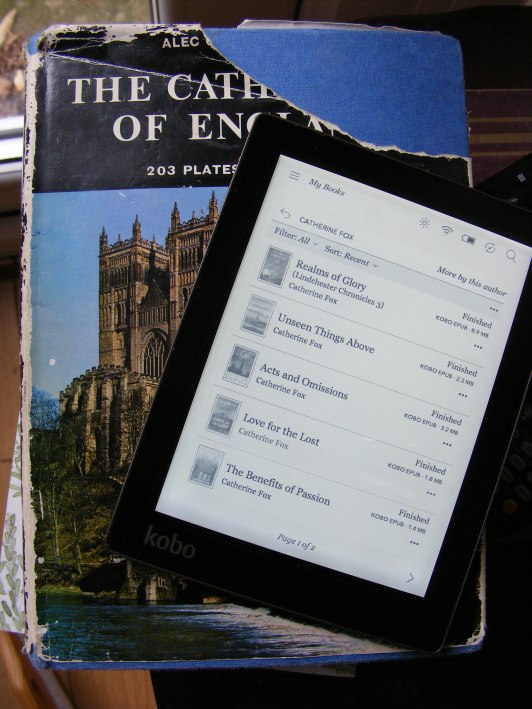
L takes us back to Britain and back to the ecclesiastical shenanigans novel in Catherine Fox’s Lindchester series.

Lindchester is explicitly in the same universe as Barchester, and it has a rather more explicit location:

The diocese of Lindchester is not large, squashed as it is between Lichfield to the south and Chester to the north; so don’t worry, we will not be travelling far.

This locates it, unusually for an ecclesiastical shenanigans novel, in the northern province. The Archbishop of Canterbury surely has quite enough to deal with in Barchester, Christminster, Starbridge and Torminster. It’s only fair that the Archbishop of York gets to fret about Lindchester’s problems.

Transport links? If you were starting in London, you’d get a train out of Euston. Euston is horrible. Maybe don’t start in London. Change at Crewe.

I’ve been using ‘Lindchester’ as shorthand for the locale in which the action happens. This is not limited to the town of Lindchester itself; it encompasses the whole diocese: Lindchester, Lindford, Cardingforth… (In fact, the narrator is scrupulous about not depicting anything that happens beyond the diocesan boundaries.)

Recently, I’ve been mulling over a hypothesis about fictional places, about the difference between Barchester and Ruritania (I know we haven’t got to the latter yet). And I’m not convinced it’s entirely down to geography. It’s not the difference between a city and a state – in fact, so many modern Ruritanias are so tiny that they basically are cities. I think it’s more to do with the way that the characters – and particularly the protagonist – interacts with the place.

If you’re the protagonist, Ruritania is the place you visit. You might have a longstanding connection with the place, your visit may have a disproportionate effect on the place, and you might very well get more than you bargained for on that visit, but you’re essentially an outsider. Barchester is the place where you live, very probably the place where you were born. In Barchester, you’re a part of the system, the whole complicated interconnected web of human relationships. You may well be able to effect change, but the system is something that has shaped you. You can’t just pass through it.

That’s because the place itself exists within a larger system, whether that’s political, religious, social, or any combination. It’s a system that the author suspects that many of their readers know well, might themselves exist within. Lindchester is a diocese within the Church of England. It operates in a similar way to any other diocese in the Church of England. Happy endings are very much a possibility, but they have to be negotiated within the constraints of the real-life system. The author has control of the fates of the individual characters, but they don’t mess around with the way we all know things work. That would be cheating. That would be far less satisfying.

Books referred to in this post

Lindchester series (Acts and Omissions, Unseen Things Above, Realms of Glory), Catherine Fox

Barchester series, Anthony Trollope

ABCDEFGHIJKLMNOPQRSTUV

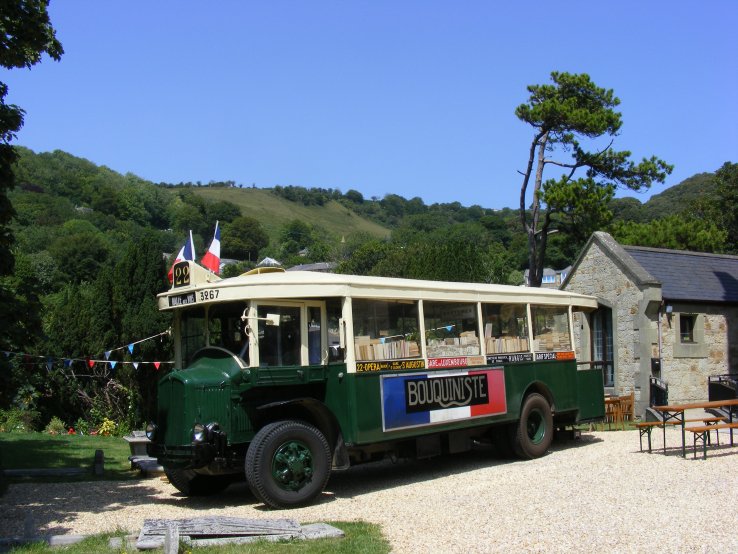
Back on the Book Bus (where do you get your ideas?)

DSCF8495

Last week I was back on the Isle of Wight for Ventnor Fringe. I had good intentions about selling a lot and writing a lot. As it was, I sold very little and immediately spent all the proceeds on other books. I finished a short story (submissions deadline was today) and managed to get the current novel about a thousand words further forward and a little bit tidier.

Apart from that, I sat in the sun, and listened to and watched other people doing their thing. Poetry. Music. Theatre. Comedy. I looked for lizards (and found them) and drank Belgian beer.

In between times, I did quite a lot of thinking, and I noticed how my best ideas seem to come from thought experiments of the ‘What if?’ variety. For example:

I know the Society of Authors aren’t expecting a novel inspired by the three weeks of foreign travel their award funded, but, if they were, what would it look like?

(Answer: a modern Ruritanian adventure with ice dancing!)

Or, this week:

If I were going to write something that I could sell at a price point of £4 or under, so that buyers aren’t going to be put off it in favour of the cheaper, and excellent, second-hand books around it, what could that be?

(Answer: a little book that can double as a souvenir!)

So that’s two projects in the pipeline. I’m also attempting to write more short stories. Some of those I’m submitting them to other people’s anthologies and magazines; others, I have other plans for. For example, I’m thinking of setting up a mailing list, and I’d like to offer an exclusive short story as a thank you for joining it.

At the moment, though, my main focus is still the sequel to Speak Its Name, which is currently standing at just over 62,000 words. It still doesn’t have a title. I thought of Scandal and Folly (sounds too much like a bodice ripper). I thought of Truth and Power (sounds too much like a political thriller). I’ll just have to trust that I’ll come up with something before it’s finished. And that’ll be early next year, at a guess. I’ll keep you posted.

How to tell if you’re in a Kathleen Jowitt novel

DSCF8024

How To Tell If You’re In A Kathleen Jowitt novel*:

You’re not nearly such a terrible person as you thought you were. A red-haired activist from the North is trying to make your life better whether or not you wanted her to. You have devoted your life to this institution and it isn’t thanking you for it. You’re going through hell, but you come out the other side. Your friends spend their lives arguing on the internet. You can’t make any assumptions based on someone else’s religion, but you do anyway.

Oh, and you were never interested in the politics, but that hasn’t stopped the politics in being interested in you. And your parents are appalling.

The reader can also expect to find:

  • a fictional location
  • politics
  • a bisexual character
  • a reasonably optimistic romance which might or might not be the focus of the story


P. S. I’m trying to write less appalling parents.

* preserved from Twitter, and expanded slightly.

#indiechallenge – Clio Rising (Paula Martinac)

DSCF8443

The blurb

In 1983, Livvie Bliss leaves western North Carolina for New York City, armed with a degree in English and a small cushion of cash from a favorite aunt. Her goal is to launch a career in publishing, but more important, to live openly as a lesbian. A rough start makes Livvie think she should give up and head home, but then a new friend helps her land a job at a literary agency run by the formidable Bea Winston.

Bea hopes Livvie’s Southern charm and “boyish” good looks will help her bond with one of the agency’s most illustrious clients—the cranky Modernist writer Clio Hartt, a closeted octogenarian lesbian of the Paris Lost Generation who has rarely left her Greenwich Village apartment in four decades. When Livvie becomes Clio’s gofer and companion, the plan looks like it’s working: The two connect around their shared Carolina heritage, and their rapport gives Clio support and inspiration to think about publishing again.

But something isn’t quite right with Clio’s writing. And as Livvie learns more about Clio’s relationship with playwright Flora Haynes, uncomfortable parallels begin to emerge between Livvie’s own circle of friends and the drama-filled world of expatriate artists in the 1920s.

In Clio’s final days, the writer shares a secret that could upend Livvie’s life—and the literary establishment.

The author

Paula Martinac is the author of four published novels and a collection of short stories. Her debut novel Out of Time won the 1990 Lambda Literary Award for Lesbian Fiction. She has published three nonfiction books on lesbian and gay culture and politics as well as numerous articles, essays, and short stories. Also a playwright, her works have had productions with Pittsburgh Playwrights Theater Company, Manhattan Theatre Source, the Pittsburgh New Works Festival, No Name Players, and others. She teaches creative writing at the University of North Carolina at Charlotte.

The publisher

Bywater Books describes itself as representing “the coming of age of lesbian fiction… committed to bringing the best of contemporary lesbian writing to a discerning readership.”

How I got this book

I won this in the Women & Words Hootenanny giveaway.

The bingo card

This might count towards: ‘A Woman’s Press’; ‘An author from another country’; ‘A new to you press’; ‘Marginalised people’; or ‘LGBTQIA’.

My thoughts

A historical novel with two layers: the narrator, Livvie, goes to New York in the 1980s to find a job and the lesbian scene. The job puts her in contact with Clio Hartt, a giant of the lesbian literary coterie in 1930s Paris and author of The Dismantled, but now living alone in a Greenwich Village apartment.

The Dismantled is a classic, but Clio has published nothing since. Livvie’s job is to try to get Clio writing again, which seems to lead inevitably into digging into her past to find out why she stopped writing in the first place. I enjoyed (and occasionally cringed at) Livvie’s attempts to find out, but the big twist behind this felt a bit like a fuss about nothing to me. I couldn’t quite buy it on an emotional level.

Livvie’s relationship drama tended to come second to her investigation of Clio’s past. This worked for me, if only because I wasn’t massively invested in it, and I rather liked the low-key way in which it played out.

I enjoyed the evocation of 1980s New York, and the contrast with Livvie’s Southern background. My own preference would have been for a little more inter-war Paris, though that’s purely personal, and the structure worked well as it was.

There was some period-typical but narratively unnecessary biphobia, which made me find the character it came from rather less sympathetic than she was intended to be.

I ought to have loved this one, dealing as it does with settings that I find fascinating, but overall it fell a bit flat for me.

Engaging with the tradition

DSCF8273

A few weeks ago I was having a conversation with a friend about what I was writing and what he’d been watching. I’m writing the sequel to Speak Its Name, which in its current state is mostly about vocations and relationships and what they do to each other. He’d been watching Fleabag, and thought that it had quite a lot to say to what I was doing, and had I seen it?

I said that I hardly watch any TV at all, because I lack the staying power. I can keep up with something for one or two episodes, but then life gets in the way and I get behind. (So I mostly watch Doctor Who, where you can dip in and out and it makes just as much sense as if you had managed to see last week’s episode.) So no, I hadn’t seen Fleabag.

But it’s a very good point. Whatever you’re writing about, whatever genre you’re writing in, someone will have been there first. (And if you don’t engage with that tradition, then there’s a very real danger of making yourself look like an utter plonker. See: Ian McEwan and sci-fi.)

Speak Its Name and whatever-the-sequel’s-going-to-be-called sit not quite comfortably within the Barchester genre. And that is a tradition that I’ve been engaging with ever since I wrote my undergraduate dissertation (Fit Persons To Serve In The Sacred Ministry of Thy Church: representations of Anglican clergy 1855-65) if not before (my mother, seeing me with a copy of Glittering Images shortly before my A-level exams, prudently removed it from me). Most recently, of course, there’s been Catherine Fox‘s Lindchester. Sometimes I think I’m engaged not so much in a dialogue with Lindchester as in a stand-up screaming match, while at the same time finding it intensely familiar and moving. So maybe I’ll get round to watching Fleabag, or more probably I won’t, but I think I’ve probably done enough homework there.

A Spoke in the Wheel is slightly different. Not so much in terms of genre – I suppose it’s somewhere between a romance and a social problem novel – but in terms of subject matter. I read loads of cycling books, but they were all non-fiction. Most of them were memoirs.

There isn’t really a tradition, you see. Elsewhere (and elsewhen – almost a decade ago, in fact) on the Internet, William Fotheringham has a list of the top ten cycling novels. They’re a mixed bag, and the diversity of genres represented suggests that he had to scratch around quite a lot to find any ten, let alone a top ten.

If I were feeling inspired I’d try matching the titles to the various roles within a team (sprinter, GC contender, domestique, grimpeur, rouleur, etc), but I’m feeling a bit too tired for that. And I’ve only attempted three of them in recent years. (I’m sure I must have had The Adventure of the Priory School read to me when I was a child, but it hasn’t stuck.)

  • Cat ought to be the sort of thing I’d love, but every time I’ve tried it I’ve foundered on the extended passages in italic type.
  • Three Men on the Bummel is not quite as good as Three Men in a Boat, and contains quite a lot of tedious national stereotyping.
  • The Rider was the one I saved for after I’d finished writing A Spoke In The Wheel, because when something’s been sold as ‘the best cycling novel of all time’, it’s a bit intimidating when you’re just trying to write a decent one.

And I’ve now downloaded The Wheels of Chance (thank you, Project Gutenberg).

Actually, the one cycling book I’m really glad I didn’t read before starting ASITW is Fotheringham‘s own Put Me Back On My Bike. I just don’t think I’d have had the nerve to write about fictional doping with that magnificent and uncomfortably vivid account of the tragedy of Tom Simpson always in the back of my mind.


* Having said that, I’ve now watched all of Good Omens, so it turns out that I’m perfectly capable of watching television when somebody else organises it and when it’s a day that I didn’t have earmarked for writing. I’m still two episodes behind on Gentleman Jack, though, and it’ll be three if I don’t get my act together this weekend.