The Reader’s Gazetteer: G

For some reason, certain letters of this gazetteer are much easier to populate than others. G is a case in point. The fictional map of Europe is chock full of countries whose name begin with G. Here are a few of them.

dscf7948

I gave up on the Princess Diary series before we ever visited Genovia – the princess in question lives in New York, and has only just discovered her royal status – but even from a distance it was pretty convincing. In The Princess Diaries: Take Two, Mia describes it as:

a small country in Europe located on the Mediterranean between the Italian and French border

The history, as Mia tells it, seems a little bit unlikely, taking no account of Italian unification, and claiming a much nobler backstory than Genovia’s real-life equivalent Monaco, but the geography is plausible enough. How to get there? On your million-pound yacht, or don’t bother.

I can’t quite believe in the Brontës’ Gaaldine and Gondal, but a brief foray into Sherlock fanfiction allows me to bring in A. J. Hall’s Queen of Gondal series, which relocates them from an African island to somewhere in the Balkans and makes them into quarrelsome, complicated, plausible nations.

In The Heart of Princess Osra we have a visit from the Prince of Glottenberg, which I don’t propose to spend too much time on, given that I can’t actually tell where it is and I’ll be devoting a lot of attention to Anthony Hope when we get to Ruritania (and probably Strelsau and Zenda, too).

And I have to admire Robert Louis Stevenson’s bold assertion in Prince Otto that the reason you can’t find Grünewald on your map of Europe is that you’re looking at the wrong map; the one that would actually show you where it is has been long since rolled up:

You shall seek in vain upon your map of Europe for the bygone state of Grünewald. An independent principality, an infinitesimal member of the German Empire, she played, for several centuries, her part in the discord of Europe; and, at last, in the ripeness of time and at the spiriting of several bald diplomatists, vanished like a morning ghost. Less fortunate than Poland, she left not a regret behind her; and the very memory of her boundaries has faded.
dscf8084

There’s a good sense of physical and political geography, too, if one allows for some creative licence in the inclusion of The Winter’s Tale‘s Bohemia:

North and east the foothills and Grünewald sank with varying profile into a vast plain. On these sides many small states bordered with the principality, Gerolstein, an extinct grand duchy, among the number. On the south it marched with the comparatively powerful kingdom of Seaboard Bohemia, celebrated for its flowers and mountain bears, and inhabited by a people of singular simplicity and tenderness of heart. Several intermarriages had, in the course of centuries, united the crowned families of Grünewald and Maritime Bohemia; and the last Prince of Grünewald, whose history I purpose to relate, drew his descent through Perdita, the only daughter of King Florizel the First of Bohemia.

I can’t help wondering if that’s meant to be the same Gerolstein as the one in La Grande-Duchesse de Gérolstein, which I haven’t included because it’s not a book. In fact, I rather suspect that Stevenson is having a good deal of fun with other people’s fictional locations. Which is, as is probably apparent, a favourite pastime of my own.

Books referred to in this post

The Princess Diaries and sequels, Meg Cabot

Queen of Gondal series, A. J. Hall

The Heart of Princess Osra, Anthony Hope

Prince Otto, Robert Louis Stevenson

ABCDEFGHIJKLMNOPQRSTUV

#indiechallenge – Milkman (Anna Burns)

dscf8079

The blurb

In this unnamed city, to be interesting is to be dangerous. Middle sister is busy attempting to keep her mother from discovering her maybe-boyfriend and to keep everyone in the dark about her encounter with Milkman. But when first brother-in-law sniffs out her trouble and rumours start to swell, middle sister becomes ‘interesting’. The last thing she ever wanted to be. to be interesting is to be noticed and to be noticed is dangerous…

Milkman is a tale of gossip and hearsay, silence and deliberate deafness. It is the story of inaction with enormous consequences.

The author

Anna Burns was born in Belfast, Northern Ireland. She is the author of two novels, No Bones and Little Constructions, and of the novella Mostly Hero. No Bones won the Winifred Holtby Memorial Prize and was shortlisted for the Orange Prize for Fiction. She lives in East Sussex, England.

The publisher

Faber & Faber calls itself ‘one of the world’s great publishing houses’. It was founded in London 90 years ago. I’d associated it more with the highbrow end of the market and with poetry, but it also does things like the QI tie-in gift books.

The bookshop

I bought this in Hatchards in Saint Pancras station (and missed my train). Hatchards is a subsidiary of Waterstones these days, but the carrier bags are a very classy green and gold design, if you care about that sort of thing.

The bingo card

This could count for either ‘an award winner’ or ‘a press over 20 years old’. This one the Booker Prize in 2018, and Faber & Faber have been around for a very long time.

My thoughts

This was one of three books offered as choices for my office book club, and I have to admit that my first thought on seeing the shortlist was, ‘Ugh, this is all a bit worthy’. By the time we’d all voted and the results had come back, however, I’d read a review of this by a friend, which suggested that this novel wasn’t going to be as much of a slog as I’d feared.

And it wasn’t. What I’d heard about it – that it’s set in the Troubles; that the paragraphs are long and the prose is involved; that hardly anybody has a name – was all true. But, although it was often grim and often bleak, it sometimes struck a gorgeous seam of hope and sometimes made me laugh outright; although I occasionally lost track in the middle of a flashback in the middle of a conversation, I always had a reasonable idea of what was going wrong; and the thing with the names didn’t bother me at all. After all, we often find ourselves talking about ‘you know, thingummy, the narrator’s sister’s husband, the one with the shop,’ even when we’re talking about books where all the characters have names. The narrator was unreliable, but not in the annoying way, more in a demonstration of how living in the middle of a state of war messes with your head, and how other people don’t see us the way we see ourselves.

And it was all horribly plausible. The unwritten rules of interaction are written down here; the narrator knows them (she thinks) and sets them out as a thing that everybody knows. Burns makes the link between ‘existing as a woman’ (which is a thing that I know about) and ‘existing as a person in the middle of sectarianism and violence’ (which is something that I don’t), and it’s very effective:

I did not want to get in the car with this man. I did not know how to say so, though, as he wasn’t being rude and he knew my family for he’d named the credentials, the male people of my family, and I couldn’t be rude because he wasn’t being rude….

At the time, age eighteen, having been brought up in a hair-trigger society where the ground rules were – if no physically violent touch was being laid upon you, and no outright verbal insults were being levelled at you, and no taunting looks in the vicinity either, then nothing was happening, so how could you be under attack from something that wasn’t there? At eighteen I had no proper understanding of the ways that constituted encroachment. I had a feeling for them, an intuition, a sense of repugnance for some situations and some people, but I did not know intuition and repugnance counted, did not know I had a right not to like, not to have to put up with, anybody and everybody coming near.

I thought Milkman was well-observed and convincing and, rather to my surprise, I enjoyed it very much. Book club hasn’t met yet. I’ll be interested to see what the general response is…

The Reader’s Gazetteer: F

Back to England, and back to Barsetshire and Framley. Framley Parsonage provides some more detail of the geography of Barsetshire in general.

… that letter went into Barchester by the Courcy night mail-cart, which, on its road, passes through the villages of Uffley and Chaldicotes, reaching Barchester in time for the up mail-train to London. By that train, the letter was sent towards the metropolis as far as the junction of the Barset branch line, but there it was turned in its course, and came down again by the main line as far as Silverbridge; at which place, between six and seven in the morning, it was shouldered by the Framley footpost messenger, and in due course delivered at the Framley Parsonage exactly as Mrs. Robarts had finished reading prayers to the four servants.

The further I get through this abecedarium, the more I’m coming to appreciate the importance of plausible fictional systems as a component of plausible fictional locations.

Because novels are about humans, and humans create systems, and are part of systems, and are influenced by the systems that contain them and are around them. A village is a system; a town is a system; a country is a system.

One doesn’t necessarily need pages of infodumping explaining how it all works. The odd snippet of details can be enough to convey the idea of a coherent universe. In the Framley Parsonage extract above, it’s the postal system (which of course Trollope knew a lot about), which intersects with the rail system, and, here, meets the class system and the religious system. Framley Parsonage is not about the post or the trains. The systems that it’s really looking at are politics and money and friendship and marriage. But that little excursion along the Barset branch line situates it in a geographical system.

It’s where systems meet landscape – are imposed upon a landscape, shape landscape, are shaped by a landscape – that we get the kind of place that I’m looking at in this series. Different landscapes mean different systems. Which brings us to The Nine Tailors, and Fenchurch St Paul. The landscape here is fen – reclaimed from the sea, flat and prone to flooding, dotted with churches built with wealth from the wool trade – and the system is drainage.

dscf8076

“… Ah! look – over to the right – that must be Van Leyden’s Sluice that turns the tide up the Thirty-foot Drain – Denver Sluice again on a smaller scale. Let’s look at the map. See, here’s where the Drain joins the Wale, but it meets it at a higher level; if it wasn’t for the Sluice, all the Drain water would turn back up the Wale and flood the whole place. Bad engineering – but the seventeenth-century engineers had to work piecemeal and take things as they found ’em. That’s the Wale, coming down through Potter’s Lode from Fenchurch St Peter. I shouldn’t care for the sluice-keeper’s job – dashed lonely, I should think.”

This is a system that’s been put in place by humans, and is therefore vulnerable to the shortcomings of those humans.

“Nobody knows whose job this here sluice is, seemin’ly. The Fen Drainage Board, now – they say as it did oughter be done by the Wale Conservancy Board. And they say the Fen Drainage Board did oughter see to it. And now they’ve agreed to refer it, like, to the East Level Waterways Commission. But they ain’t made their report yet.”

It could be argued that we hear more than we strictly need to about the drainage around the Fenchurches. But I think it contributes to the book as a whole. Certainly I would find it difficult to describe what drains into what and where floods or doesn’t flood as a result, but I come away with a sense of a vast landscape imperfectly controlled, and when, at the climax of the book, it plays its part, I believe in it unreservedly. (I feel much the same about the bell-ringing; I let my eyes pass over the page without feeling any particular need to understand what’s going on.)

Fenchurch St Paul itself has two pubs and a Big House and, set a little way off, on a hill (this is important later), a church, and it’s a very plausible fenland village. I’m quoting the description of the church, because it’s lovely:

At the first glance he felt himself sobered and awe-stricken by the noble proportions of the church, in whose vast spaces the congregation – though a good one for so small a parish in the dead of a winter’s night – seemed almost lost. The wide nave and shadowy aisles, the lofty span of the chancel arch – crossed, though not obscured, by the delicate fan-tracery and crenellated moulding of the screen – the intimate and cloistered loveliness of the chancel, with its pointed arcading, graceful ribbed vault and five narrow east lancets, led his attention on and focused it first upon the remote glow of the sanctuary. Then his gaze, returning to the nave, followed the strong yet slender shafting that sprang fountain-like from floor to foliated column-head, spraying into the light, wide arches that carried the clerestory. And there, mounting to the steep pitch of the roof, his eyes were held entranced with wonder and delight. Incredibly aloof, flinging back the light in a dusky shimmer of bright hair and gilded out-spread wings, soared the ranked angels, cherubim and seraphim, choir over choir, from corbel and hammer-beam floating face to face uplifted.

dscf8074

Later we learn that the angels have in the current vicar’s tenure been restored with new gilt, which made me raise my eyebrows a little. I would be surprised to hear of a church doing that these days; but then fashions in church upkeep change – which is itself an important point.

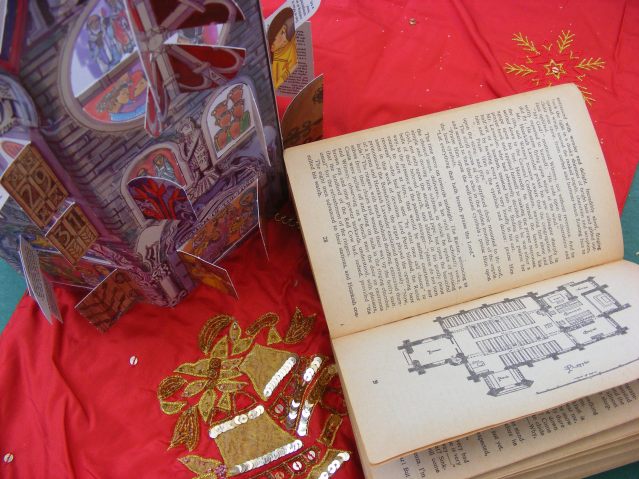
Detective stories often oblige the reader with a plan of important locations. My copy of The Nine Tailors has three: the two showing roads and drains, and the church:

dscf8075

They’re particularly useful in detective fiction because they allow readers to follow the action and authors to make sure that all the characters are in the right place at the right time. Some people use them to make a fictional location seem more real. But Fenchurch St Paul feels quite real enough already.

Books referred to in this post

Framley Parsonage, Anthony Trollope

The Nine Tailors, Dorothy L. Sayers

ABCDEFGHIJKLMNOPQRSTUV

#indiechallenge – 119: my life as a bisexual Christian (Jaime Sommers)

dscf8070

The blurb

As a bisexual Christian woman, happily and faithfully married to a man, a mother of three children and with a blossoming ministry as a preacher, Jaime Sommers had always felt as if her true self did not really exist in the eyes of the Church. She could find neither theology nor pastoral support for a person who felt the need for physical closeness with both sexes in order to feel well or ‘whole’.

Following a brief, isolated incident in which Jaime kissed another woman, the full extent of the Church’s inability to acknowledge or understand her identity became apparent. The disciplinary process to which she was subjected led to her suffering depression and anxiety and feelings of isolation.

Jaime’s powerful and emotive story reveals the failure of the Church – and of large parts of wider culture and society – to recognise and support the experience and needs of those who identify as the silent ‘B’ in LGBT.

The publisher

Darton Longman Todd is an independent Christian publisher, specialising in books for the awkward squad. (I’m paraphrasing their ‘About‘ page there. I am myself a proud member of the awkward squad and have an essay in Our Witness, published by DLT.)

The bookshop

I bought this in Gay’s The Word, a long-established independent London bookshop (not far from my office, to the great detriment of my bank balance).

The bingo card

There are quite a few squares that this one could be filed under. ‘A book from your TBR’. ‘Biography’. ‘Marginalised people’. ‘Non-fiction’. ‘LGBTQIA’. Even ‘A debut’. I’m going to see what else I end up reading before I decide where to put this.

My thoughts

The ‘119’ of the title refers to the 119 words granted to the subject of bisexuality in the Church of England House of Bishops’ Issues in Human Sexuality. Those are 119 words that I’ve ranted about myself before now, and this book resonated. The early parts, dealing with Sommers’ childhood, adolescence and university years, felt a little incoherent and self-conscious, but when Sommers begins to address the crisis that forms the greater part of the book all that falls away, and she recounts the events with an honesty and clarity that roused my anger and kept me reading. Because yes, this is what it feels like:

It was very clear that they had absolutely no idea what to do with me. I wasn’t gay, but I wasn’t wholly straight. My marriage was not in trouble and my husband was supportive of my sexuality. I did not fit a single box they sought to put me in. In short, I was an inconvenience – and a major one at that.

I don’t experience bisexuality in quite the same way that Sommers seems to – for me, it’s more like a dormant but undeniable sense of possibility, the knowledge that, regardless of the gender of my current partner, my next one (if there is a next one) could be of any gender. But the consciousness of all that being erased, looked past, ignored, because one looks like a straight married person – I recognised all that. And realised how very fortunate I’ve been not to have come up against the Church’s misunderstanding of it in such a destructive manner.

In some ways, ‘119’ feels like a slightly irrelevant title. This book challenges Issues in Human Sexuality, yes, but it’s much more than that; it’s a personal account of how the system failed an individual; it’s representative of the failure of a whole system to recognise and provide for a whole group of people within it. Having said that,  the title does highlight how criminally inadequate the current thinking is.

… what is missing in the bisexual Christian’s life is the ability to hold a bisexual identity – and a clear sense of personal identity is imperative to mental health. Bisexuality is largely invisible in church publications and doctrinal debate and support for bisexual issues are missing in our churches and faith communities. It is as if we don’t really exist, that we are just a figment of our own imagination.

People forget about us, particularly when we can be slotted neatly into the ‘married’ box. I’m glad this book exists, because it must go some way towards stopping people forgetting.

2019 reading: #indiechallenge

indiechallenge

I remain committed to my principle of reading whatever the hell I feel like, but I liked the look of this challenge and I think it’s compatible with it. It will be interesting to see what the balance between books from small presses and self-published books ends up looking like. My instinct is that I’ll pay more attention to self-published books, for fear of being bitten by imprints; on the other hand, I’d like to put less business in the way of Amazon this year, and more in the way of independent bookshops.

I’ll be posting brief write-ups on this blog, but if I don’t have anything nice to say about a book I won’t say much at all.

There’s a bingo card:

indiechallengebingo

It would be very poor business practice not to point out that I have two books that are eligible for this challenge.

I can potentially help with the following squares:

  • A debut. Speak Its Name was my first book.
  • An award winner. It was the first ever self-published book shortlisted for the Betty Trask Prize, and that’s one of those lovely prizes where just being on the shortlist means you come away with an award.
  • Book that defies genre. Speak Its Name is LGBT university-set Barchester. A Spoke In The Wheel is… belated coming-of-age? Redemption? Maybe romance, if you look at it sideways? I tend to stick them both under ‘contemporary’ and dodge the question.
  • Out of your comfort zone. Depends on where your comfort zone lies, really. You may run screaming from Christian politics, and I really couldn’t blame you. I will say that a lot of reviews of A Spoke In The Wheel have led with ‘I know nothing about cycling, but…’
  • LGBTQIA. Both of my books feature queer characters in prominent roles (two bisexuals, a lesbian, and I’m still not sure about Gianna). If you want head-on engagement with the space where faith meets sexual orientation, try Speak Its Name. If you want a happy background f/f relationship, go for A Spoke In The Wheel.
  • Marginalised people. See LGBTQIA above, and there’s also Polly in A Spoke In The Wheel, who has a chronic illness.

I also have a short story in Supposed CrimesUpstaged: an anthology of queer women in the performing arts, which is:

  • an anthology

There’s only one of me, and I’m a woman, so you could make a case for my being both:

  • A Women’s Press

and:

  • a micro press

If you’ve never heard of me, I’m:

  • a new to you press

And, if you’re not from the UK, I’m:

  • an author from another country

Finally, of course, there’s the old favourite:

  • free square


Now to see what’s already on my bookshelves that will count towards the challenge… Whatever you’re intending to read, I hope 2019 has many good books in store for you!

December Reflections 28: new book

DSC_0318

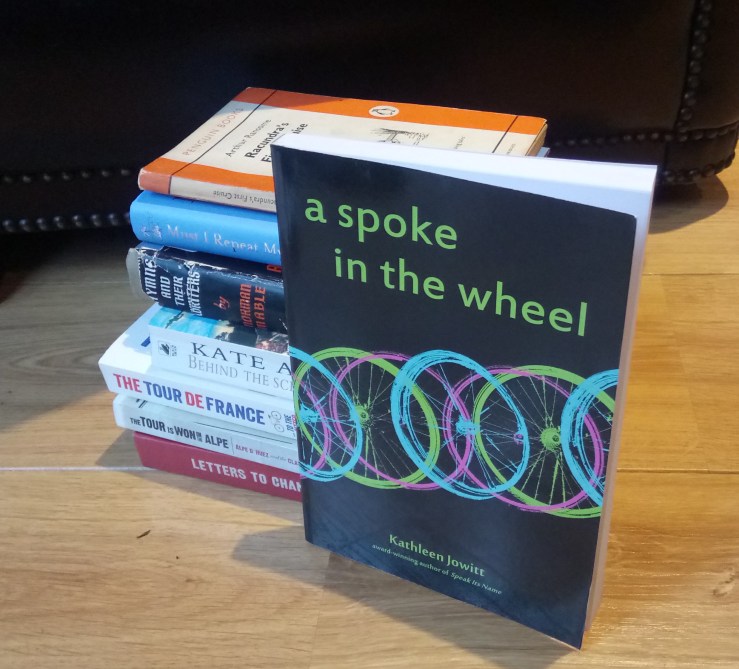
I suspect the prompt is really looking for ‘a book you received as a gift recently’, or ‘a book you picked up in the sales’. I was given a delightful selection of books for Christmas: see the picture. I’m most impressed by my youngest brother’s having found an orange Penguin edition of Racundra’s First Cruise.

But yes, I do happen to have a new book out this year. A Spoke in the Wheel appeared in May, after a lot of wibbling about whether it was going to be as good as the last one, and has been trundling along gently ever since. It hasn’t set the world on fire, but it’s had some decent reviews. Cycling friends have found it convincing and respectful. So have disabled friends. Sometimes I think it isn’t as good as the last one. Sometimes I think it’s better. Mostly I think I did with it what I wanted to do, and that really is as good as it gets, when it comes to books.

December Reflections 6: best book of 2018

DSC_0217

It’s been another year of ‘reading what I happen to feel like reading‘, an approach which I recommend. Ceasing to feel guilty about the books that I have or haven’t read has been one of the best decisions of my life. Before I set off on my InterRail trip, I asked people to recommend me books that they had enjoyed, and then loaded up my e-reader with the results. I also downloaded a lot of free stuff from Project Gutenberg. More recently, I’ve been reading and re-reading books with particularly convincing imaginary locations, for my Reader’s Gazetteer series.

I’m amused to note that my top three this year have strong f/f themes, which in some ways is very representative of my reading habits, and in other ways leaves a lot out. But there we go.

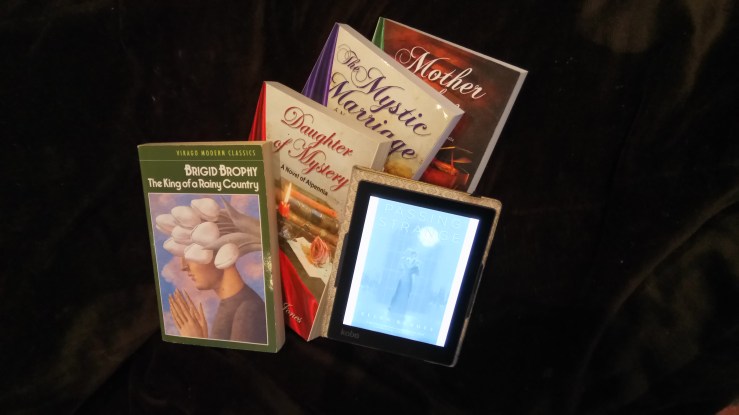
I’ve already written about Heather Rose Jones’ Alpennia series, and why I enjoy it so much. In fact, I have read the three main books twice within the space of this year, a habit which I thought had gone the way of long school holidays. I’ll repeat what I said before –

If I’d written a wishlist of all the tropes and themes that I most enjoy reading, and handed my specifications over to an author, I couldn’t have liked the result better than I like this. The series contains nights at the opera, women in breeches, swashbuckling, politics both national and ecclesiastical, relationships between women, and a sensitive portrayal of religious experience. And a fictional state somewhere in Europe. –

– and add that I’m very grateful to the person who recommended it based on my enthusiasm for The Prisoner of Zenda.

The King of a Rainy Country (Brigid Brophy) is a book that I’ve had on the bookcase for ages (I was almost certainly drawn to the Virago green spine in a charity shop) and hadn’t got around to reading. It turns out to be a wistful, regretful, funny novel with moments of sheer beauty, in which a young woman drags the young man she isn’t really in a relationship with around Italy in search of the girl she had a (reciprocated) crush on at school.

But I think my favourite book of 2018 was Passing Strange by Ellen Klages. It was one of the ‘InterRail recommendations’ acquisitions – in fact, one friend recommended it, and another chipped in to say how much they had liked it. This was a short book based in San Francisco in 1940, with a convincing evocation of the lesbian scene, and magic applied with a very light hand. I loved it.

My least favourite book, incidentally, was The Way We Live Now, in which I hated everybody except the American adventuress, and was horrified by the anti-semitism. I only kept reading to see who was going to end up marrying whom.

The Reader’s Gazetteer: D

DSCF7900

D and E will both feature books from John Buchan’s Dickson McCunn series. I’m not going to apologise for this: I can think of few authors who are so good at landscapes, either real or imaginary, and, if you don’t know the place yourself, it’s difficult to tell where the seam is between the two.

D is for Dalquharter, but it’s interesting to see how Dickson McCunn gets there. He starts in Glasgow – real enough – and takes a train.

A little after midday he descended from a grimy third-class station whose name I have forgotten. In the village near-by he purchased some new-baked buns and ginger biscuits…

We’re already in imaginary countryside. Dickson stays overnight in a village called Cloncae, which Google optimistically suggest might be an anagram of ‘Conceal’, and passes through Kilchrist, which also seems to be fictional. Then he reaches Kirkmichael, which might or might not be this village, and spends the night at the Black Bull before setting out again:

Westward there ran out a peninsula in the shape of an isosceles triangle, of which his present high-road was the base. At a distance of a mile or so a railway ran parallel to the road, and he could see the smoke of a goods train waiting at a tiny station islanded in acres of bog. Thence the moor swept down to meadows and scattered copses, above which hung a thin haze of smoke which betokened a village. Beyond it were further woodlands, not firs but old shady trees, and as they narrowed to a point the gleam of two tiny estuaries appeared on either side. He could not see the final cape, but he saw the sea beyond it, flawed with catspaws, gold in the afternoon sun, and on it a small herring smack flapping listless sails.

And then he gets the map out:

The peninsula was called the Cruives – an old name apparently, for it was in antique lettering. He vaguely remembered that ‘cruives’ had something to do with fishing, doubtless in the two streams which flanked it. One he had already crossed, the Laver, a clear tumbling water springing from green hills; the other, the Garple, descended from the rougher mountains to the south. The hidden village bore the name of Dalquharter, and the uncouth syllables awoke some vague recollection in his mind.

By this point I’m very happily convinced. I’ve had my railway journey (and some extra trains), I have a reasonable idea how I’d get there from the real world, and I have been shown the map.

Dickson encounters a poet, John Heritage, who he’s been avoiding, and they speculate about Dalquharter and Dickson’s psyche before heading towards the village.

In front of groves of birch and rowan smoked the first houses of a tiny village. The road had become a green ‘loaning’, on the ample margin of which cattle grazed. The moorland still showed itself in spits of heather, and some distance off, where a rivulet ran in a hollow, there were signs of a fire and figures near it…

… There were not more than a dozen whitewashed houses, all set in little gardens of wallflower and daffodil and early fruit blossom. A triangle of green filled the intervening space, and in it stood an ancient wooden pump. There was no schoolhouse or kirk; not even a post-office – only a red box in a cottage side. Beyond rose the high wall and the dark trees of the demesne, and to the right up a by-road which clung to the park edge stood a two-storeyed building which bore the legend ‘The Cruives Inn’.

And we’re off. Up until now, Dickson was on holiday; from here on it, it’s an adventure. And this, I think, is why the McCunn stories are my favourites. I don’t have mysterious men getting murdered in my London flat, and I don’t get recruited for spying missions. But I do go on holiday. I haven’t had a holiday turn into an adventure as yet, though there was that time I found myself in Vienna, explaining to an opera singer how to go about organising a strike…

Come to think of it, that’s probably John Buchan’s fault, too. More on that next time.

Books referred to in this post

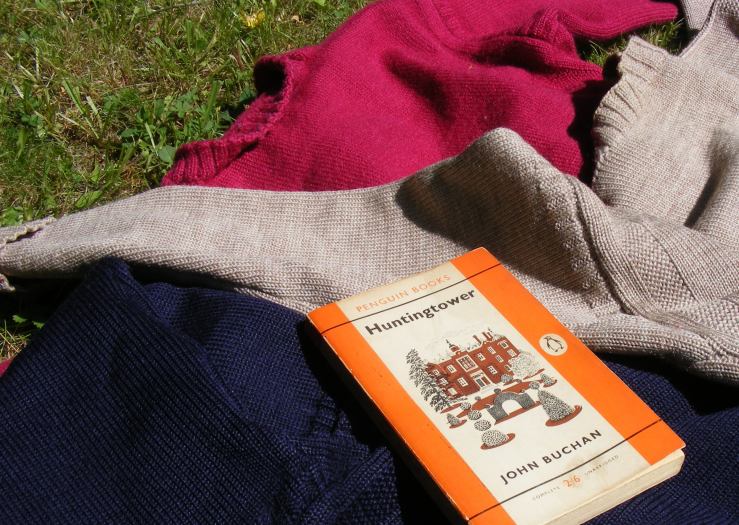
Huntingtower, John Buchan

ABCDEFGHIJKLMNOPQRSTUV

The Reader’s Gazetteer: C

DSCF7944

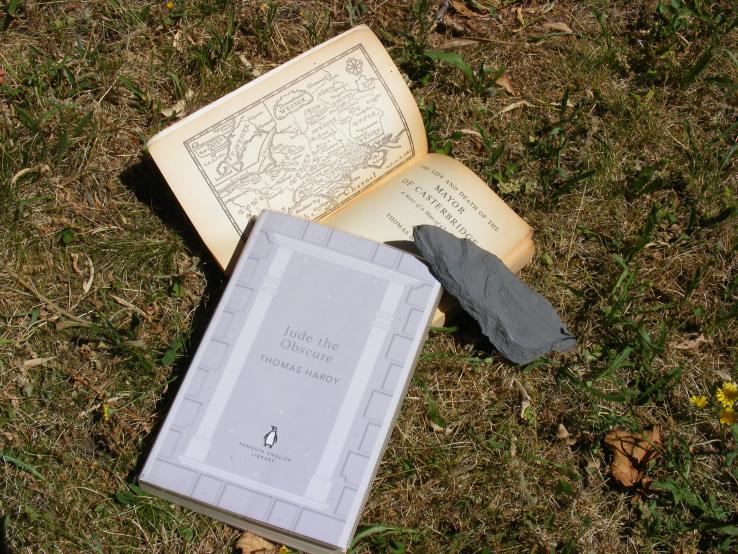
Thomas Hardy makes it easy.  Casterbridge, Christminster, you’ll find them on the map inside the front of every Wessex novel. And you can lay the map of Wessex down over the map of south-west England and work out how to get to any of these places. At least, you could, if they were real. Which they sort of are, and sort of aren’t. Hardy calls Wessex “a merely realistic dream country”, or so Wikipedia tells me.

There’s a lot of travelling in Hardy’s books, whether it’s emigrating to Canada or going to market. People come from places and they go to places; they pass through places on their way. And the landscape is vividly described, and feels coherent:

So, stealing out of the hamlet he descended into the same hollow which had witnessed his punishment in the morning, never swerving an inch from the path, and climbing up the long and tedious ascent on the other side, till the track joined the highway by a little clump of trees. Here the ploughed land ended, and all before him was bleak open down.

Not a soul was visible on the hedgeless highway, or on either side of it, and the white road seemed to ascend and diminish till it joined the sky. At the very top it was crossed at right angles by a green ‘ridgeway’ – the Icknield Street and original Roman road through the district. This ancient track ran east and west for many miles, and down almost to within living memory had been used for driving flocks and herds to fairs and markets. But it was now neglected and overgrown.

From this, and other passages through the Wessex novels, one might almost be able to put the map together without knowledge of the real-world equivalents or a sight of the map of Dorset and Hampshire, Somerset and Berkshire and Oxfordshire and Devon.

Here are Susan and Elizabeth-Jane Henchard approaching Casterbridge:

‘What an old-fashioned place it seems to be!’ said Elizabeth-Jane, while her silent mother mused on other things than topography. ‘It is huddled all together; and it is shut in by a square wall of trees, like a plot of garden ground by a box-edging.’

Its squareness was, indeed, the characteristic which most struck the eye in this antiquated borough, the borough of Casterbridge – at that time, recent as it was, untouched by the faintest sprinkle of modernism. It was compact as a box of dominoes. It had no suburbs – in the ordinary sense. Country and town met at a mathematical line.

To birds of the more soaring kind Casterbridge must have appeared on this fine evening as a mosaic-work of subdued reds, browns, greys, and crystals, held together by a rectangular frame of deep green. To the level eye of humanity it stood as an indistinct mass behind a dense stockade of limes and chestnuts, set in the midst of miles of rotund down and concave field. The mass became gradually dissected by the vision into towers, gables, chimneys and casements, the highest glazings shining bleared and bloodshot with the coppery fire they caught from the belt of sunlit cloud in the west.

From the centre of each side of this tree-bound square ran avenues east, west, and south into the wide expanse of cornland and coomb to the distance of a mile or so.

And then we enter the town itself, and the impressionist bird’s-eye view resolves into detail, and the plot gets going. The social geography is slotted into the physical geography; we learn who drinks at which public house. Durnover; the market place; Mixen Lane: Casterbridge is very credible.

I’m trying to remember whether I’ve ever been to Dorchester and, if so, whether it looked like that. (Although the narrative explains later that Things Have Changed between the date of the action and the date of writing, so it probably wouldn’t have.) I thought I had, but on reflection I suspect I was thinking of Bridport.

I have, however, definitely been to Oxford. Here’s Jude Fawley’s first sight of Christminster:

Some way within the limits of the stretch of landscape, points of light like the topaz gleamed. The air increased in transparency with the lapse of minutes, till the topaz points showed themselves to be the vanes, windows, wet roof slates, and other shining spots upon the spires, domes, freestone-work, and varied outlines that were faintly revealed. It was Christminster, unquestionably; either directly seen, or miraged in the peculiar atmosphere.

Even without the map, even without the clue of the name (Oxford’s cathedral – ‘minster’ – doubles as the chapel of Christ’s College) it’s easy to make the connection with the ‘dreaming spires’ of cliché.

How to get there? A little find+replace, together with traveline.info, makes it easy enough. For Casterbridge, take the train direct from London Waterloo (ultimate destination Budmouth); alternatively, go from Paddington and change at Castle Cary or Westbury (again to a train heading for Budmouth). For Christminster, take the direct train from London Marylebone – or go from Paddington again, changing at Aldbrickham this time.

Other Cs on the map of Wessex are Chalk Newton, Chaseborough, Cliff Martin and Cresscombe, but they’re only bit players, mentioned in passing if at all.

You might ask why I’m using Casterbridge and Christminster now, rather than waiting for W for Wessex. The truth is, I’m not really convinced by the whole of Wessex as an entity, even broken up into North and Upper and Mid and South and Outer and Lower, but I can believe in the individual towns and villages, and the landscapes around and between them. Plus, C comes a lot earlier in the alphabet…

DSCF7946

That ammonite came from Charmouth, which does not have a Wessex equivalent, but is the right neck of the woods.

Books referred to in this post

The Mayor of Casterbridge, Thomas Hardy

Jude the Obscure, Thomas Hardy

and the other Wessex novels

ABCDEFGHIJKLMNOPQRSTUV

The Reader’s Gazetteer: B

DSCF7892

Of course it has to be Barchester. Other fictional Bs that come to mind are bit-part players: Borduria in Tintin, or Belsornia in the Chalet School series. But Barchester is one of the big ones. In terms of its significance, that is; the whole point of it is that it isn’t exactly a bit city.

Anthony Trollope is a little bit vague about the precise location of Barchester at the beginning of The Warden:

The Rev. Septimus Harding was, a few years since, a beneficed clergyman residing in the cathedral town of ––––; let us call it Barchester. Were we to name Wells or Salisbury, Exeter, Hereford, or Gloucester, it might be presumed that something personal was intended; and as this tale will refer mainly to the cathedral dignitaries of the town in question, we are anxious that no personality may be suspected. Let us presume that Barchester is a quiet town in the West of England, more remarkable for the beauty of its cathedral and the antiquity of its monuments than for any commercial prosperity; that the west end of Barchester is the cathedral close, and that the aristocracy of Barchester are the bishop, dean, and canons, with their respective wives and daughters.

But that doesn’t matter; it’s all we need to get the story going. In The Warden, it’s the personalities and politics that drive things: the close, the clergy, the councillors.  Trollope shows us a city that’s been minding its own business, getting along quite happily in its own way, sorting out or ignoring its petty troubles and corruptions – until someone comes in from outside and shakes it all up. And ‘outside’ means, of course, ‘London’. John Bold, the reformer, is a Barchester man, but he has been away to London and come back again with ideas:

His passion is the reform of all abuses; state abuses, church abuses, corporation abuses (he has got himself elected a town councillor of Barchester, and has so worried three consecutive mayors, that it became somewhat difficult to find a fourth), abuses in medical practice, and general abuses in the world at large.

In very broad terms, Barchester just has to not be London, and to be influenced by the events and people (Tom Towers, for example) that happen in or come from London. Nothing more than that is necessary, and, broadly speaking, that’s all we get. There is, however, one mention of a London terminal, and that terminal is Paddington.

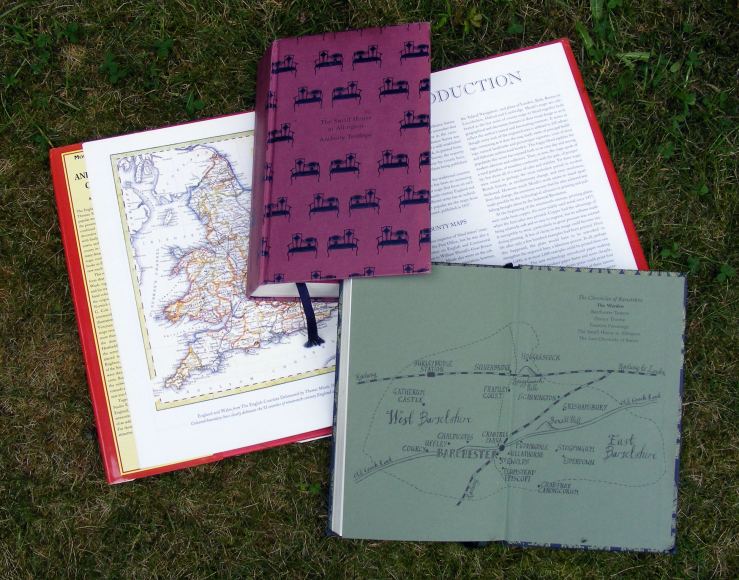
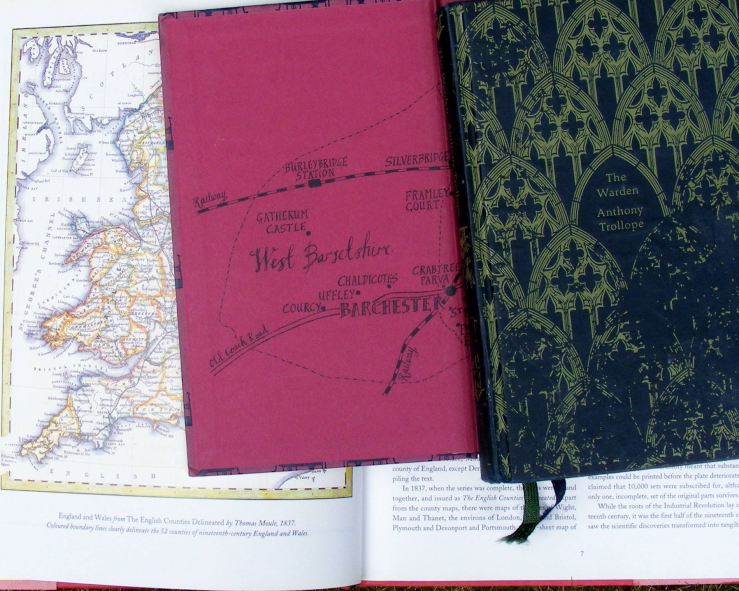
As we work our way through the series, the location stabilises. We travel further afield around the city of Barchester. The internal geography of Barsetshire emerges, and is sufficiently consistent for the folk at Penguin to have produced the map on the endpapers of the Penguin Classics edition in the photograph. We learn in Framley Parsonage that Exeter exists in this universe, and so can’t be Barchester. Then, in The Small House at Allington, Johnny Eames also goes to London, and also arrives at Paddington. That puts Barchester firmly on the Great Western Railway, and certainly rules out Salisbury.

DSCF7893

(These were library copies, and it took me a while to realise that the disintegrating Gothic tracery on the cover of The Warden was down to wear and tear, rather than a comment by the cover designer. One could certainly read some symbolic significance into that…)

In my head Barchester lies south of the Severn rather than on it, but that might just be because I first read The Warden when I was at university in Exeter. Hereford just feels far too far north. The real-life scandal that inspired the plot of The Warden happened, of course, at Winchester: Hiram’s Hospital bears a remarkable similarity to the hospital of St Cross (where, oddly enough, I was baptised rather more than a century later). The reader will notice that Winchester is not mentioned at the beginning of The Warden. Then again, it’s even more hassle to get to from Paddington than Salisbury.

Later in this series I’ll be examining other cathedral cities, and I’ll be speculating just what it is about the West of England that makes it so attractive to the constructors of fictional towns. In the meantime, however, it’s only right to salute Anthony Trollope and the one that, in many ways, started it all.

Books referred to in this post

The Warden, Anthony Trollope

Framley Parsonage, Anthony Trollope

The Small House at Allington, Anthony Trollope

King Ottakar’s Sceptre, Hergé

various Chalet School titles, Elinor M. Brent-Dyer

ABCDEFGHIJKLMNOPQRSTUV