Late to the #IndieAthon party

indieathon-9

On Monday my mother texted me to say ‘Looks like ASITW is very timely’. I texted back to say, ‘Haha, it always is’, and felt slightly smug about being with it for once.

Yesterday I looked at Twitter and discovered that I’d missed a good thirty per cent of an initiative that’s very relevant to my interests, as they say, and now I feel less smug.

#IndieAthon is a month-long celebration of self-published authors and small presses. The organisers have this to say:

Throughout the month you can read however many books you want, not all of them have to be for the readathon of course, but the goal is to read as many indie-published or self-published books as you want! The only limitation to what you can read is that it has to be either self-published or published by a small or independent publisher to count for the readathon. The books can be old, new, popular, unpopular, fiction, non-fiction, anything!

We also would really like you to post reviews of the books you read on Goodreads, Amazon and wherever else you want to post it! Reviews are so important for authors, and especially for smaller authors it can make a huge difference!

There’s a bingo card and everything!

So, hello, #IndieAthon, here I am, sneaking in through the back door, hanging my coat over a chair, grabbing a drink from a tray, and pretending I’ve been here all along.

Um. Er. Yes. Hello. I’m Kathleen Jowitt, and my book Speak Its Name* was the first self-published book ever to be shortlisted for the Betty Trask Prize. I’m in the middle of preparing my second novel, A Spoke in the Wheel, for publication, and that’s my excuse for not having looked at Twitter properly all month.

I’m self-published and very glad of it. Why? One word. Freedom. Self-publishing gives me the freedom to do my own thing, and to do my own thing at my own pace. I’m only answerable to myself. I don’t have to worry about whether anybody actually wants to read a book about a Christian lesbian university student finding her way out of the closet, or, if they liked that, whether they’ll then be interested in a disgraced professional cyclist.

I don’t have to please other people to get my book into print. I just have to put the work in myself. I’m free to experiment, to tell the stories that nobody else tells.

And I’m free to do my own thing at my own pace. I’m the only person who gets to set me deadlines. If I decide that something needs an extra six months’ work to get it really good, I’m free to put those six months in. Conversely, if I have a spare couple of hours and I want to get going on the back cover copy or the front cover design, then I can do that. I don’t have to wait on decisions from anybody else.

Sometimes it’s a scary thing, this freedom. It means taking responsibility for every little thing. Every word that makes it into the finished book is there because I put it there, and it stays there because I didn’t take it out. I can – and I do – ask other people to read for inaccuracy and insensitivity, but the decision whether or not to respond with changes remains with me. The cover, typesetting and formatting, are exactly as good as I can get them.

Any errors or infelicities remaining, as it says on my acknowledgements page, are my own. But I wouldn’t have it any other way.

Reflecting life: the Staunch Prize and writing honestly

2014 June July 153

There’s been a little bit of controversy this week around the new Staunch prize for thrillers where ‘no woman is beaten, stalked, sexually exploited, raped or murdered’. And about time, says one side of the argument. For too long, lazy writers have been fridging women for the sake of a cheap plot point, and exploitative writers have been using violence against women to titillate male readers. The other says, No. Writers need to be free to explore and subvert difficult themes. Women should not be told that their own experience is off-limits.

As a reader, I can see myself falling on either side of the fence depending on my mood. It might be quite nice to read a book in the knowledge that it’s safe to get attached to the female characters. On the other hand, if I pick up a book knowing that a character, or several characters, must get to the end of it alive because otherwise it wouldn’t have been eligible for this prize, that would spoil the suspense a little.

‘Does a woman die in this?’ is a bit of a blunt instrument, but then so is any means of categorizing books.

As a writer, I don’t have a horse in this race. The books that might possibly end up being eligible for this prize are third and fourth in the ‘to write’ queue, so we won’t be seeing much of either of them for a good five years, I’d have thought – by which point this prize will have become well established, or else have disappeared entirely.

I don’t really see much point in getting upset about this. Establishing a prize for books that don’t include one particular plot point doesn’t stop anybody writing that plot point, it just stops their book being entered for that prize. I’m sure that 2018 and 2019 will see just as many dead women on the bookshelves as previous years, and that many of those books will still engage with the question in a thoughtful or angry manner. If we start to see an increase in people arguing that the only right way to write something is not to write it, that’s when I’ll start getting worried.

No prize is for everyone. I’m not just talking about criteria that restrict entry according to age or whether one’s been published before. Most prizes are out of bounds to me because of my self-published status (and it’s an absolute delight to find one that isn’t). What I mean is, not every book will be suitable for every prize. In 2007 I thought briefly about entering (a very embryonic version of what eventually became) Speak Its Name for a Scripture Union writing competition in memory of Patricia St John. I’ll pause here for you to read up on Scripture Union and Speak Its Name. And then laugh.

No, there’s no point in my getting irritated by a prize that I’m not going to enter. It does raise a more interesting question, though. How do we respect our own and others’ experience? How do we give an honest portrayal of the problems that a [member of a marginalised group] is likely to encounter without giving the impression that being a [member of a marginalised group] is wall-to-wall awfulness? Where is the line between representation and exploitation? Can we say that we’ve dealt with enough of all this bullshit in the real world and just give ourselves a night off?

This is something that I’m thinking about quite a lot as I work through the final edits on A Spoke In The Wheel, and as the sequel to Speak Its Name unfolds itself in my mind. How do I show the grinding misery that is the modern British benefits process without buying into damaging assumptions about what makes life worth living for disabled people? How do I show Lydia engaging with the institutional homophobia of the Church of England and its vocations process (yes, we’re going there) without undermining her integrated identity as a lesbian Christian? It is something that I think about as I watch Yuri!!! on Ice, where homophobia just doesn’t exist, and as I read Check, Please!, where homophobia exists but never touches our heroes, and the ways that those work and don’t work for me.

I’m still thinking, and still writing, and really, the best answer that I can come up with is that no single book is going to do this. We need the escapist books that can be opened in the confidence that everybody’s going to be OK. We also need the books that expose the awful things that people do to other people. We need the books in the middle, where we know that awful stuff will happen or might happen, but that the characters we love will come through somehow. That middle space is where my books – or at least the ones that have emerged so far – sit, and all I can do is write them the best I can. And, so far as I’m concerned, people are very welcome to establish prizes for any of them.


Many places we don’t know

DSCF9842
A familiar London landmark

Here is what two thirty-something-year-olds, who have spent a lot of time in many various types of churches and who have often travelled into London by rail, sound like watching the last two episodes of Around The World With Willy Fogg:

– King’s Cross? From Liverpool?

– Westminster Cathedral? Really?

– Well, this is a Spanish programme. Maybe they’ve decided he’s Catholic.

– Why is he wearing vestments in the street?

– At least they’ve got the colour of the stole right.

– No, that’s Westminster Abbey. They’re just wrong.

You may well point out that the hero of Around The World With Willy Fogg is a lion who wears a top hat, and that’s a fair point. This is children’s television, and one might as well put the increasing price of stamps  down to the fact that Postman Pat now has a two vans, a motorbike, and a helicopter as expect logic. But sending the Liverpool trains to King’s Cross requires me to believe not only in a world where animals wear clothes, but also in one where all the northbound trains leave London from one sole station. Which would make much more sense than the real world, but there we go. Actually, thinking about it, I can’t fault Willy Fogg’s decision to avoid Euston. It’s one of my least favourite stations, ahead of Birmingham New Street and only slightly behind Gatwick Airport.

One of the other eyebrow-raising things about Willy Fogg was the way that Fogg’s acquaintances at the Reform Club seemed to know about his movements almost as soon as he does. This despite the fact that the action is set during a period of history where news cannot travel across the sea any faster than a human (or a top-hat-wearing lion) can. I can give Willy Fogg a pass on this one, but I’m less indulgent when Joseph O’Connor makes the same mistake in Star of the Sea.

We all have our own areas of expertise, our own sensitivities, our own knowns that may well be authors’ unknowns. And so, when a character is meant to know more about a particular subject than their author does, and when a reader knows more than the author, any mistakes are likely to come to the surface.

Apart from how to get to the North West and the difference between Westminster Abbey and Westminster Cathedral, I know enough about the career of Kathleen Ferrier, for example, to know that she was singing the role of Orpheus when she broke her leg on stage, not Eurydice, as Rose Heiney assumes in The Days of Judy B.. And that wouldn’t be a problem, except for the fact that it’s Judy B.’s singing teacher, who really ought to know better, who says that. I know enough about the Church of England to know that it’s unlikely that a bishop would wear a ‘soutane’ to a secular function, as Kate Lace assumes in The Chalet Girl, and very unlikely that he’d call it that.

I know enough to know that I’ve almost certainly missed something myself.

And so, as I wait for the edits to come in on A Spoke In The Wheel, I am nervous. I am nervous about what I may have got wrong about professional cycling and about disability benefits and about how flood defences work. I am nervous about what I may have got wrong about the road to Preston and about doping and about working for a charity. I am nervous about what other people will see that I cannot.

Where possible, I have asked people who know more about those things than I do to read the manuscript and advise me, but I know that it’s inevitable that something is still going to slip through the gaps. I can only hope that it’s not going to be something too embarrassing.


Down the rabbit hole: reading in 2017

tintin

I’ve read some great books this year. In fact, I can’t remember enjoying a year’s reading so much since I was a teenager. I started out with a whole lot of comfort reading to get me through the New Year virus and the associated sleepless nights (fanfic; the Richard Hannay series), and… kept on with the comfort reading. No, not necessarily comfort reading. Some of it was distinctly uncomfortable. But this year I’ve read far more things just because I wanted to read them.

I picked things up because they were old favourites that I wanted to revisit (White Boots), or because I’d heard of them years ago and had always meant to get around to reading them (The Towers of Trebizond), or because someone gave them to me (A Good Hiding), or because someone mentioned them in passing on something totally unrelated and I liked the sound of them (The Hare with Amber Eyes). I read some new things by authors whose work I’ve enjoyed in the past (Trouble for Lucia and Meet Me at Beachcomber Bay), and I experimented with some new authors (Four Steps).

This year I read thrillers (The Spy Who Came In From The Cold) and mysteries (The China Governess). I read fanfic (Blackbird). I read memoir (The World of Cycling According to G) and biography (though I’ve yet to reach the end of the giant Rudolf Nureyev one). I read chicklit (To the Moon and Back). I read literary criticism (Literary Allusion in Harry Potter). I read children’s books (Alice’s Adventures in Wonderland and Through the Looking Glass). I read non-fiction. I read poetry (Listen to the Green; Four Quartets; Measured Extravagance).

I read fewer things for motives of self-improvement (La Dame aux Camélias). I read a couple of things just to get them off my shelves (Mulligan and The Widow). Next year I’d like to get more things off my shelves without reading them.

I followed rabbit holes and felt less guilty about enjoying what I read (pretty much everything, but particularly the Victorian and early twentieth century British stuff). I think I’ll write more about that tomorrow. The only book that I deliberately abandoned was Snuff – to my mind it’s the point in the Discworld series where the quality takes an obvious and understandable turn for the worse, and I just couldn’t bear to keep going with it. I may also give up on Will Grayson, Will Grayson before the year’s out, because I’m finding the chapters without capitalisation rather an effort to read.

Last year I decided not to bother recording my reactions to books, and just wrote down what I actually finished. This strategy continued to work this year, and I find that the memorable ones are memorable and the rest of them aren’t, and my reactions don’t make much difference, really. And then of course there are the books that are enjoyable but not memorable, and looking back at previous years’ records I can’t actually tell the difference between those and the books that I was pretending to enjoy because I thought I should.

I’ve finished sixty-six books so far, and will probably get a couple more in before the end of 2017. (Last year I managed seventy-eight, but more of those were things that I Felt I Ought To Read, either for self-improvement reasons or because I’d got them free and felt I should get my money’s worth… yeah.) Most of my reading time was on the train, with a little bit at lunchtimes or bedtimes.

I think this year I’ve come to understand that I’m not reading for anybody else – not for friends, not for colleagues, not for my own readers or even for my future self. I’m reading for me, now.

It’s fun.

Ways to help your author friend sell a book

2013-07-02 12.18.05
Pass it on

Assuming, of course, that this is something that you want to do. Many of my friends have very little interest in my book, and this is absolutely fine. We are friends because we have a shared interest in something totally different. These tips are only for people who actually want them!

Talk about it

Not in an ‘I’m my friend’s unpaid salesperson’ way, because that’s a very good way to lose all your other friends, but just in a natural, ‘if we’re talking about books, my friend wrote a book [and it got published/won a prize/got a good review]’ kind of way. Word of mouth is a wonderful thing. Nobody can want to read a book if they haven’t heard of it. You get to brag about your author friend. Your author friend gets someone else hearing about their book. Apart from anything else, it builds credibility. The more people who talk about them as an author, the more seriously they get taken.

And by ‘talk’, of course, I also mean ‘Tweet, post about on Facebook, include in shelfie picture on Instagram, leave casually on coffee table when expecting company, etc’.

Lend it

This one divides opinions among authors. There is a school of thought that says that every book lent is a sale lost. I don’t agree with that. As a reader I can point to dozens of books that I’d never have bought at full price, but which I came across some other way (book swap shelf at work/charity shop/lent by my mother/Bookcrossing.com) and which I loved so much that I went on to seek out more by the same author.

As an extreme example, I know someone who shoplifted his first Discworld book – then bought all the rest of them full price. I don’t actually recommend this course of action, but it does go to show… something.

Anyway, if you buy my book and then lend it to someone else, I won’t mind at all.

Order it

Ask your library to get it in for you – then it might reach other people when you’ve finished it and taken it back. Authors do receive a small amount of money when their books are borrowed from libraries.

Or you can order it from a bookshop, and if bookshops get the idea that this is something that people want to buy, they might start stocking more copies, and other people might then see it and buy it. Well, we can dream.

Give it

Only to people you think might like it, obviously. Books can be surprisingly tricky presents, but, depending on the book and the occasion and the recipient, they can work well.

I’d recommend mine for: the person who’s about to go to university; the person who is simultaneously LGBT and Christian; the person who would benefit from knowing that LGBT Christian people exist; the person who likes Catherine Fox’s books. Extrapolate for the book that you have in mind. (You might have to read it first. You might not.)

If you’re fed up with having your own copy knocking around the house, then by all means give it to a friend or a jumble sale or charity shop. See ‘Lend it’, above, for my rationale on this – and if you want my opinion on which particular charity shop to give it to, see this post and extrapolate for your own home town.

Review it

The more (honest, balanced) reviews a book gets, the more credible it becomes. And for those of us who don’t get into the Times Literary Supplement, reviews by real people are particularly valuable. Review it on your blog, review it on Goodreads or LibraryThing or Amazon.

Nobody quite knows how Amazon works, but I have seen a hypothesis that if an author reaches a certain number of reviews, they start popping up in the ‘Customers also bought items by’ recommendations. (Authors currently popping up in this manner on my Amazon page are Kate Charles, Winifred Peck, Simon Park, and Kate Charles. I don’t know how many Kate Charles has sold to be there twice, or, indeed, if that’s got anything to do with it at all.)

In this case you really should read it first. Although with some reviews, one does wonder.

Nominate it

This is only really recommended if you have a thick skin, as it is a well-known fact that book clubs can get vicious. Favourite books, and books by favourite authors, can come out shredded. Having said that, selling a dozen copies all at the same time is really exciting for us small-time authors. Maybe nominate it and then stay in bed with a heavy cold when the time comes to actually discuss it? Or perhaps show up at the meeting the far side of several gins?

If you’d rather not be present when it gets shredded, then there are quite a few literary awards that accept nominations from the general public. If you think it merits an award, obviously, but your opinion is as good as anyone else’s. A nomination can make an author’s day. Actually winning something can make their year.

Any more ideas?

I’m sure I’ve forgotten something! Tell me in comments.

No, it *is* about enjoying it

DSCF9908
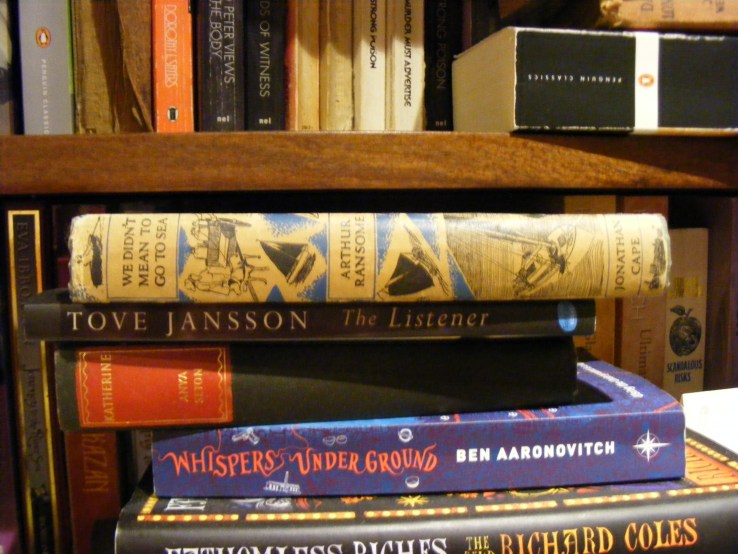
A very grainy photo of some books I’ve enjoyed. You might not enjoy these. That’s fine!

On Thursday I took part in a workshop for union learning reps, exploring ways of promoting reading and writing for pleasure in the workplace. One of the initiatives that they work with is the Reading Ahead challenge – members are encouraged to choose six reads (which could be anything from a haiku to War and Peace) and write a brief review of each of them. The idea is to make reading less off-putting, to demonstrate that it’s for everybody.

One of the ULRs told a story about someone who had managed to put one of her recruits right off joining in the challenge.

‘And what are you reading at the moment?’ he’d asked. She’d told him, had said, a little apologetically, that maybe it wasn’t the most intellectual thing in the world, but she was enjoying it.

‘But it’s not about enjoying it, is it?’ he said. ‘It’s about challenging yourself, learning something new.’

That person was wrong. WRONG.

It is about enjoying it.

I’m going to write that bigger:

It *is* about enjoying it

And if the person who said that it isn’t was the person I think it was, I’m going to tell him so when I next see him.

This person is also wrong, or, at least, missing the point spectacularly. If we try to make people read because it is good for them, they will never enjoy reading. It’s like eating enough vegetables, or getting enough exercise: if you do it because you think you should, you’re constantly fighting with yourself and sooner or later you give up because you just hate yourself so much for making yourself do it.

The world is full of things that we read because we have to. Bills. Textbooks. Contracts. Procedures. They are not fun. Why should we extend that misery to the rest of our reading life?

The more people read for fun – read because they genuinely enjoy it, because they would rather be reading than doing something else – the easier they will find it when they come to reading what’s dull, or difficult, but essential.

Can we enjoy reading challenging material? Of course we can. Personally, I have just downloaded Le Tour du Monde en Quatre-Vingt Jours – yes, in French – which is going to be a challenge, and also something that I will enjoy. As one of my friends says, ’embrace the power of AND’. We can also keep reading things that we’re not currently enjoying in the hopes that we will enjoy them eventually.

But to deliberately seek out things to read that we don’t expect to enjoy… no. No, thank you.

In much the same way as one gets tired of doughnuts very quickly if one eats nothing but doughnuts, it’s unlikely that people will read nothing but [that book you’re thinking of] and [that other book you’re thinking of]. And really, if they did, would that be such a problem?

The more we read – the more we read for pure pleasure – the more we will find our horizons expanding and our tastes diversifying. If we just let people read what they want to read, and keep reading what they want to read, they’ll probably end up reading something that comes up to the exacting standards of the person who terrorised that poor potential Reading Ahead challenge participant.

But that’s not the point. Enjoyment comes first. Life is too short to drag ourselves through things we’re not enjoying just because somebody thinks they’re good for us.

It is about enjoying it. In fact, enjoying it is the most important thing.

Our Witness: the unheard story of LGBT+ Christians

DSCF1171

I’m looking forward to the release of Our Witness: the unheard stories of LGBT+ Christians later this month. As a contributor, I’ve had the chance to glance through the proofs of this collection of personal essays, and I’ve been impressed by the sheer breadth and depth, as well as the honesty, of the content.

Too often, the debate in the Church around gender and sexuality assumes that the question begins and ends with gay men. Lesbians are ignored. The rest of us might as well not exist. Even among allies, there’s a depressing tendency to write ‘LGBT’ in the first line and then revert to ‘gay’ for the remainder of the article/sermon/book, as if that covered everyone’s experience. Terms like ‘gay marriage’ are thrown around with, er, gay abandon. One gets the impression that the middle-aged cis white gay men are the only ones in the Church with any problems.

This book goes a long way to redress that balance. There are stories from gay Christians, yes – but there are stories from lesbian Christians, bisexual Christians, and trans Christians too. I’m in there as The Amazing Invisible Bisexual Christian – the woman who’s been married to a man for getting on for a decade and still stubbornly refuses to forget that she’s queer. There are stories from ordained ministers and from laypeople; from many denominations; there are stories of hurt, and stories of hope.

Some stories are not found in there: how could they be, when there are as many stories as there are LGBT+ Christians? Some will appear in the US version, which is coming next year. Others, of course, won’t. But there are more stories in here than I have ever seen before.

Our Witness: the unheard stories of LGBT+ Christians is published on 29 October by Darton Longman and Todd.

Too many books

2013 September 022-002

There are far more books in the world than anyone could possibly read in their lifetime. There are far more films than anyone could possibly watch, far more songs than anyone could possibly listen to.

I don’t know how old I was when I understood that. I feel that it might have been university, when all my horizons expanded in all directions at once, and I realised that:

  1. I didn’t know everything
  2. I was never going to know everything
  3. I didn’t have to know everything

Before that, the books I knew about were at home, or in the school library, or in the local library. And yes, that was a lot of books, but I always felt that if I really applied myself I could work my way through the whole lot in a logical fashion.

Maybe it was seeing the university library that did it. Who knows? I wish I had one neat moment of epiphany to trot out, but I don’t.

Anyway, once you’ve had that epiphany, what do you do with it?

There are a variety of approaches.

You can read/watch/listen to as many of the books/films/songs as you humanly can. Read every book that your hand touches. My godmother told me once that John Cage said that one should only ever listen to each piece of music once, because there simply isn’t time to do more.

But I know that if I only listen to a piece of music once, I can do little more than nod and smile. In order to really appreciate it, I need to listen to it over and over again, to get right into it. If possible, to perform it, even.

(Probably if I were a better musician, this would be a quicker process for me. A degree in English Literature and a decade plus of creative writing trial and error have enabled me to see how a text is put together without having to think much about it.)

So that suggests an opposite approach: consume very few pieces of art, but really get into them. Re-read, listen over and over, watch again and see what you didn’t pick up the first time, or the second time, or the third time.

The temptation then is to ensure that the art that one does examine is somehow worthy of all these hours that one’s putting into it – but, without putting the hours in, how does one know what’s worthy? One ends up deferring to others’ judgement. Let us watch the films that won the Oscars, or read the books that are on the list of 1001 Books You Must Read Before You Die, or whatever it might be.

(Personally, I find that any attempt to tell me that I must read anything results in instant resentment and a resolution not to read the thing if humanly possible. As it happens, I’ve read a decent number of those books, but not because they’re on that list, and I feel no compunction to read all of them.)

There are two main dangers that I can see to concentrating on the good stuff.

Firstly, you might miss things. But that’s inevitable, however you go about this. That’s the whole point of this post. You will miss things.

Secondly, you might never read anything because you actually want to read it. You might end up trapped in a book you hate, never finishing it, and never starting anything else, either.

In fact, that’s the main drawback to both of those approaches, and I’ve tried them both. ‘Read everything, no matter what it is’ – and you’ll end up slogging through a whole load of ill-written drivel, pompous litfic, formulaic genre and spectacularly biased unclassifiable screeds, and hating all of it. ‘Concentrate on what is known to be good’ – and it’ll be like having to get  through plateful after plateful of worthy vegetables before you’re allowed pudding. Pudding might never come. You might never get round to reading anything fun.

And if reading isn’t fun, then why on earth are you doing it? (Well, actually… to be discussed in a subsequent post.) These days, you know, I mostly read what I feel like reading, and I stop if I’m not enjoying it. And that’s good enough for me.

E-books versus tree books: a false dichotomy

Books

Tree books are dead. No, wait, e-books are dead. E-books are e-books and tree books are tree books and never the twain shall meet. Loyal paper book readers will never read an e-book. Converts to e-readers will never pick up a physical book again. People fight to the death over this. TO THE DEATH!

Really, if you believe the press, it all sounds like an even pettier version of the Montagues and Capulets biting their thumbs at each other. But, while I know several diehards who wouldn’t know how to turn the page on a Kindle, and I’m sure there are a few e-book zealots who have pulped all the paper books they’ve ever owned, most of the serious readers of my acquaintance flick between paper books and e-books without a second thought. Why argue about formats when you could be, you know, reading?

As a reader

For me, it comes down to practicalities. On the most obvious level, if a book was printed in 1995 and nobody’s thought of releasing it in e-book format, then of course I’m going to read the hard copy. Or if it only exists in electronic format, then it goes on the e-reader.

In fact, the format in which I choose to read a book often depends on where I am when I decide I want to read it. At work? I’ll probably pick up a paperback in one of the station bookshops on my way home. At home? I’ll download it to my Kobo. If I’m standing in a charity shop, slightly bored and wondering what to read next? I’ll get the most interesting looking thing on the shelf.

Still on the theme of convenience: these days, most of my reading time is on the train, so the question of size becomes important. If I can’t fit it in my handbag, it’s probably not going to get read. And yet… I read War and Peace this year. I’d attempted it a couple of times before, but the physical copy is so big and so bulky, and it’s so easy to lose track one’s track among the various plot themes, that I never managed it. Having it on the Kobo (free from Project Gutenberg, I might add) I was able to just keep plugging away, a couple of chapters every day, until I got to the end.

On the other hand, if I’m going somewhere damp (the bath, for example, or northern Spain), I have no desire to risk an expensive piece of electronic equipment. As it happened, all the books I took to Spain with me came back in the state in which they left, and I’ve never dropped a book in the bath, but there’s always a first time.

In short, I tend to read books in whatever format I have them, and to obtain them in whatever format suits me at the time. Whatever makes it easiest for me to read, in fact.

When you dig into the debate, it often comes down to nebulous feelings about what the experience of reading should be like, and an aesthetic appreciation of the book as an object. Which affects my choices some of the time, but not always.

I’ve finished 45 books so far this year. 11 were e-books. 7 were hardbacks. Of those hardbacks, two were the family copies of Alice’s Adventures in Wonderland and Through the Looking Glass, and three were John Buchan thrillers in the Nelson edition, which I’ve been collecting. I had no particular connection to any of the other hardbacks, or to any of the paperbacks, as objects. Indeed, some of them I read specifically to see if I really wanted them taking up space on my shelves, and now they aren’t on my shelves any more.

People talk about the smell of books. I’ve never quite got this. In my experience, old books smell of dust and possibly damp, and new books smell of solvent or nothing. But then I don’t have a very good sense of smell, so this argument doesn’t do much for me.

Books can be lovely things. They can also be hideous. (My photo above doesn’t do justice to quite how hideous the cover of Mulligan is.) To be honest, so long as the loveliness or the hideousness doesn’t get in the way of my reading the story, I don’t care.

As a writer

Similarly, I really don’t mind which format somebody chooses to read my book.

In pure financial terms, e-books make me more money. I can charge half the price for an e-book and still make twice as much as I would from the sale of a paperback. (Which is why the high price of a lot of mainstream publishers’ e-books is annoying, because I know what the mark-up is. I’m unlikely to spend more than about a fiver on an e-book, unless I’m really desperate.)

On the other hand, I miss out on the phenomenon where one of my readers says to one of their friends, ‘You might like this one,’ and lends them their copy. And the one where the friend of one of my readers, having a sneaky nose along their bookshelves, sees my book, thinks, ‘oh, that looks interesting,’ picks it up and starts reading.

Why should I care about that? you might well ask. Or, indeed, why am I not up in arms about it? I don’t make any money off that.

No, not immediately – but it means that another person has heard of me, has had the opportunity to see if they like my writing. My book doesn’t get into libraries or bookshops, so I’m reliant on this sort of interaction to spread the word. And anyway, since that’s the main way that I’ve discovered authors whose work I love, it feels a bit off to whinge about it. I very rarely buy a book by an unknown author at full price, and I don’t believe that many other readers do.

Anyway, maybe they then buy their own copy. Or maybe they nick the copy from their original owner, who buys a replacement.

You never know.

Save

LGBTQ Christian fiction book recs

20161008_153542

Note: this began as a spontaneous blog post in 2016 and has metamorphosed into an ongoing rec list over the years. I add relevant books to it as I read them, and am always on the lookout for more. The fact that a book appears on this list doesn’t necessarily imply that I thought that it was particularly good, just that it matches the criteria in the third paragraph below.

I got chatting on Twitter with the user of the Diverse Church account about books with LGBTQ Christian characters, and how few of these there actually are.

Now, at least part of the reason I wrote one (now two) of my own was that I was frustrated with the lack of representation. However, I’ve found a few over the years, and it only seems fair to share the intel. In this post, I’m only listing books I’ve actually read, but in some cases it was a while ago. I’m adding warnings, but there’s always a possibility that I’ll not have remembered something horrible. Proceed at your own risk!

While not all of these end with hugs and puppies, they do start from, or at least eventually arrive at, the assumption that being Christian and being LGBTQ are not incompatible states, and call, in one way or another, for affirmation.

As for things I haven’t read (yet)… I’ve found Jesus in Love to be a very interesting source of recommendations. There’s also the reliqueer tag on LGBTQ Reads. Do add your own – either for individual books or authors, or for rec sites or round-ups – in comments!

On to the books…

Michael Arditti, The Celibate. The AIDS crisis and the narrator’s own personal crisis meet head-on. Warning for some gory Ripperology and [see spoilers in footnotes]*

Michael Arditti, Easter. Set in a London parish over the course of one Holy Week, with multiple storylines playing out across the congregation, seen from multiple perspectives.

Jaye Robin Brown, Georgia Peaches and Other Forbidden Fruit. US young adult. The narrator is the daughter of a radio minister, is herself a committed Christian, and is an out lesbian. None of which is a problem in Atlanta, but when her father remarries and the reconfigured family moves to a more conservative part of Georgia, she agrees to go back in the closet, just for the time being. Things only get more complicated when she falls for one of the girls at her new church.

Paula Boock: Dare, Truth or Promise. New Zealand teen fiction of the ‘challenges of high school’ type. One of the main characters is Roman Catholic, and there’s a lovely scene with her priest, which meant a lot to me back in the day.

Carol Anne Douglas: Sister Matthew and Sister Rose: Novices in Love. Does what it says on the tin, really, with a side of magical realism. Both novices express a good deal of frustration with the rules of the convent and the Roman Catholic Church, but at least one of them appears to maintain a strong faith in spite of this.

Catherine Fox: Lindchester chronicles (Acts and Omissions, Unseen Things Above, Realms of Glory). Barchester for the modern day, with outright representation of gay and lesbian characters and engagement with the politics.

Elena Graf: This Is My Body. A romance between an Episcopalian priest and former opera singer and a professor of philosophy, set in a seaside town in Maine. It’s very refreshing to read a romance between two women (two older women, at that) which deals seriously and respectfully with questions of faith.

Aster Glenn Gray: Briarley. M/M Beauty and the Beast retelling, in which one of the main characters is a parson in wartime rural England. I loved this. Full review here.

Radclyffe Hall: The Well of Loneliness. Definitely short in the hugs and puppies department, but I couldn’t leave it off the list, for much the same reasons as those that Kittredge Cherry explains over at Jesus in Love.

Heather Rose Jones: Alpennia series. (Daughter of Mystery, The Mystic Marriage, Mother of Souls). Low fantasy, early nineteenth century, Ruritanian. I ate these books up with a spoon, but I append a health warning as the fantasy element crosses over with the religious element in a way that might not work for everybody. Nevertheless, they do include at least one character who speaks positively and explicitly about the intersection between her faith and her sexual identity, and absolutely deserve their place on this list.

Kathleen Jowitt: Stancester series. (Speak Its Name, The Real World). I wrote these, on the basis that if you can’t find what you’re looking for you might as well create it yourself. Faith, identity, and student politics on a West Country university campus. 

A. M. Leibowitz, Anthem. A worship leader’s confessional song becomes an accidental Christian hit. Particularly entertaining for anyone who’s ever had to stifle a snigger at the unintentional suggestiveness of some worship music.

A. M. Leibowitz, Passing on Faith. The gay son of one homophobic pastor (and brother of another) falls for his affirming Christian neighbour. This is the first in a series; I haven’t read the rest of it yet.

Rachel Mann, The Gospel of Eve. Many fucked up things happen in this book, and it’s hardly a spoiler to say that there isn’t a happy ending, but the relationship between two women ordinands is by far the least fucked up. Or, at least, only in the way that relationships generally are.

J. B. Marsden, Bobbi and Soul. Romance between an Episcopalian priest and a doctor, with nice background details of rural Colorado and both main characters’ workplaces.

ed. Gabriela Martins, Keep Faith. This anthology of short stories includes two featuring queer Christian girls: “Godzilla” (Kate Brauning), a perceptive examination of what it’s like to be the token same-sex couple in a well-meaning affirming church youth group, and “Whatever She Wants” (Kess Costales), whose time-lapse structure works well to show how its narrator comes to understand who she is and how her faith fits with that. (I reviewed the anthology as a whole here.)

Jessica Pegis: The God Painter. Sci-fi novel in which the entire population of Earth is evacuated to another planet, and finds that all the old divisions still exist despite surprising new evidence. Reviewed here.

Alex Sanchez: The God Box. American teen fiction, also of the ‘challenges of high school’ type; engages the question head on throughout the book.

Caren J. Werlinger: In This Small Spot. A bereaved doctor enters an abbey, only to find herself falling for one of the nuns. I loved most of this and had some reservations about the rest of it. Reviewed here (spoilers, but there’s a warning before you get there).

Sarah L. Young, Plus One. Another American YA book. One of the narrators is bisexual and (presumably) Roman Catholic; there’s quite a lot of discussion about how her faith affects her reaction to an unplanned pregnancy, but she doesn’t seem to experience any conflict between her faith and her sexual orientation. Reviewed here. (Edit: unfortunately the publisher has folded, but you may be able to pick up a second-hand copy.)


* child sexual assault, connected with gay identity in a way that I found quite distasteful. But ultimately affirms the holiness of queer sexuality.