Last year. An autumn morning, probably very much like this one. Sunday. October, rather than November, because the clocks hadn’t gone back. A slow morning. Not the morning, really. Me. Sluggish. Lethargic. I couldn’t summon the energy to get out of bed because getting out of bed meant crossing the room to find my dressing gown and then I would have to have a shower and how do you even take a shower, I’d have to take my pyjamas off and step into the bath and ugh, then decide which clothes to wear, as if anybody cared, and eat something, and probably I hadn’t done any washing up, and could I face making toast…
But something wonderful had happened. Something had changed. All that was true, but I no longer felt like the worst person in the world. The moral judgement that usually accompanied such a morning had evaporated. It was as if someone who actually liked me had taken charge, someone who thought it was perfectly reasonable to take an hour to get out of bed if that was what was needed.
Every book I write disentangles something in my mind in some way. Speak Its Namesorted out a lot of internalised biphobia. A Spoke In The Wheel showed me how to deal with burnout and overcommitment. And The Real World seems to have taught me about depression.
The Real World is very much a book about depression. I’m not sure that I even mention the word in the text, but it shapes the protagonist’s experiences and, even more, her perceptions, in a way that’s almost bigger than the text. I nearly painted myself into a corner with it; had to tear the walls down to get us all out of there. There are several levels of irony to the title, and one of them is the fact that depression creates a world that isn’t real at all and keeps you trapped in it.
Writing about a fictional character’s depression, writing both the world she’s moving through and the world she’s limited to, reaching deep into my own experience to convey the sheer awkward clumsy fatigued too-bloody-muchness of it all, the way it narrows your horizons and stalls your momentum until it’s as much as you can do to put one foot in front of the other, I was able to find the compassion for her that I’d never been able to find for myself. Writing about someone who loved her and could see her as she was, not as she thought she was, helped me understand that I, too, could be loved as I was. And something inside me, something wiser than my rational brain, was able to apply it to me, too.
It’s still here. Even having been relieved of my 6am alarm and my commute by the lockdown, I’m still finding mornings difficult. I prickle at sympathy and suspect well-wishers of wanting to fix me, of thinking me unacceptable unless better. But my miracle is here, too, singing its serene quiet song: I am loved. I am enough.
This was not the only interesting thing that writing The Real World did to my head. I’ll tell you about the other thing another time. But I’m not sure it wasn’t the most important one.
I am not a particularly patient person. I’m also not particularly fond of hassling people. You can imagine, therefore, my state of mind over this past week, waiting for Lulu customer service to tell me what the hell was wrong with my book and why it wasn’t showing up anywhere except Lulu. (At least it’s been a distraction from the US election, which has also had a certain ‘hurry up and wait’ quality to it. US friends, you have my deep respect. When there are elections on over here, I usually go to bed half an hour after polls close so that I can face whatever joy or gloom the morning might bring on a decent night’s sleep. I don’t know how I’d have coped with this endless election week that you’ve had to go through.)
Well, I got a reasonably helpful response from one person. I acted on their suggestions and uploaded the new file. It took me a while to get the thing to recognise that this was a new submission. It gave me an ‘Error approving your project for distribution’ message within a minute. It did not tell me why. Nor did customer service.
Lather, rinse, repeat. Lulu kept spitting the book back at me, giving me no indication as to what might have failed. Yesterday I gave up, retired the ebook from Lulu, and made myself an account on Smashwords instead. Smashwords also kept spitting the book back at me, but it did tell me that it didn’t like my numbered lists.
There are no numbered lists in The Real World.
This was almost as frustrating, but I eventually tracked the problem down to the chapter headings. By this point it was getting on for midnight, so I gave up and went to bed.
This morning I deleted all the chapter headings, put them all back in as body text, and made a hyperlinked table of contents with my own fair hands. And here we go.
It’s now waiting for manual review, which won’t happen over the weekend, but my hope is that it’ll be fairly quick next week. And if there still are any problems with the file then at least a manual reviewer will be able to tell me what they are. If not, it should then start filtering out to more mainstream suppliers.
I should say at this point that Amazon won’t be one of those, unless I manage to sell seriously vast numbers through Smashwords. So I need to work out what to do about that. The MOBI is available from Smashwords in the meantime, and the paperback is staying on Amazon.
The great irony is that I got everything done – or so I thought – in September, and then sat on it to give it a chance to get through the distribution channels.
Well, look, you’d have thought so too if your book had been sitting there all that time with a little message saying ‘Your project has been approved for distribution’. It’s only since I started asking politely why it wasn’t showing on any of the other platforms, and why, come to that, both the other two had started falling off, that the ‘Error approving your project for distribution’ message appeared.
Now I need to work out what to do next. I’ll probably move the other ebooks over to Smashwords too, beginning with Speak Its Name. I also need to work out how I feel about Kindle Direct: i.e. whether I think I’ll sell enough ebooks through Amazon, given the fact that Smashwords does a decent MOBI file, to make it worth getting my head round it. (I’d be interested to hear from Kindle owners on this, though I make no promises.) But this is not a decision to make before I’ve had a cup of coffee. I’m off to make one now. In the meantime, here’s The Real World.
That cryptic (thank you, thank you, I’m here all week) title refers not an award-winning clue, nor even an award-winning crossword (though you never know), but to Jae‘s F/F Fiction Crossword featuring award-winning WLW & lesbian fiction, which features, among other award-winning books, my first novel, Speak Its Name.
What’s the name of the hall of residence at the University of Stancester where Lydia Hawkins is Christian Fellowship representative?
Well, you can find the answer in the extract on my site, but I thought I’d take this opportunity to talk a little bit about the book (and the award), because I know a lot of readers will very reasonably be reading that clue and thinking ‘what on earth???’ Because, let’s face it, that question (which I drafted) seems like a bit of an unlikely start for a WLW book. And yet there it is, in some excellent lesfic company.
Speak Its Name is (as you see) a university story and (as you can guess) a coming out story. It’s got a bit of romance and a bit of satire. It is, above all, a story about how it’s possible to be more than one thing at once, to claim an identity that might be more complicated than most people assume, about the joy and the tension and the grief of having both a religious faith and a queer identity.
Lydia Hawkins is the main character, and by now you’ve probably guessed that ‘the secrets she tried to keep even from herself’ include her identity as a lesbian. Which I suppose would be a bit of a spoiler, if you hadn’t come here from Jae’s crossword. Anyway, she manages to get her head and her heart around that, but that’s rather less than half the story…
In ‘very good timing’ news, I’ve just released the sequel. In ‘very bad timing’ news, I’ve been hit by a bug that’s kicked all my ebooks off the major retail platforms. I’m trying to get that fixed; in the meantime, you can still get everything in paperback, and the ebooks are available from Lulu.
The award that it won was the 2017 Betty Trask Award. The Betty Trask Prize is awarded every year by the Society of Authors to the best debut by an author under the age of 35. Submissions, it says, have to be in ‘a romantic or traditional style’. Speak Its Name is a bit of both.
I only entered because it was free to do so, and because they accepted self-published books (at least, they didn’t say they didn’t). Being shortlisted was a huge surprise. I was walking with my brother in northern Spain at the time, and had in fact forgotten that I’d even entered my book for the awards. Realising that I was the first self-published author ever to have been shortlisted blew me away completely. I’ve made a tiny piece of literary history, and I’m still immensely proud of that.
The delightful thing about it is that even being on the shortlist gives you a Betty Trask Award and a cheque for £3000 to be spent on foreign travel. (I went Interrailing and enjoyed myself hugely.) And again, I’m in good company. Previous winners include Sarah Waters – who I met at the awards ceremony, and who was absolutely lovely.
I have the certificate hanging on the wall to the right of my desk, and it makes me smile every time I see it. Writing a book is a slog. (So is self-publishing.) If my experience is anything to go by, all the authors on that list of clues will have put a huge amount of work into their books, and will have been delighted to have it recognised.
Good luck with the rest of the crossword clues – and I hope you find many more new authors to enjoy!
November is here, and so is The Real World. Well, mostly. I’m very annoyed that the ebook has not yet filtered through to any mainstream retailers, despite having had six weeks to do so, and, to add insult to injury, all my other ebooks have disappeared. I apologise for the inconvenience.
It is possible to convert EPUB to MOBI and get the ebook onto Kindle that way. Here’s a guide. But I appreciate that this is something of a faff. I’ll update here as soon as the ebook has become more widely available.
I’m having a launch party over Facebook Live this evening (8.30pm GMT) and I’d be delighted for any of my blog readers to join me. I’ll be doing a reading from The Real World and answering questions about it, and my other books, if people have questions about them.
Anyway, distribution hitches aside, I’m immensely proud of this book and very glad to be able to share it with you at last. If you liked Speak Its Name, I hope you’ll be glad to see more of the characters you met there. If this is your first encounter with the people of Stancester, I hope you’ll enjoy the experience. (And yes, it should work as a standalone. One of my beta readers said that they didn’t realise it was a sequel!)
Writing this book took me longer than I’d expected, and there were times when I thought it was never going to be done. It took me to some interesting places, too. I’ll be talking a bit more about that in the weeks to come. But it’s been worth it, and I think this might be the best thing I’ve ever written.
It’s too early to be thinking about Christmas, I’d gripe. In a normal year. (And my clergy and church worker friends, who would have been thinking about Christmas since August if not before, would roll their eyes.) In a normal year I’d have been making excuses to get out of this term’s workplace choir sessions (because weekly Shakin’ Stevens turns out to intersect really, really badly with my tendency to seasonal depression) since September, and right about now I’d be pondering whether it would be more socially awkward to sign up for the Secret Santa and misread my giftee’s preferences than not to sign up at all. I’d also have worked out which branch of the family I’d be spending the actual day with, booked the leave, and had a look at the trains.
But here we are, and a whole load of people are thinking about Christmas vocally, loudly, and argumentatively. We’ve just had a minor hail shower, so one could even argue that the weather’s getting in on the act.
So here are my thoughts about Christmas under Covid-19 restrictions, how I will (attempt to) deal with it myself, and some ideas which anybody’s welcome to act on or not, as they feel would be most helpful.
Feelings
There are many feelings. I’ve been through disappointment (I’d have loved to host a big Christmas gathering in this, our first year in our new house) and am now somewhere between irritation and boredom.
It is OK to be disappointed. It is OK to be irritated. It is OK to be bored. It is OK to be sad. (If you’re somebody who finds it helpful to think about how there are lots of people in the same boat, it might be worth remembering that millions of people are, well, in the same boat. Not to mention folk of other religions who have had to modify their festival celebrations without nearly so much of a fuss having been made.) It is OK to be secretly relieved! (Personally, I’m rather glad that my parents won’t be spending four hours in a car with each other, debating the merits of an outdated satnav and outdated Ordnance Survey maps all the way from the Isle of Wight to the Fens. And I’ll also miss them.)
Anyway, whatever you’re feeling, there’s probably a good reason for that, and, so long as you don’t use it as an excuse to be obnoxious, that’s fine. Not that you need my permission, obviously.
Traditions
What’s going to be weird this year is that thing we always do – which we can’t do, or shouldn’t do, or won’t do.
And I suppose the question to ask oneself, when considering how or whether to replace that thing, is: what is it about this tradition that is important? Why do we do this? What’s the quality, the essence, of this thing that we always do? And can you replicate that in some other way? To pick a very obvious example: if you always visit your great-aunt on Boxing Day, but this year her care home isn’t allowing visitors, well, can you make it a phone call instead? Do you usually bring her a box of marzipan fruits? Put one in the post to her, and get one for yourself too. It won’t be the same, but perhaps it will have enough of the original essence to work. And see Feelings, above: you’re allowed to feel whatever it is you feel about it not being the same.
One of the least negotiable elements of a Jowitt Christmas is the Nine Lessons and Carols from King’s College on Christmas Eve. The Queen is optional; Doctor Who is dependent on whether we have a working television; the communicant members of the household may or may not be awake enough to go to Midnight Mass; but you’d better believe that at 3pm on Christmas Eve Radio 4 will be playing. We will sing along with the congregational carols (some of us will attempt the descants); we will have grumpy choral opinions about the choir-only carols; we will listen out for our favourite passages (upon another shore, and in a greater light, that multitude whom no man can number; the weaned child shall put its hand into the cockatrice’s den); we will argue about the correct pronunciation of cockatrice.
When I was a child, we’d decorate the tree (fighting over who got to put up which baubles) while my father lit a fire and my mother iced the cake. Now we all live in different houses, it’s become rather looser. I doubt, for example, that my brother could get Radio 4 when he was working in a ski resort in the French Alps. But it’s still an important part of the festivities. In 2017 my husband and I got up at 5am and queued outside King’s for the tickets to be there live. In 2018 we listened to the broadcast and then went straight on to sing the exact same service at our parish church. Other than that, it tends to be my father and I texting each other ‘Bound!’ when the choir sings Adam lay ybounden. This is a reference to a long-dead dog. Hey, it’s a tradition.
And honestly, a lot of what’s important about that is that we always do it. We: me, my parents, whichever brothers happen to be around. Always: every Christmas. It’s about that shared experience, doing the same thing at the same time. It isn’t so much about the Christmas story, which comes across better to me at live church (more on that further down).
What’s that going to be like this year? I suppose it’s down to King’s and Auntie Beeb. I’m sure there’ll be something in that 3pm slot, whether it’s a smaller, physically distanced choir, or a recording from a previous year, but let’s imagine there isn’t. What might we do instead? Off the top of my head:
find a previous year’s service on YouTube, send the link around, and agree to watch that at 3pm
conduct our own service (it’s all in the back of the first volume of Carols for Choirs)
put on a CD/record/playlist of carols
listen to what was being broadcast on the radio instead
By next year, that would probably have become a tradition in its own right. And circumstances that are less than ideal can spawn their own, more optimistic, traditions. For example:
The year my parents separated, there were suddenly two houses and two Christmas trees. And only one of me.
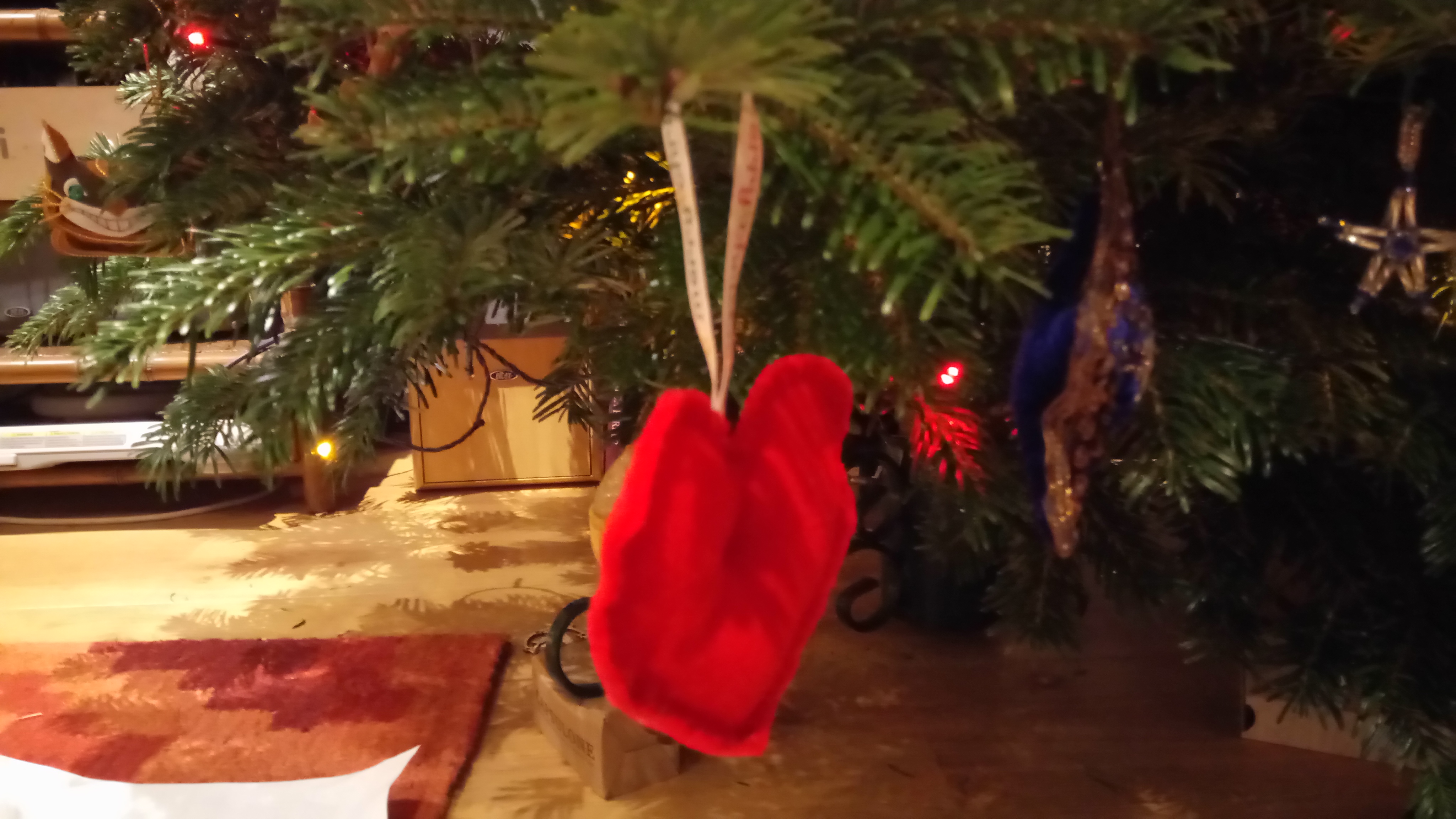
That Christmas was grim, but one thing was worth doing, and has stuck: I bought two identical tree ornaments, one for each of my parent’s Christmas trees. I couldn’t be in two places at once, but I could at least show that I wished I could be.
Over the years, I’ve expanded the practice, and now send tree decorations to both of my parents, the two of my brothers who have moved out, and my in-laws, as well as keeping one for our own tree – so even when I can’t be with someone for Christmas, there can be something of me there.
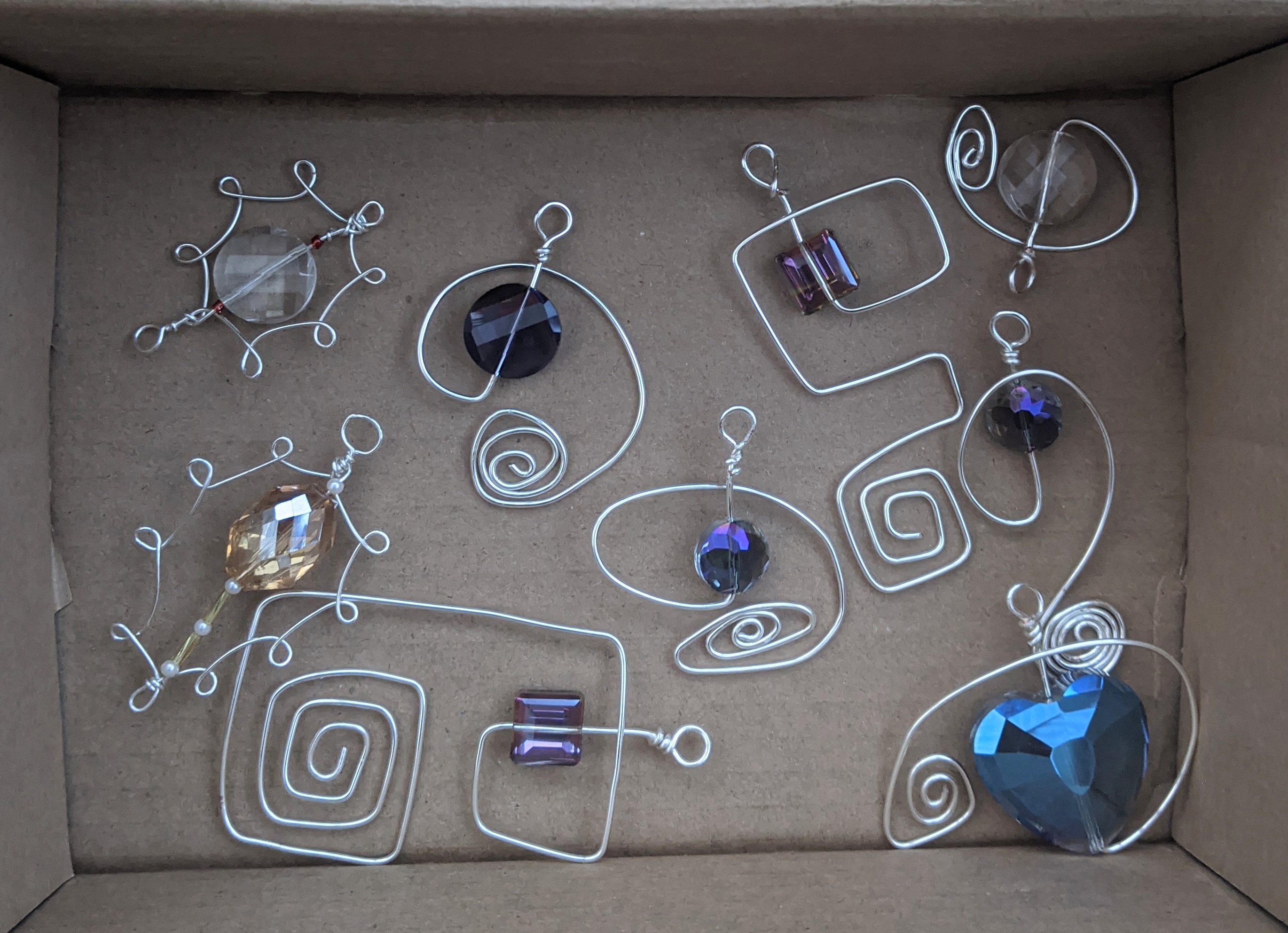
Sometimes I’ve made decorations. Sometimes I’ve bought several identical ones. Sometimes I’ve got a set and split it up. Glass angels, laser-cut wooden dragons from Ljubljana, crystal stars, iridescent hummingbirds… This year I’ve been threading gorgeous faceted glass beads onto thick silver-plated wire and bending it into abstract spirals. This tradition, born of one of the most painful experiences of my life, has become one of the preparations that I most enjoy.
Enjoyment
I talked about relief, further up the page. And if it’s a relief not to be going home, not to be having the blazing rows over Brexit or your sister’s wedding or why you don’t have children, then make the most of it. This could be the year you break the tradition. You don’t actually have to do things just because you’ve always done them. If you’d actually prefer Christmas at home, Christmas on your own, Christmas with your bubble, then why not go for it? Work out what you want to do, and do that.
Looking out
Christmas is traditionally a time for attempting to make things a little brighter for people one doesn’t know. Here is a seriously incomplete list of ways in which someone who had the time and/or funds might do that, even (particularly!) in such a year as this.
Make a donation to your local foodbank. It can’t have escaped many people’s notice that there’s a real problem in this country with poverty, and poverty-related hunger. There are going to be a lot of people this year for whom Christmas is not going to be fun at all. (I have a standing order set up, but I also throw the occasional pack of fun-sized Mars bars into the collection basket at Sainsbury’s, because poverty is miserable enough without being wall-to-wall lentils.)
One idea I’ve seen is the ‘reverse Advent calendar’ – put one item aside every day to give to the foodbank. The only problem with this is that, if you want someone who have nice things at Christmas, you need to get it to them in advance, so maybe do it through November instead of Advent.
Make a donation to another appropriate charity. Safe Passage, for example.
Find out what’s going on near you and who needs help. Is there a befriending service? A Covid mutual aid group? A local newspaper, Facebook group, or community noticeboard should give you some pointers.
Here’s an initiative for getting Christmas presents to children and teenagers in mental health units.
You’re expecting me to encourage you to fill a shoebox with toys for an underprivileged child. I’m not going to do that. Here’s why. And here’s an alternative if you still want to.
Church
Well, we got through Easter. Easter was before we had proper internet access, so in this house we got through Easter livestreaming a Zoom service via mobile phone tethering, so Christmas ought to be a doddle.
Seriously, though. Nobody seems to know what church services will look like come Christmas, but I think it’s fair to say that they probably won’t look any less weird than they do now. At the moment, in the Church of England, people in church have to wear masks through the service (unless they’re leading, singing, or reading), the congregation isn’t allowed to sing, and numbers are limited – which might mean that, come the big turnout of Christmas, services may have to be ticketed.
If your typical Christmas includes attendance at a church service (crib service, carol service, Midnight Mass, whatever) and you haven’t been to a service since the pandemic hit, you might want to try one in the next few weeks to get the initial weirdness out of the way.
Your church may have something on its website to explain the arrangements. They may also be streaming services. Anyway, it’s extremely unlikely to be the same as normal, and you’re probably better working out how it’s going to be different, and how you feel about that, well before Christmas.
Advent
My plan for this year is to lean hard on Advent. Possibly harder than I usually do. As I hinted at the top of this post, I don’t deal terribly well with the festive pre-Christmas season, and I just don’t have the energy to celebrate all the way from mid-November. I get sick of the parties and the music and the constant expectation that I be cheerful and sociable all the time. So this is one of the aspects of normal Christmas that I’m rather relieved to escape this year.
In a normal year, I lean hard on Advent. To quote something I wrote last year,
Advent suits my mood. The readings are apocalyptic, saved from despair by the hope that something better is coming, is on the way even now, if I can only keep hanging on until I see it. The music is alternately spare and intense. I shut myself in the study each evening and take time to be where I really am. Advent comes a day at a time, a door on the calendar, a centimetre on the candle. A square inch of sweetness, which is about all I can manage while others around me are already on the mince pies and gingerbread liqueur.
Advent leaves space for me to rant and rage and demand why everything is awful. Advent lets me admit that things are awful. Advent acknowledges the hole in my life. It doesn’t demand false cheer. And very often I find that, little by little, it makes room in my life for something that is genuinely joyful, whenever that comes.
And if that was true last year, how much more so this year?
Come and grump with me! Tell me what I’ve forgotten, or about new practices or traditions you’re inventing this year. Comments are open.
It’s almost a month since I uploaded the finalised files for The Real World. The wheels are turning, and, though I’m never quite confident that the book is going to appear on the sites I want it to until it, you know, appears on the sites I want it to, I think it’s all heading in the right direction.
I’ve approached some bloggers and reviewers, some of whom have previously enjoyed Speak Its Name, and some who I’ve only recently come across. And apart from that, I’ve just got to hurry up and wait.
In the meantime…
… I’ve put an extract – the first thousand words or so – up. Find it here.
… I’m going to be having a launch party over on Facebook. Time: 8.30pm GMT. Date: 2 November 2020. I’ll be reading a bit (the awkward party scene seems appropriate) and answering some questions. Bring your own fizz and canapés. And questions. RSVP here.
… I’m doing a giveaway of some ebook copies over at LibraryThing. Scroll about half way down this page to find it.
I’m very pleased to announce that I’ve had a story published today over at Enchanted Conversations. If you haven’t come across it before, the site is an utter delight – a treasure trove of stories new and old, essays, poems, and other material related to fairy tales.
Wings Over The Plain is a story that was inspired by the Camino de Santiago – specifically, the long drag of the Camino Frances across the meseta, the plain that forms much of the province of Castilla y Leon. It’s inspired by the landscape, and the skyscape, the longstanding association of the Camino with the Milky Way. But most of all it’s inspired by the storks who build their nests on any elevated corner they can find and who, for me at least, were one of the loveliest sights of a lovely journey.
Winter is harsh out on the high, broad, plain of Castile. There’s nothing to stop the wind: it blows in cold from the sea, and becomes colder still as it crosses the mountains. Sometimes it brings snow; sometimes it just sweeps bitingly around every hunched tree and huddled building, and the people get through the winter as best they can. And on those long, cold, nights, the sky breaks into stars, more of them than you could count, brighter than you can imagine, showing a westward path that only the very devout or the very foolish follow at this time of year…
Turn to page 69 of any book and read it. If you like that page, buy the book. It works.
Marshall McLuhan, quoted in ‘How To Read A Novel’ by John Sutherland
Last time round, I put both my existing books through the test, showed you what would have been page 69 had The Real World gone to print as it stood, and promised to be back ‘in a few months’ with the final page 69.
Well, just over a year later, here we are.
… make a great sermon illustration. You could demonstrate a miracle.’
Lydia sniggered. ‘And I noticed they weren’t using actual custard. Does actual custard not work? Or is it too expensive to make a whole paddling pool full?’
Colette thought about it. ‘Do you know, I’m not sure. The egg might do something weird…’ She frowned at her diagram: she’d missed a bond somewhere. When she next looked at the screen, an Asian woman was talking enthusiastically about the properties of wood. Barry did not appear again.
*
‘Are you up to anything interesting today?’ Colette asked the next morning.
‘Not at work. But I’m going to have lunch with Felicity, and bring her up to date with all the discernment stuff.’
‘Ah.’ Colette felt faintly put out. It wasn’t really fair, she knew: Felicity had as much right as anybody to know what was going on in Lydia’s life, and more than most. Felicity had been the one who had started all this, had been the one to say to Lydia, ‘So have you ever thought about ordination?’
‘Is that OK? I did mention it a few days ago.’
Colette remembered, and quashed an irrational surge of resentment. Why shouldn’t Lydia talk to Felicity? Why shouldn’t she let off steam? Why shouldn’t she complain to Felicity about the arcane processes of their Church, and the fact that she wouldn’t be getting married any time soon? ‘You did. It’s fine. Are you still going to want dinner when you get home?’
Lydia stretched up to kiss her cheek. ‘If you’re cooking.’
It was her turn. ‘I’ll sort something out.’
*
It was a grey day, and colder outside than it looked. Colette regretted walking up to campus, but told herself that waiting for the bus on Southview would be even colder. She buttoned her coat up to…
Well, other than the fact that this one also begins and ends mid-sentence, I think it works better than the previous page 69. It’s more representative. We get a hint of Colette’s academic trials (Barry, who has just pulled a disappearing act, is her PhD supervisor) and also see her being more absorbed than strictly necessary in an intriguing but unimportant question; we do get the Church of England and the discernment process this time. We lose James, but we gain Felicity. (They’re both new supporting characters, and I’m quite fond of both of them.) There’s also more of a sense of place, which is something I’ve been working on quite a bit lately.
If you preferred the previous page 69, well, it’s all still there. It’s just on page 76 now. And I’ve replaced [thing] with spike.
I put the finishing touches to The Real World a week ago, and since then I’ve been doing my best to do very little. Writing this book has taken an awful lot out of me, and I’m trying to make up for that by sitting in a deckchair on the lawn, reading other people’s books.
But I do also write things that aren’t 94,000 word novels, and I’m very pleased to have two pieces to share for Bi Visiblity Day. As I wrote in one of these,
my experience of being bisexual has been the ever-present consciousness of other possibilities. I’ve made a particular series of choices, my life has unfolded in a particular way – but I’m always aware that I could have made other choices, that my life might look very different today if… If I hadn’t grown up under Section 28. If I’d heard the word ‘bisexual’ before the age of 20. If, if, if.
I might have taken the road more travelled by, but that doesn’t mean all the other roads disappear from existence. (They closed the road through the woods…) Both of these pieces explore that sense of possibility, in fiction and in non-fiction (A merry road, a mazy road…).
The first one is perhaps more bi audibility than visibility, as it’s a podcast. This is the second story I’ve had featured at A Story Most Queer (the first was Prima Donna), but my first to be premiered there. I’ve added a PDF version too. It’s a fairy tale about a young woman who sets out to look for her friend who’s gone missing…
The second piece is a guest post at Licence To Queer, where I wander all over the 007 canon, both book and film, looking for bisexual possibilities and revisiting my Eng Lit past. I even gave it a proper Eng Lit essay title with a colon in the middle. If that sounds a bit dry, I should also warn you that I fail to answer the question of what Felix Leiter was doing in Bond’s hotel room, and that I do pick up on a surprising allusion to the Book of Common Prayer. Fortunately David’s added some pictures.
If you’re at all interested in James Bond and queer themes I recommend the whole Licence To Queer site heartily: it’s a joyful deep dive into the world of 007 – with some intriguing cocktail recipes too.
Interestingly, while The Real World has turned out to be an extremely bi novel in other ways, the sense of possibility isn’t nearly so present. Except, perhaps, as a sense of something missing, something distorted… Ah, you’ll see.
I’m sorry to say that the prices of Lulu’s paperback books have gone up quite a lot. I’d intended to price The Real World at £8.99, the same as the other two, but I find upon uploading the file that it won’t let me put it on at anything under £13.06. Which is a silly price, liable to change with exchange rates. And it’s a bit demoralising for me not to be paid anything at all, so I’m afraid that when it appears it’ll be £13.99.
Worse news: the other two books will also have to go up, because the current cover price isn’t covering the printing and distributor costs. (This might explain why I don’t seem to have been paid for any Amazon sales recently.) Oh, well: I suppose I was making new covers anyway (a complete redesign for Speak Its Name, and adding an award badge to A Spoke In The Wheel) – so I might as well add the updated prices.
I do understand that there’s a pandemic on, and no doubt printers’ costs have gone up the same as everything else, but I feel that fourteen quid is a bit steep for a paperback myself. So I’m going to knock another quid off the price of the ebook. I also understand that ebooks don’t work for everybody, and fourteen quid is still a bit steep for a paperback. If you’re not in a hurry, it’s worth waiting for Lulu to do a 10% or 15% off promotion, which happens quite frequently (though you may still get dinged on the postage). If you’re really not in a hurry, Amazon occasionally makes substantial reductions on POD paperbacks (I note for the benefit of fellow Clorinda Cathcart fans that A Man of Independent Mind is currently down to £3.37, for example) but I can discern no rhyme or reason to this, and it may never happen to any given book.
I’ve no desire to set myself up as a bookshop, but in exceptional circumstances I’ll consider supplying the paperback at [cost price] + [postage and packing]. If, when the time comes, you’re someone for whom the difference between £8.99 and £13.99 is really quite a big one, drop me an email and I’ll see what I can do.
In the meantime, you can find a number of free reads (and listens!) linked from the menu at the top of this site, and there are a couple of exclusive ones available if you sign up to my newsletter. Which I really must get round to sending, as I have a couple of things to announce…