This year Jae is running a Sapphic Reading Challenge: 50 categories, from which you can choose to read 10, 20, 50, or 100 books. There’ll be a big giveaway at the end of the year, although, as Jae says, “real prize, of course, is discovering a lot of awesome books and new favorite authors”.
Character with a disability or mental illness (7) – depression ended up being a major element of The Real World, though I don’t think I ever actually mentioned the word. I wrote a bit about that here.
Character is a book lover (8) – Lydia is doing an English Literature in Speak Its Name. By The Real World she’s mostly reading school stories.
Genre you don’t usually read (15) – well, I don’t know what you usually read, but if you don’t usually read literary fiction with overtly religious characters then these might fit.
Shy or socially awkward character (27) – Colette. It’s probably more obvious in The Real World, which is told from her point of view.
Bisexual or pansexual character (37) – Colette, again.
Part of a series (43) – either one would work, obviously! The Real World makes sense without having read Speak Its Name, but you do learn a couple of major plot points that you can’t then unknow.
Character works in STEM (48) – Colette’s studying chemistry at undergraduate level in Speak Its Name and working on her PhD in The Real World.
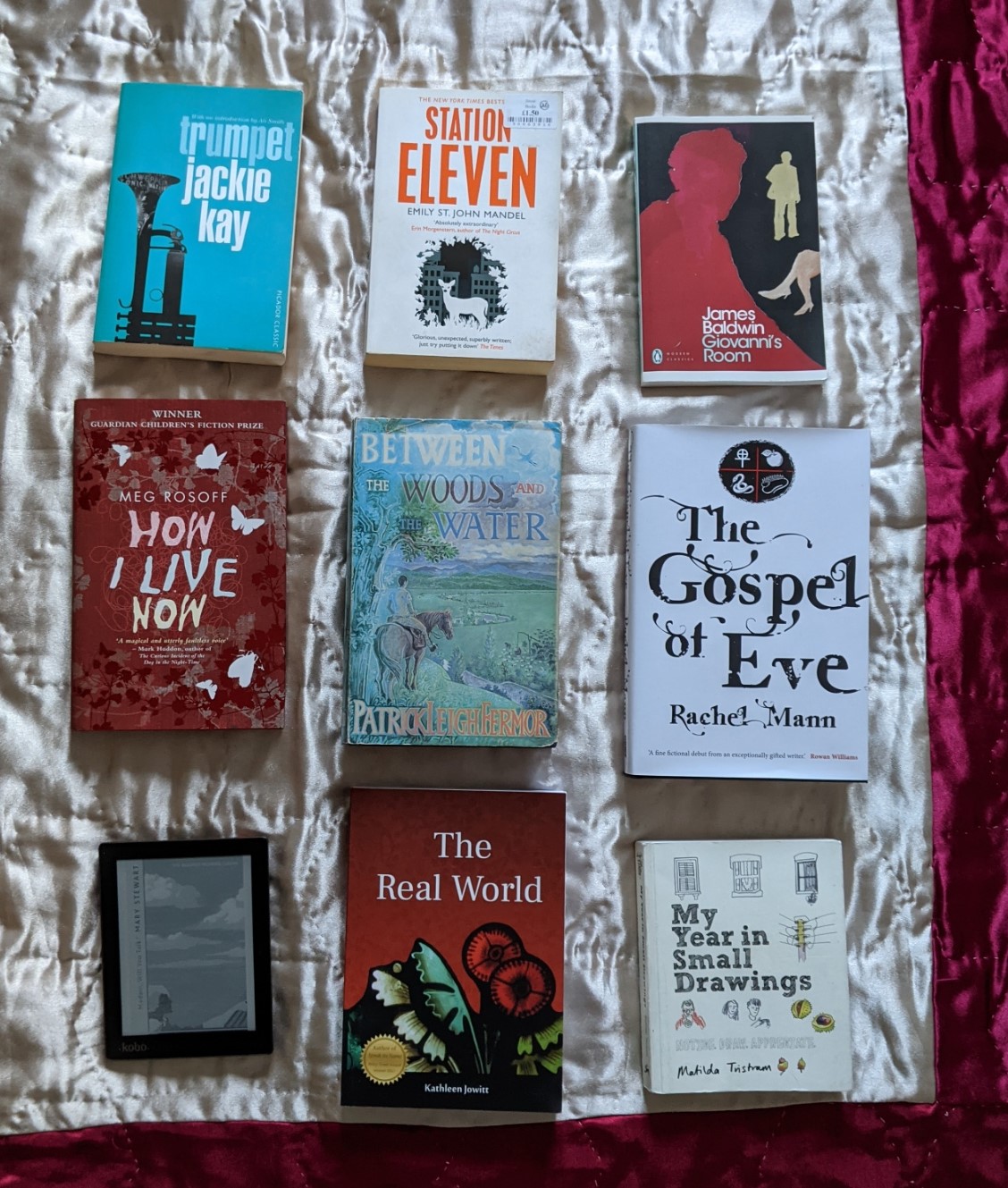
I’ve read a lot this year, and taken a lot of pleasure in reading. I’ve enjoyed many books. Even after excluding rereads, I had a lot left to choose from, and I think I’d present this photo more as a representative sample than any sort of top picks.
These aren’t in any particular order, though the top three were all begun and finished before the pandemic really hit the UK. I have a particularly vivid memory of standing on the platform on Cambridge station some time in February, overhearing two men discussing what was going on in China, before I boarded my train and went back to Station Eleven (Emily St John Mandel). It’s one of the least depressing post-apocalyptic books I’ve ever read, and I was glad to have read it going in: it made the first national lockdown seem tame by comparison.
Trumpet (Jackie Kay) follows the family and friends of a trans man who’s outed after his death: a really good book with a convincing (and often infuriating) array of voices.
Giovanni’s Room (James Baldwin) gets points for having not one but two scenes including a proper Paris bus; but it also made me think a lot about relationships, and about what impossible expectations people can place on each other.
Had someone warned me that The Way I Live Now (Meg Rosoff) takes place in World War Three, I would probably not have picked it up. It made for a heavy afternoon, given the circumstances. But it’s so good that I can’t regret it: it has the eccentric, matter-of-fact quality of I Capture The Castle followed up with the devastation of the war narrative.
I read a lot of travel writing early on in lockdown, particularly older work, finding it refreshing to move in time as well as in space. Patrick Leigh Fermor gets the slot here, for the lovely luminous character of his writing.
I was in three book groups/readalongs at one point. One folded after the first book, and I’ve got behind on reading for both of the other two, but it was an absolute joy to read Madam, Will You Talk? (Mary Stewart) with perceptive and witty people on the internet. I even bought a dress because of it.
I’m generally behind everyone else in getting round to reading new releases, and several books that I thought might have been published this year actually date back to 2018 or 2019. But 2020 books that I enjoyed in 2020 included the first two of the Will Darling Adventures (K J Charles) and, particularly, The Gospel of Eve (Rachel Mann), which was a dark, twisty, theological college romp.
I only published one book this year, so obviously The Real World must be simultaneously my best and my worst book of 2020. Actually I think it’s probably the best book I’ve ever written.
Technically a book, although not one to be read as such: My Year in Small Drawings (Matilda Tristram). I’ve had enormous fun with this. There’s something very liberating about allowing yourself to not be very good at something.
Not pictured, because not a book, are any of the issues of hidden europe that I’ve read this year. Not pictured, because I haven’t finished it, is Women and Angels, a Virago anthology of women’s spirituality. Not pictured, because I never read it all in one go, is any of the poetry. Not pictured are the books I bought but haven’t yet got around to. My reading brain has been more or less shot recently; I’ve mostly been watching the skiing instead. Nor have I been doing much writing, apart from this blogging, obviously. I hope to catch up with all of this over the Christmas break and in 2021.
I’m never quite sure what makes something a hobby rather than a mere pastime. How seriously does one have to follow it? Does it have to be creative? And of course, one person’s hobby is another person’s livelihood.
So I’m going to go for the very broadest definition and say something that I do because I enjoy it, that nobody pays me for.
I have plenty of hobbies, and I have most of them because I saw something in a book, thought, ‘I could do that’, and tried it. Some of them (crochet) I abandoned again; some (knitting) I do very intermittently; some (making bead jewellery) I do quite often.
Some (teaching myself to play the piano) are part of my regular routine; some (teaching myself to ice skate) have been scuppered by the coronavirus pandemic; some (gardening) have been made very much easier by lockdown; some (doing small drawings) I even do daily.
But really, all of those feel like quite a lot of effort at present. Indeed, at this point in post-launch torpor, I find myself thinking that I only write books because nobody else is writing the precise thing that I want to read. And so I go back to reading.
I’ve read quite a lot in 2020. I note that there’s a ‘best book’ prompt coming up later in the month, so I won’t talk about preferences, but I will recall…
taking a folding chair out into the garden to read Julian of Norwich over Holy Week
lounging on a blanket on the lawn, reading Miss Moonshine’s Emporium of Happy Endings
turning my ebook reader back on after lights out to finish Slippery Creatures
sitting in an armchair, legs tucked under me, working through the first seven Bond novels
picking up Busman’s Honeymoon to take a photo of it, and the rest of the day just disappearing
reading all of Four Quartets out loud to myself, with the rain beating at the roof of the conservatory
unable to sleep, making myself a late night cup of peppermint tea, and reading Spiderweb For Two for the first time
starting off a Saturday morning by inhaling a Jae or a Jill Mansell
bickering amiably online about Madam Will You Talk and The Man In The Brown Suit
I’ve read for research, both for other people’s blogs and my own, to finish things I’ve been meaning to read, and for sheer fun.
I have until the 20th to decide which was my favourite. I’ll let you know.
I’ve always loved stars, loved looking up into the night sky to see more and more pinpricks of light becoming visible to my adjusting eye.
My ability to recognise the constellations has been limited, however; I’ve known Orion, the Plough/Great Bear/Saucepan, and Cassiopaeia for years, but others have been trickier. Bootes has broad shoulders and slim ankles. The big square one might be some combination of Perseus and Andromeda. My knowledge remains sadly lacking.
What’s really helped has been having a phone with enough memory to cope with Stellarium. (The fact that it has a camera with settings advanced enough to cope with stars has also been a bonus.)
This year I’ve added Cygnus, sort of. There it is, dropping behind our neighbour’s garage. And the planets have been big and bright and hanging around in the same place for long enough that I’ve got used to them. Here are Jupiter and Saturn over the Solent in July. The moon is at the right and looking a bit lopsided; Jupiter is the bright speck about a quarter of the way in from the left; Saturn is just visible as a point about halfway between Jupiter and the left-hand edge.
More recently, Mars has been looking very handsome in the south-east.
I could say that this year, when I haven’t really been going anywhere, I’ve been more aware of the stars, but I’m not sure that would be true. I haven’t had my evening bike rides home alongside the Cam, with Orion huge over the opposite bank; I haven’t paused in the back garden to look up before unlocking the shed.
I think, though, that I’ve become more aware of the here and now, and of the stars as a marker, a backdrop, a map, have wanted to know more. Much as I’m grateful for Stellarium, I’m also delighted by this analogue guide to the night sky. The rivet at the Pole Star allows the transparent window to be moved according to the time, day, and month: here I’ve set it at the time I took the photo at the top of this post.
And I’ve been fascinated by the way that humans relate to them. I’ve been reading this book, a history of astronomy that has itself been overtaken by history, one chapter every Sunday afternoon over the last couple of months. I’m still with Copernicus and Galileo, jumping through a new paradigm shift every week.
Also on Sunday afternoons, I’ve been reading back issues of hidden europe magazine. This week I read about a village called Groβmugl, just outside Vienna, which has become popular as a stargazing site, and where:
locals sometimes refer to the village as ‘Groβmugl an der Milchstraβe’ (Groβmugl on the Milky Way)
“On a Starry Night”, hidden europe issue 54, spring 2018
Well, I immediately wanted to go there (some day, some day, I’ve already promised myself a return to Vienna), but it resonated on a deeper level than that. Like a child adding as many lines as possible to their address, I thought that this could be here, too.
The fact that I’ve arrived at S just when I have a Stancester book to promote is less a tribute to my skills as a publicist and more a testimony of my inefficiency as a blogger. Nevertheless, here we are, and I’ll talk a little bit about Stancester after I’ve dealt with the work of some considerably more venerable authors.
And I will start with Frances Hodgson Burnett’s The Lost Prince, and Samavia. (I always got The Lost Prince mixed up with The Silver Sword, probably because they came in Puffin editions of about the same thickness with a teenage boy on the cover, albeit wearing very different clothes. The Silver Sword does not fall within the scope of this project.)
Later in this series I’ll be writing about the imaginative landscape in children’s play, but it bears mentioning here because the way that the boys interact with the idea of Samavia is so important in establishing it as a place.
A good half of the book takes place in London, with the idea of Samavia built up through stories told by Marco and newspapers read by the Rat and maps drawn in flagstones in chalk and in the games that the boys play. Even Marco Loristan, who has been studying Samavia all his life, only knows it in theory. And that fact makes it possible for the the Rat and his gang to know it, too. Similarly, so can we.
He who had pored over maps of little Samavia since his seventh year, who had studied them with his father, knew it as a country he could have found his way to any part of it if he had been dropped in any forest or any mountain of it. He knew every highway and byway, and in the capital city of Melzarr could almost have made his way blindfolded. He knew the palaces and the forts, the churches, the poor streets and the rich ones. His father had once shown him a plan of the royal palace which they had studied together until the boy knew each apartment and corridor in it by heart. But this he did not speak of. He knew it was one of hte things to be silent about. But of the mountains and the emerald velvet meadows climbing their sides and only ending where huge bare crags and peaks began, he could speak. He could make pictures of the wide fertile plains where herds of wild horses fed, or raced and sniffed the air; he could describe the fertile valleys where clear rivers ran and flocks of sheep pastured on deep sweet grass…
The map of Europe into which Samavia is inserted is at first a very rough one:
“You know more about geography than I do. You know more about everything,” [the Rat] said. “I only know Italy is at the bottom and Russia is at one side and England’s at the other. How would the Secret Messengers go to Samavia? Can you draw the countries they’d have to pass through?”
Because any school-boy who knew the map could have done the same thing, Marco drew them. He also knew the stations the Secret Two would arrive at and leave by when they entered a city, the streets they would walk through and the very uniforms they would see; but of these things he said nothing. The reality his knowledge gave to the game was, however, a thrilling thing.
When Marco and the Rat eventually leave London, they travel through Paris, then Munich, then Vienna, before at last reaching Samavia. Because the game is, of course, real.
(Incidentally, The Lost Prince also gives me a solution to my J problem: Samavia borders a country called Jiardasia, but since that’s literally all we know about it I still wouldn’t have had much to write about.)
Many of these fictional countries signal a location somewhere in central or southern Europe with this combination of an S and a V suggesting ‘Slav…’ or ‘Slov…’ Which is rather lazy and, as we shall see in a little, occasionally even embarrassing.
Between Northumberland and London, the Sadler’s Wells books have a very strong sense of place. Revisiting them as an adult, I find that I can’t believe in Slavonia in quite the same way (I think it was actually the Swiss mountains that caught my imagination), but I’ll include it for the sake of my thirteen year old self.
… one of those pocket-sized countries in Europe which have still managed to retain their monarchies or principalities. The capital of Slavonia is Drobnik, and it is about as big as a good-sized English village, but of course all on a very grand scale. Dominating the capital is the royal palace, all in white and pink stone, with pepper-box turrets at the corners. Then there is the Royal Opera House, which is upholstered in red plush and white satin, like the inside of a jewel-box. This building is situated on the banks of the river Juno, which rushes through the city under a succession of little bridges, all covered with sloping roofs to keep off the snow in winter. The cathedral, where the rulers of Slavonia are crowned, is made of rose-coloured quartz, and it stands in the main square, in the middle of which a fountain, designed by one of Europe’s well-known sculptors, plays night and day, and is floodlit on the King’s birthday and other important occasions.
No, at the age of 35 I really can’t believe in a cathedral made of rose-coloured quartz. Ah, well. Still, it gets points for having a national flower, which is a nice detail. This is all from Principal Rôle, which I adored. I didn’t have a copy of The Secret, the other book that deals with Slavonia. Maybe I’ll get a copy some day (yes, I know Girls Gone By are reprinting it, but for these it’s an Evans hardback or nothing).
As for how you get there, well, Lorna Hill carefully doesn’t identify ‘the adjoining country’, and the only people who go there in the course of the book fly, but, though a couple of nice vintage planes (a twin-engined Dakota; a Constellation airliner) are mentioned, they’re going to and from Switzerland. There’s a region of Croatia with that name. Maybe it’s somewhere around there.
While we’re (probably) somewhere in the Balkans, we might as well visit Syldavia. I mentioned its neighbour Borduria earlier in the series; Syldavia is very much the sinned-against party in the relationship between the two. It’s a reasonably coherent entity, though its continued existence is hampered by its being lumbered with a liability of a McGuffin for a sceptre. The Tintin wiki supplies a whole lot more detail, much of which I don’t remember. There’s a shocking dearth of Tintin books in this house.
We were in Ruritania last time, so I’ll only mention Strelsau briefly:
The city of Strelsau is partly old and partly new. Spacious modern boulevards and residential quarters surround and embrace the narrow, tortuous and picturesque streets of the original town. In the outer circles the upper classes live; in the inner the shops are situated; and, behind their prosperous fronts, lie hidden populous but wretched lanes and alleys, filled with a poverty-stricken, turbulent and (in large measure) criminal class.
(Well, he would say that, wouldn’t he?)
Part of the reason for all these S places is the proliferation and plausibility of places named for saints (real or fictional). Hergé obliges again with San Theodoros. Agatha Christie’s St Mary Mead springs immediately to mind. I want to look, though, at St Loo, which she uses in her Mary Westmacott persona as well as in the Poirot series.
In Peril at End House there isn’t much more to St Loo than the Majestic Hotel, where Poirot and Hastings are staying, and the titular house. It exists as a seaside resort:
It is well named the Queen of Watering Places and reminds one forcibly of the Riviera.
In The Rose and the Yew Tree it turns out to have a lot more going on:
There were… three separate worlds. There was the old fishing village, grouped round its harbour, with the tall slate-roofed houses rising up all round it, and the notices written in Flemish and French as well as English. Beyond that, sprawling out along the coast, was the modern tourist and residential excrescence. The large luxury hotels, thousands of small bungalows, masses of little boarding houses – all very busy and active in summer, quiet in winter. Thirdly, there was St Loo Castle, ruled over by the old dowager, Lady St Loo, a nucleus of yet another way of life with ramifications stretching up through winding lanes to houses tucked inconspicuously away in valleys beside old world churches.
This isn’t just a place where people stay. It’s a place where people live. And what that means is politics. The bulk of the book deals with the General Election (I do like a good election): our anti-hero, Major John Gabriel VC, is standing as the Conservative candidate, and the pettiness of small town gossip and politics, the uneasy interaction between the different strands of society, drives the action.
The narrator wonders how John Gabriel, ‘an opportunist, a man of sensual passions and great personal charm’ could have become Father Clement, a man of ‘heroism, endurance, compassion and courage’. Personally, I think that at least part of the answer is that he’s jumped genres.
Because The Rose and the Yew Tree isn’t just a Barchester novel. Its framing device is distinctly Ruritanian. Slovakia(not the Slovakia we know; its capital is Zagrade, suggesting a portmanteau of Belgrade and Zagreb, rather than Bratislava) gets a scant chapter, hastily daubed with unsavoury characters and assassinations in the name of local colour. And the first we hear of any of these places or people, we’re in Paris.
Yes, Paris again. I’m beginning to wonder if I should have done a post on the importance of Paris as a staging post in the Ruritanian novel. We saw Marco and the Rat pass through on the way to Samavia; Rudolf Rassendyll, of course, takes his Great-Uncle William’s advice and spends twenty-four hours there before heading east into Ruritania and the action; Conway Carruthers attempts to see the head of the Sûreté on his way through.
Of course, before air travel you’d be hard pressed to get to anywhere in mainland Europe from Great Britain without passing through Paris sooner or later (probably sooner) but I think there’s more to it than that. Paris occupies a unique place in the Anglo-Saxon imagination: foreign, yet accessible; faintly naughty (both Lord Peter Wimsey and James Bond lose their virginity there); instantly recognisable; a known point from which to triangulate our unknown destination.
Asia no longer begins at the Landstraβe, but travel back in time via the medium of the novel, and you’ll probably find that you have to change in Paris for Ruritania.
Back to Cornwall. Jill Mansell’s St Carys has featured in a couple of books now. It has cafés and hotels, whitewashed cottages, huge private houses, estate agencies, newsagents, holiday lets, everything you’d want in a seaside town, really. And a map.
Finally, I do have to mention Stancester. We’re definitely in Barchester country now, with characters who can only negotiate their relationships with the Church and academia, not dictate terms. In Speak Its Name I was able to write the Students’ Union rules the way I needed them; in The Real World I was working with stricter constraints. I had more freedom with the geography, however. I have a distinct memory of sitting in the park at Woking one sunny Tuesday, with my notebook and a map of Roman Britain, trying to work out where would be a good place to put a city with a cathedral and a university. I did dreadful things to the railway (either diverted it to the north, away from Yeovil or to the south, away from Somerton) but there are a couple of clues that remain intact. The A303 is in the right place, and, if you happen to have a copy of that map of Roman Britain, this is a dead giveaway:
The harshest critic would struggle to fault the setting of Stancester cathedral. Built on the site of a Saxon minster, presiding over the crossing of two Roman roads, it dominates the north side of the city. Its honey-gold hamstone is echoed all around the old town, and, should one be fortunate enough to visit on a sunny afternoon, the overall effect is charming.
If not, I’ll tell you. I put it down on top of Ilchester, having moved a few hills around. I borrowed the church with the octagonal tower, too.
There’s something very enjoyable, making up new places (and then writing about them in the voice of pompous local historians – don’t worry, he doesn’t get any more than that chapter heading). But it turned out that there was a little more to it than that. I’d had the name for Stancester in my head long before I fixed on its location. And I was a long way into a redraft when I went to Wells with my choir and, in the cathedral museum, found a relief map that showed me that in fact I was a lot closer than I thought.
Books mentioned in this post
The Lost Prince, Frances Hodgson Burnett
Peril at End House and The Rose and the Yew Tree; various Miss Marple novels, Agatha Christie
King Ottakar’s Sceptre and Tintin and the Picaros, Hergé
The Prisoner of Zenda, Anthony Hope
Speak Its Name and The Real World, Kathleen Jowitt
Meet Me At Beachcomber Bay, The Unpredictable Consequences of Love, and It Started With A Secret, Jill Mansell
That cryptic (thank you, thank you, I’m here all week) title refers not an award-winning clue, nor even an award-winning crossword (though you never know), but to Jae‘s F/F Fiction Crossword featuring award-winning WLW & lesbian fiction, which features, among other award-winning books, my first novel, Speak Its Name.
What’s the name of the hall of residence at the University of Stancester where Lydia Hawkins is Christian Fellowship representative?
Well, you can find the answer in the extract on my site, but I thought I’d take this opportunity to talk a little bit about the book (and the award), because I know a lot of readers will very reasonably be reading that clue and thinking ‘what on earth???’ Because, let’s face it, that question (which I drafted) seems like a bit of an unlikely start for a WLW book. And yet there it is, in some excellent lesfic company.
Speak Its Name is (as you see) a university story and (as you can guess) a coming out story. It’s got a bit of romance and a bit of satire. It is, above all, a story about how it’s possible to be more than one thing at once, to claim an identity that might be more complicated than most people assume, about the joy and the tension and the grief of having both a religious faith and a queer identity.
Lydia Hawkins is the main character, and by now you’ve probably guessed that ‘the secrets she tried to keep even from herself’ include her identity as a lesbian. Which I suppose would be a bit of a spoiler, if you hadn’t come here from Jae’s crossword. Anyway, she manages to get her head and her heart around that, but that’s rather less than half the story…
In ‘very good timing’ news, I’ve just released the sequel. In ‘very bad timing’ news, I’ve been hit by a bug that’s kicked all my ebooks off the major retail platforms. I’m trying to get that fixed; in the meantime, you can still get everything in paperback, and the ebooks are available from Lulu.
The award that it won was the 2017 Betty Trask Award. The Betty Trask Prize is awarded every year by the Society of Authors to the best debut by an author under the age of 35. Submissions, it says, have to be in ‘a romantic or traditional style’. Speak Its Name is a bit of both.
I only entered because it was free to do so, and because they accepted self-published books (at least, they didn’t say they didn’t). Being shortlisted was a huge surprise. I was walking with my brother in northern Spain at the time, and had in fact forgotten that I’d even entered my book for the awards. Realising that I was the first self-published author ever to have been shortlisted blew me away completely. I’ve made a tiny piece of literary history, and I’m still immensely proud of that.
The delightful thing about it is that even being on the shortlist gives you a Betty Trask Award and a cheque for £3000 to be spent on foreign travel. (I went Interrailing and enjoyed myself hugely.) And again, I’m in good company. Previous winners include Sarah Waters – who I met at the awards ceremony, and who was absolutely lovely.
I have the certificate hanging on the wall to the right of my desk, and it makes me smile every time I see it. Writing a book is a slog. (So is self-publishing.) If my experience is anything to go by, all the authors on that list of clues will have put a huge amount of work into their books, and will have been delighted to have it recognised.
Good luck with the rest of the crossword clues – and I hope you find many more new authors to enjoy!
November is here, and so is The Real World. Well, mostly. I’m very annoyed that the ebook has not yet filtered through to any mainstream retailers, despite having had six weeks to do so, and, to add insult to injury, all my other ebooks have disappeared. I apologise for the inconvenience.
It is possible to convert EPUB to MOBI and get the ebook onto Kindle that way. Here’s a guide. But I appreciate that this is something of a faff. I’ll update here as soon as the ebook has become more widely available.
I’m having a launch party over Facebook Live this evening (8.30pm GMT) and I’d be delighted for any of my blog readers to join me. I’ll be doing a reading from The Real World and answering questions about it, and my other books, if people have questions about them.
Anyway, distribution hitches aside, I’m immensely proud of this book and very glad to be able to share it with you at last. If you liked Speak Its Name, I hope you’ll be glad to see more of the characters you met there. If this is your first encounter with the people of Stancester, I hope you’ll enjoy the experience. (And yes, it should work as a standalone. One of my beta readers said that they didn’t realise it was a sequel!)
Writing this book took me longer than I’d expected, and there were times when I thought it was never going to be done. It took me to some interesting places, too. I’ll be talking a bit more about that in the weeks to come. But it’s been worth it, and I think this might be the best thing I’ve ever written.
It’s almost a month since I uploaded the finalised files for The Real World. The wheels are turning, and, though I’m never quite confident that the book is going to appear on the sites I want it to until it, you know, appears on the sites I want it to, I think it’s all heading in the right direction.
I’ve approached some bloggers and reviewers, some of whom have previously enjoyed Speak Its Name, and some who I’ve only recently come across. And apart from that, I’ve just got to hurry up and wait.
In the meantime…
… I’ve put an extract – the first thousand words or so – up. Find it here.
… I’m going to be having a launch party over on Facebook. Time: 8.30pm GMT. Date: 2 November 2020. I’ll be reading a bit (the awkward party scene seems appropriate) and answering some questions. Bring your own fizz and canapés. And questions. RSVP here.
… I’m doing a giveaway of some ebook copies over at LibraryThing. Scroll about half way down this page to find it.
Speak Its Name wasn’t meant to have a sequel. I thought I’d made all the points I’d wanted to make, answered all the questions I’d raised in it, had taken the characters as far as they needed to go.
Ninety-four thousand words say otherwise. I was wrong. Stancester was a city I hadn’t finished with – and perhaps still haven’t finished with. The Real World, which picks up the action three years later, works as a standalone, but adds something to Speak Its Name, makes it something more than it was before. And so it seemed appropriate to create not one but two covers.
Here’s The Real World:
Colette is trying to finish her PhD and trying not to think about what happens next. Her girlfriend wants to get married – but she also wants to become a vicar, and she can’t do both. Her ex-girlfriend never wanted to get married, but apparently she does now. Her supervisor is more interested in his TV career than in what she’s up to, and, of her two best friends, one’s two hundred miles away, and the other one’s dead.
Welcome to…
The Real World.
And here’s Speak Its Name:
A new year at the University of Stancester, and Lydia Hawkins is trying to balance the demands of her studies with her responsibilities as an officer for the Christian Fellowship. Her mission: to make sure all the Christians in her hall stay on the straight and narrow, and to convert the remaining residents if possible. To pass her second year. And to ensure a certain secret stays very secret indeed.
When she encounters the eccentric, ecumenical student household at 27 Alma Road, Lydia is forced to expand her assumptions about who’s a Christian to include radical Quaker activist Becky, bells-and-smells bus-spotter Peter, and out (bisexual) and proud (Methodist) Colette. As the year unfolds, Lydia discovers that there are more ways to be Christian – and more ways to be herself – than she had ever imagined.
Then a disgruntled member of the Catholic Society starts asking whether the Christian Fellowship is really as Christian as it claims to be, and Lydia finds herself at the centre of a row that will reach far beyond the campus. Speak Its Name explores what happens when faith, love and politics mix and explode.
I’ll be uploading the new cover for Speak Its Name at the same time as sending The Real World live (give or take – I may need a bit of a lie down in between), meaning that they should both be available on 2 November.
In the meantime, you can add The Real World to Goodreads, or join my mailing list, or, of course, both.
Ruritania is, for me, where it all started. My father read The Prisoner of Zenda to me when I was perhaps ten or eleven, and it’s stuck.
Anthony Hope presents the kingdom of Ruritania as if we already know about it, introducing his narrator, Rudolf Rassendyll, and the Rassendylls in general with reference to
an highly interesting and important kingdom, one which had played no small part in European history, and might do the like again
The journey to Ruritania occupies the first half of chapter 2. Rudolf goes via Paris and Dresden – a city from which, in the reality we currently inhabit, one can go east into Poland or south into Czechia. (The train in the photo at the top of this post is waiting at Dresden Hauptbahnhof before heading south to Prague.) South feels more likely to me. Ruritania is implied to be, if not huge, reasonably expansive in terms of territory: Zenda is ten miles from the frontier, and Strelsau, the capital, fifty miles further than that. And there’s no suggestion that Strelsau is very close to any other frontier.
In fact, Hope uses a pretty light touch all round. The descriptions in The Prisoner of Zenda are reserved for smaller geographical features – woods, castles, cities – which I’ll come to later in the series. Paradoxically, that’s part of what makes Ruritania feel real. You don’t need to be told what it looks like. It isn’t Anthony Hope’s fault that you weren’t paying attention in Geography. Or History. But the imaginative landscape is huge.
Philip Pullman doesn’t stray so very far either from this locale or from this model for Razkavia, in The Tin Princess. He shies away from doing anything drastic to the map of Europe, squeezing it in between Prussia and Bohemia, and making it ‘hardly bigger than Berkshire’.
But he has put some thought into other aspects of geography:
The country wasn’t especially prosperous. There had once been rich mines in the Karlstein mountains, producing copper and a little silver, but as long as two centuries before they had begun to run out, at least of copper. There was plenty of some ore that looked like copper but wasn’t, and which poisoned the miners who worked it. It was so useless and unpleasant that they called it Kupfer-Nickel, or devil’s copper, and left it well alone. Much later someone discovered that Kupfer-Nickel was a compound of arsenic and a new metal, which they called nickel, and by the beginning of the nineteenth century they’d found some uses for it, so the mines of Karlstein began to work again.
This will, of course, be important later, but in the meantime:
The people milked the cows that grazed on the upland pastures, made wine from the grapes that grew on the slopes of the Elpenbach Valley, and hunted the game in the forests. In the capital, Eschtenburg, there was an opera house, where the composer Weber had once conducted; there was a theatre and a cathedral and a pretty baroque palace, all fantastic columns and fountains and icing-sugar plasterwork; and there was a park with a grotto-pavilion built by Razkavia’s one mad king, who had been fairly harmless, as mad kings went. In the 1840s, the younger set of the aristocracy, tired of the stuffy life around the king and his conservative court, tried to establish a little spa called Andersbad, down the Elpenbach Valley, as a centre of fashion. There was a casino; Johann Strauss had played there with his orchestra and they’d even paid him to write an Andersbad Waltz, although it wasn’t one of his best.
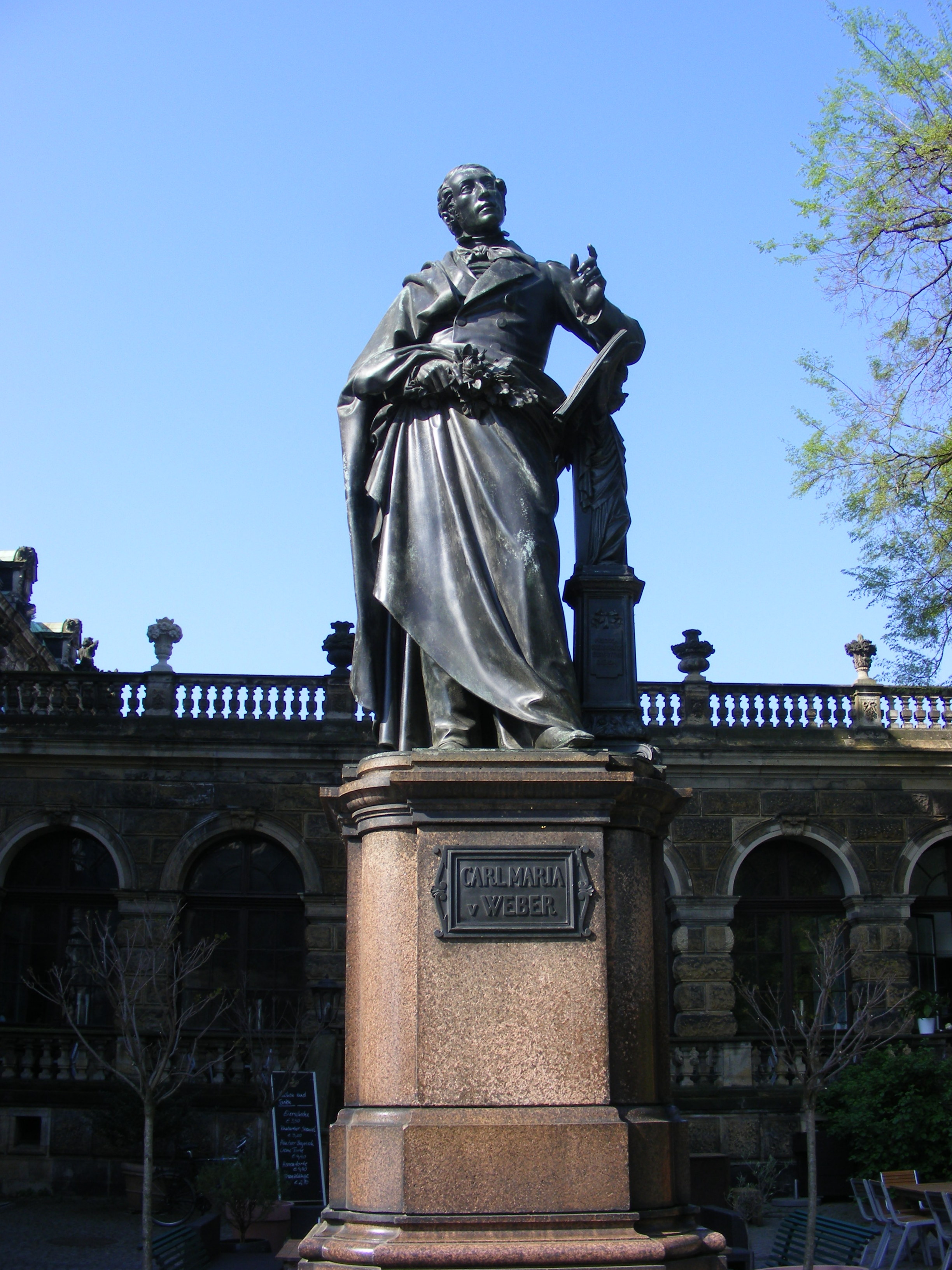
I should have used this book for A and E, as well. Never mind. Here’s Weber, in Dresden again.
I’ve mentioned Heather Rose Jones’s Alpennia a few times in this series, but it seems remiss not to talk about Rotenek and, in particular, the Rotein. The river shapes the city, and the society, and, quite often, the plot. The social calendar is driven by the flooding; so is religious observance; so is public health (or lack of it).
High in the mountains to the east and south of Alpennia, spring rains and warming winds wash the winter’s snow from the peaks and send it tumbling down the valleys. The melt gathers in rivulets; rivulets turn to streams; streams feed rivers. The Esikon, the Tupe and the Innek swell the Rotein, which flows through the heart of the city of Rotenek. And the city flows through the Rotein: in barges bringing goods up from French ports, in riverboats rowing passengers along the banks and up the narrow chanulezes that thread through the neighborhoods of both the upper and lower town.
They celebrate floodtide in Rotenek when the waters turn muddy and rise along the steps of the Nikuleplaiz as far as the feet of the statue of Saint Nikule, who watches over the marketplace. Sometimes the floods come higher and wash through Nikule’s church and along the basements of the great houses along the Vezenaf. Then the streets of the lower town merge with the chanulezes, and all the putrid mud from the banks and canals is stirred up, bringing the threat of river fever. For those who can leave the city, floodtide signals an exodus to the pleasures of country estates. Those who remain light a candle to Saint Rota against the fever.
But sometimes floodtide fails to come. […]
This ambivalent relationship between the river and the citizens is so central to the books that it took me a while to find a passage that encapsulated it. It makes the series. And it makes the city.
Finally, I’m heading back north and west. I commented over at Licence To Queer how muted in tone Casino Royale feels in contrast to the rest of the Bond books – a result, I think, of its being the first of the series, where Fleming’s still finding his way in, and its having been written and published so soon after the end of the Second World War, in a Europe that was still working out how it was going to rebuild itself. And Royale-les-Eaux typifies that. This isn’t the Côte d’Azur, it’s the opposite side of France, and it’s grey and shabby:
Royale-les-Eaux, which lies near the mouth of the Somme before the flat coast-line soars up from the beaches of southern Picardy to the Brittany cliffs which run on to Le Havre, had experienced much the same fortunes at Trouville.
Royale (without the ‘Eaux’) also started as a small fishing village and its rise to fame as a fashionable watering place during the Second Empire was as meteoric as that of Trouville. But as Deauville killed Trouville, so, after a long period of decline, did Le Touquet kill Royale.
At the turn of the century, when things were going badly for the little seaside town and when the fashion was to combine pleasure with a ‘cure’, a natural spring in the hills behind Royale was discovered to contain enough diluted sulphur to have a beneficent effect on the liver. […]
It did not long withstand the powerful combines of Vichy and Perrier and Vittel. There came a series of lawsuits, a number of people lost a lot of money and very soon its sale was again entirely local. Royale fell back on the takings from the French and English families during the summer, on its fishing-fleet in winter and on the crumbs which fell to its elegantly dilapidated Casino from the table at Le Touquet.
Here Fleming uses not only familiar names and places in which to ground his fictional town (some of them with ominous resonances), he gives it a mineral water too. And, more importantly, a plausible past. I always have a soft spot for a run-down seaside town. Though the 2p machines are more my level.
Books mentioned in this post
Casino Royale, Ian Fleming
The Prisoner of Zenda, Anthony Hope
Alpennia series, Heather Rose Jones (passage quoted is from Mother of Souls)




 Kathleen Jowitt