Heading vaguely in the direction of a launch

Cardboard box containing a stack of paperback copies of 'The Real World'

It’s almost a month since I uploaded the finalised files for The Real World. The wheels are turning, and, though I’m never quite confident that the book is going to appear on the sites I want it to until it, you know, appears on the sites I want it to, I think it’s all heading in the right direction.

I’ve approached some bloggers and reviewers, some of whom have previously enjoyed Speak Its Name, and some who I’ve only recently come across. And apart from that, I’ve just got to hurry up and wait.

In the meantime…

… I’ve put an extract – the first thousand words or so – up. Find it here.

… I’m going to be having a launch party over on Facebook. Time: 8.30pm GMT. Date: 2 November 2020. I’ll be reading a bit (the awkward party scene seems appropriate) and answering some questions. Bring your own fizz and canapés. And questions. RSVP here.

… I’m doing a giveaway of some ebook copies over at LibraryThing. Scroll about half way down this page to find it.

Wings Over The Plain: new story at Enchanted Conversations

Storks on the bell tower at Belorado

I’m very pleased to announce that I’ve had a story published today over at Enchanted Conversations. If you haven’t come across it before, the site is an utter delight – a treasure trove of stories new and old, essays, poems, and other material related to fairy tales.

Wings Over The Plain is a story that was inspired by the Camino de Santiago – specifically, the long drag of the Camino Frances across the meseta, the plain that forms much of the province of Castilla y Leon. It’s inspired by the landscape, and the skyscape, the longstanding association of the Camino with the Milky Way. But most of all it’s inspired by the storks who build their nests on any elevated corner they can find and who, for me at least, were one of the loveliest sights of a lovely journey.

Winter is harsh out on the high, broad, plain of Castile. There’s nothing to stop the wind: it blows in cold from the sea, and becomes colder still as it crosses the mountains. Sometimes it brings snow; sometimes it just sweeps bitingly around every hunched tree and huddled building, and the people get through the winter as best they can. And on those long, cold, nights, the sky breaks into stars, more of them than you could count, brighter than you can imagine, showing a westward path that only the very devout or the very foolish follow at this time of year…

Read Wings Over The Plain here

Page 69, revisited

Remember the Page 69 test? It’s where you:

Turn to page 69 of any book and read it. If you like that page, buy the book. It works.

Marshall McLuhan, quoted in ‘How To Read A Novel’ by John Sutherland

Last time round, I put both my existing books through the test, showed you what would have been page 69 had The Real World gone to print as it stood, and promised to be back ‘in a few months’ with the final page 69.

Well, just over a year later, here we are.

Page of a book. The text is transcribed below.

… make a great sermon illustration. You could demonstrate a miracle.’

Lydia sniggered. ‘And I noticed they weren’t using actual custard. Does actual custard not work? Or is it too expensive to make a whole paddling pool full?’

Colette thought about it. ‘Do you know, I’m not sure. The egg might do something weird…’ She frowned at her diagram: she’d missed a bond somewhere. When she next looked at the screen, an Asian woman was talking enthusiastically about the properties of wood. Barry did not appear again.

*

‘Are you up to anything interesting today?’ Colette asked the next morning.

‘Not at work. But I’m going to have lunch with Felicity, and bring her up to date with all the discernment stuff.’

‘Ah.’ Colette felt faintly put out. It wasn’t really fair, she knew: Felicity had as much right as anybody to know what was going on in Lydia’s life, and more than most. Felicity had been the one who had started all this, had been the one to say to Lydia, ‘So have you ever thought about ordination?’

‘Is that OK? I did mention it a few days ago.’

Colette remembered, and quashed an irrational surge of resentment. Why shouldn’t Lydia talk to Felicity? Why shouldn’t she let off steam? Why shouldn’t she complain to Felicity about the arcane processes of their Church, and the fact that she wouldn’t be getting married any time soon? ‘You did. It’s fine. Are you still going to want dinner when you get home?’

Lydia stretched up to kiss her cheek. ‘If you’re cooking.’

It was her turn. ‘I’ll sort something out.’

*

It was a grey day, and colder outside than it looked. Colette regretted walking up to campus, but told herself that waiting for the bus on Southview would be even colder. She buttoned her coat up to…

Well, other than the fact that this one also begins and ends mid-sentence, I think it works better than the previous page 69. It’s more representative. We get a hint of Colette’s academic trials (Barry, who has just pulled a disappearing act, is her PhD supervisor) and also see her being more absorbed than strictly necessary in an intriguing but unimportant question; we do get the Church of England and the discernment process this time. We lose James, but we gain Felicity. (They’re both new supporting characters, and I’m quite fond of both of them.) There’s also more of a sense of place, which is something I’ve been working on quite a bit lately.

If you preferred the previous page 69, well, it’s all still there. It’s just on page 76 now. And I’ve replaced [thing] with spike.

If you like it, buy the book, says Marshall McLuhan. Well, you’ll be able to do that in just under a month. If you want a reminder on the day, sign up for my newsletter.

Visibility, possibility: links for bi visibility day

I put the finishing touches to The Real World a week ago, and since then I’ve been doing my best to do very little. Writing this book has taken an awful lot out of me, and I’m trying to make up for that by sitting in a deckchair on the lawn, reading other people’s books.

But I do also write things that aren’t 94,000 word novels, and I’m very pleased to have two pieces to share for Bi Visiblity Day. As I wrote in one of these,

my experience of being bisexual has been the ever-present consciousness of other possibilities. I’ve made a particular series of choices, my life has unfolded in a particular way – but I’m always aware that I could have made other choices, that my life might look very different today if… If I hadn’t grown up under Section 28. If I’d heard the word ‘bisexual’ before the age of 20. If, if, if.

I might have taken the road more travelled by, but that doesn’t mean all the other roads disappear from existence. (They closed the road through the woods…) Both of these pieces explore that sense of possibility, in fiction and in non-fiction (A merry road, a mazy road…).

The first one is perhaps more bi audibility than visibility, as it’s a podcast. This is the second story I’ve had featured at A Story Most Queer (the first was Prima Donna), but my first to be premiered there. I’ve added a PDF version too. It’s a fairy tale about a young woman who sets out to look for her friend who’s gone missing…

Daisy’s Yarn (podcast)

Daisy’s Yarn (PDF download)

The second piece is a guest post at Licence To Queer, where I wander all over the 007 canon, both book and film, looking for bisexual possibilities and revisiting my Eng Lit past. I even gave it a proper Eng Lit essay title with a colon in the middle. If that sounds a bit dry, I should also warn you that I fail to answer the question of what Felix Leiter was doing in Bond’s hotel room, and that I do pick up on a surprising allusion to the Book of Common Prayer. Fortunately David’s added some pictures.

“What makes you think this is the first time?”: assumption, possibility, and bisexuality in Bond

If you’re at all interested in James Bond and queer themes I recommend the whole Licence To Queer site heartily: it’s a joyful deep dive into the world of 007 – with some intriguing cocktail recipes too.

Interestingly, while The Real World has turned out to be an extremely bi novel in other ways, the sense of possibility isn’t nearly so present. Except, perhaps, as a sense of something missing, something distorted… Ah, you’ll see.

Annoying pricing news

Corner bookshelf stacked with books

I’m sorry to say that the prices of Lulu’s paperback books have gone up quite a lot. I’d intended to price The Real World at £8.99, the same as the other two, but I find upon uploading the file that it won’t let me put it on at anything under £13.06. Which is a silly price, liable to change with exchange rates. And it’s a bit demoralising for me not to be paid anything at all, so I’m afraid that when it appears it’ll be £13.99.

Worse news: the other two books will also have to go up, because the current cover price isn’t covering the printing and distributor costs. (This might explain why I don’t seem to have been paid for any Amazon sales recently.) Oh, well: I suppose I was making new covers anyway (a complete redesign for Speak Its Name, and adding an award badge to A Spoke In The Wheel) – so I might as well add the updated prices.

I do understand that there’s a pandemic on, and no doubt printers’ costs have gone up the same as everything else, but I feel that fourteen quid is a bit steep for a paperback myself. So I’m going to knock another quid off the price of the ebook. I also understand that ebooks don’t work for everybody, and fourteen quid is still a bit steep for a paperback. If you’re not in a hurry, it’s worth waiting for Lulu to do a 10% or 15% off promotion, which happens quite frequently (though you may still get dinged on the postage). If you’re really not in a hurry, Amazon occasionally makes substantial reductions on POD paperbacks (I note for the benefit of fellow Clorinda Cathcart fans that A Man of Independent Mind is currently down to £3.37, for example) but I can discern no rhyme or reason to this, and it may never happen to any given book.

I’ve no desire to set myself up as a bookshop, but in exceptional circumstances I’ll consider supplying the paperback at [cost price] + [postage and packing]. If, when the time comes, you’re someone for whom the difference between £8.99 and £13.99 is really quite a big one, drop me an email and I’ll see what I can do.

In the meantime, you can find a number of free reads (and listens!) linked from the menu at the top of this site, and there are a couple of exclusive ones available if you sign up to my newsletter. Which I really must get round to sending, as I have a couple of things to announce…

The Real World: cover reveal (and one for luck!)

Speak Its Name wasn’t meant to have a sequel. I thought I’d made all the points I’d wanted to make, answered all the questions I’d raised in it, had taken the characters as far as they needed to go.

Ninety-four thousand words say otherwise. I was wrong. Stancester was a city I hadn’t finished with – and perhaps still haven’t finished with. The Real World, which picks up the action three years later, works as a standalone, but adds something to Speak Its Name, makes it something more than it was before. And so it seemed appropriate to create not one but two covers.

Here’s The Real World:

Book cover: 'The Real World' by Kathleen Jowitt, featuring a red stained glass flower with green leaves on a red, floral patterned, background.

Colette is trying to finish her PhD and trying not to think about what happens next. Her girlfriend wants to get married – but she also wants to become a vicar, and she can’t do both. Her ex-girlfriend never wanted to get married, but apparently she does now. Her supervisor is more interested in his TV career than in what she’s up to, and, of her two best friends, one’s two hundred miles away, and the other one’s dead.

Welcome to…

The Real World.

And here’s Speak Its Name:

Book cover: 'Speak Its Name' by Kathleen Jowitt, featuring a stained glass passion flower on a magenta background with a floral print

A new year at the University of Stancester, and Lydia Hawkins is trying to balance the demands of her studies with her responsibilities as an officer for the Christian Fellowship. Her mission: to make sure all the Christians in her hall stay on the straight and narrow, and to convert the remaining residents if possible. To pass her second year. And to ensure a certain secret stays very secret indeed.

When she encounters the eccentric, ecumenical student household at 27 Alma Road, Lydia is forced to expand her assumptions about who’s a Christian to include radical Quaker activist Becky, bells-and-smells bus-spotter Peter, and out (bisexual) and proud (Methodist) Colette. As the year unfolds, Lydia discovers that there are more ways to be Christian – and more ways to be herself – than she had ever imagined.

Then a disgruntled member of the Catholic Society starts asking whether the Christian Fellowship is really as Christian as it claims to be, and Lydia finds herself at the centre of a row that will reach far beyond the campus. Speak Its Name explores what happens when faith, love and politics mix and explode.

I’ll be uploading the new cover for Speak Its Name at the same time as sending The Real World live (give or take – I may need a bit of a lie down in between), meaning that they should both be available on 2 November.

In the meantime, you can add The Real World to Goodreads, or join my mailing list, or, of course, both.

The Reader’s Gazetteer: R

DSCF7432

Ruritania is, for me, where it all started. My father read The Prisoner of Zenda to me when I was perhaps ten or eleven, and it’s stuck.

Anthony Hope presents the kingdom of Ruritania as if we already know about it, introducing his narrator, Rudolf Rassendyll, and the Rassendylls in general with reference to

an highly interesting and important kingdom, one which had played no small part in European history, and might do the like again

The journey to Ruritania occupies the first half of chapter 2. Rudolf goes via Paris and Dresden – a city from which, in the reality we currently inhabit, one can go east into Poland or south into Czechia. (The train in the photo at the top of this post is waiting at Dresden Hauptbahnhof before heading south to Prague.) South feels more likely to me. Ruritania is implied to be, if not huge, reasonably expansive in terms of territory: Zenda is ten miles from the frontier, and Strelsau, the capital, fifty miles further than that. And there’s no suggestion that Strelsau is very close to any other frontier.

In fact, Hope uses a pretty light touch all round. The descriptions in The Prisoner of Zenda are reserved for smaller geographical features – woods, castles, cities – which I’ll come to later in the series. Paradoxically, that’s part of what makes Ruritania feel real. You don’t need to be told what it looks like. It isn’t Anthony Hope’s fault that you weren’t paying attention in Geography. Or History. But the imaginative landscape is huge.

Philip Pullman doesn’t stray so very far either from this locale or from this model for Razkavia, in The Tin Princess. He shies away from doing anything drastic to the map of Europe, squeezing it in between Prussia and Bohemia, and making it ‘hardly bigger than Berkshire’.

But he has put some thought into other aspects of geography:

The country wasn’t especially prosperous. There had once been rich mines in the Karlstein mountains, producing copper and a little silver, but as long as two centuries before they had begun to run out, at least of copper. There was plenty of some ore that looked like copper but wasn’t, and which poisoned the miners who worked it. It was so useless and unpleasant that they called it Kupfer-Nickel, or devil’s copper, and left it well alone. Much later someone discovered that Kupfer-Nickel was a compound of arsenic and a new metal, which they called nickel,  and by the beginning of the nineteenth century they’d found some uses for it, so the mines of Karlstein began to work again.

This will, of course, be important later, but in the meantime:

The people milked the cows that grazed on the upland pastures, made wine from the grapes that grew on the slopes of the Elpenbach Valley, and hunted the game in the forests. In the capital, Eschtenburg, there was an opera house, where the composer Weber had once conducted; there was a theatre and a cathedral and a pretty baroque palace, all fantastic columns and fountains and icing-sugar plasterwork; and there was a park with a grotto-pavilion built by Razkavia’s one mad king, who had been fairly harmless, as mad kings went. In the 1840s, the younger set of the aristocracy, tired of the stuffy life around the king and his conservative court, tried to establish a little spa called Andersbad, down the Elpenbach Valley, as a centre of fashion. There was a casino; Johann Strauss had played there with his orchestra and they’d even paid him to write an Andersbad Waltz, although it wasn’t one of his best.

I should have used this book for A and E, as well. Never mind. Here’s Weber, in Dresden again.
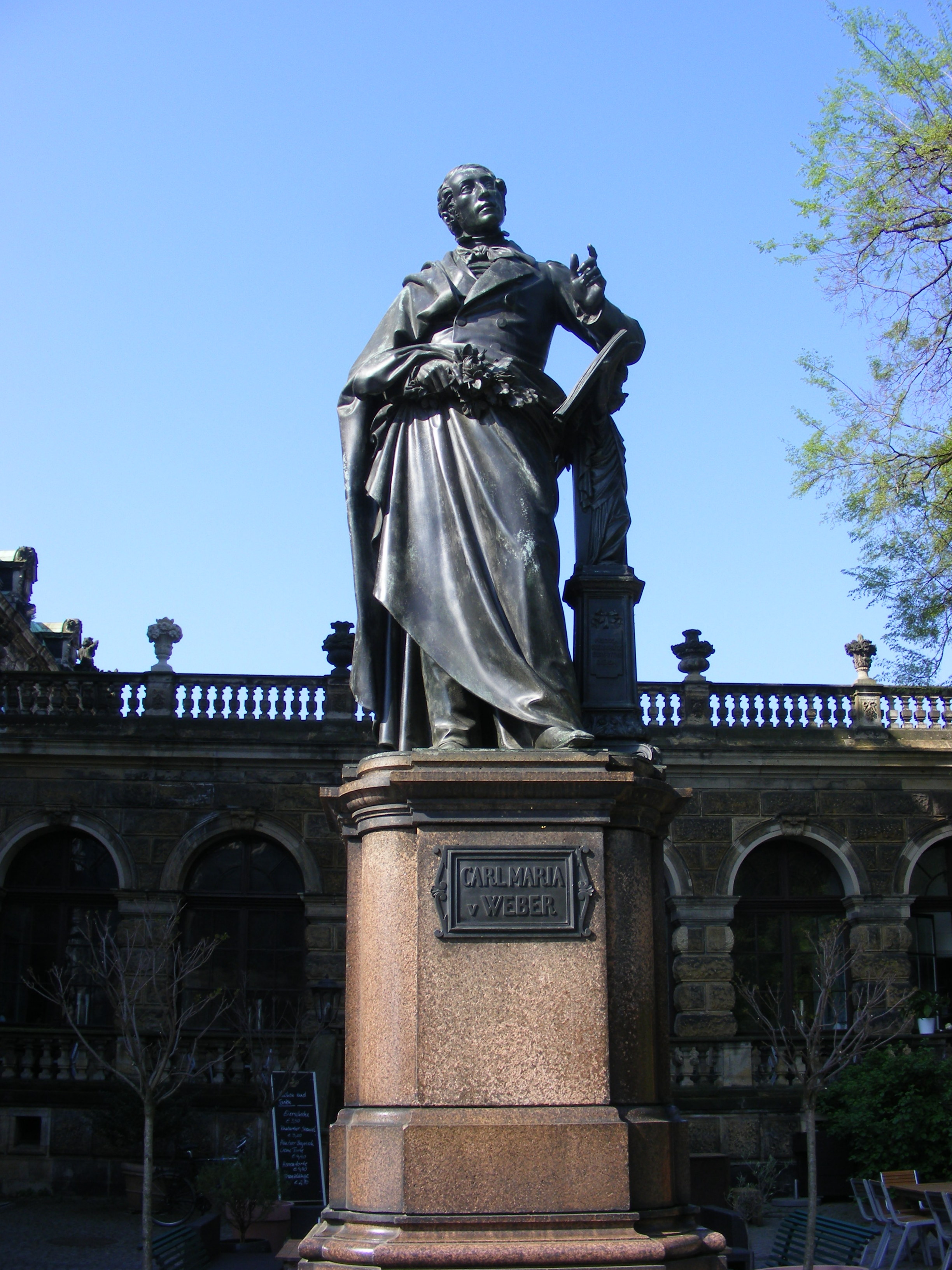
DSCF7403

I’ve mentioned Heather Rose Jones’s Alpennia a few times in this series, but it seems remiss not to talk about Rotenek and, in particular, the Rotein. The river shapes the city, and the society, and, quite often, the plot. The social calendar is driven by the flooding; so is religious observance; so is public health (or lack of it).

High in the mountains to the east and south of Alpennia, spring rains and warming winds wash the winter’s snow from the peaks and send it tumbling down the valleys. The melt gathers in rivulets; rivulets turn to streams; streams feed rivers. The Esikon, the Tupe and the Innek swell the Rotein, which flows through the heart of the city of Rotenek. And the city flows through the Rotein: in barges bringing goods up from French ports, in riverboats rowing passengers along the banks and up the narrow chanulezes that thread through the neighborhoods of both the upper and lower town.

They celebrate floodtide in Rotenek when the waters turn muddy and rise along the steps of the Nikuleplaiz as far as the feet of the statue of Saint Nikule, who watches over the marketplace. Sometimes the floods come higher and wash through Nikule’s church and along the basements of the great houses along the Vezenaf. Then the streets of the lower town merge with the chanulezes, and all the putrid mud from the banks and canals is stirred up, bringing the threat of river fever. For those who can leave the city, floodtide signals an exodus to the pleasures of country estates. Those who remain light a candle to Saint Rota against the fever.

But sometimes floodtide fails to come. […]

This ambivalent relationship between the river and the citizens is so central to the books that it took me a while to find a passage that encapsulated it. It makes the series. And it makes the city.

Finally, I’m heading back north and west. I commented over at Licence To Queer how muted in tone Casino Royale feels in contrast to the rest of the Bond books – a result, I think, of its being the first of the series, where Fleming’s still finding his way in, and its having been written and published so soon after the end of the Second World War, in a Europe that was still working out how it was going to rebuild itself. And Royale-les-Eaux typifies that. This isn’t the Côte d’Azur, it’s the opposite side of France, and it’s grey and shabby:

Royale-les-Eaux, which lies near the mouth of the Somme before the flat coast-line soars up from the beaches of southern Picardy to the Brittany cliffs which run on to Le Havre, had experienced much the same fortunes at Trouville.

Royale (without the ‘Eaux’) also started as a small fishing village and its rise to fame as a fashionable watering place during the Second Empire was as meteoric as that of Trouville. But as Deauville killed Trouville, so, after a long period of decline, did Le Touquet kill Royale.

At the turn of the century, when things were going badly for the little seaside town and when the fashion was to combine pleasure with a ‘cure’, a natural spring in the hills behind Royale was discovered to contain enough diluted sulphur to have a beneficent effect on the liver. […]

It did not long withstand the powerful combines of Vichy and Perrier and Vittel. There came a series of lawsuits, a number of people lost a lot of money and very soon its sale was again entirely local. Royale fell back on the takings from the French and English families during the summer, on its fishing-fleet in winter and on the crumbs which fell to its elegantly dilapidated Casino from the table at Le Touquet.

Here Fleming uses not only familiar names and places in which to ground his fictional town (some of them with ominous resonances), he gives it a mineral water too. And, more importantly, a plausible past. I always have a soft spot for a run-down seaside town. Though the 2p machines are more my level.

Books mentioned in this post

Casino Royale, Ian Fleming

The Prisoner of Zenda, Anthony Hope

Alpennia series, Heather Rose Jones (passage quoted is from Mother of Souls)

The Tin Princess, Philip Pullman

ABCDEFGHIJKLMNOPQRSTUV

Getting ready for The Real World

DSCF1872

Over the last few weeks I’ve been going back through old journals. A little over two years ago, at the end of July 2018, I wrote:

I am feeling ready to start the new books. They are both feeling pretty huge and intimidating, as if the end of them is a long way off, but that’s to be expected.

Yes, that’s books, plural. One of them was ‘the Ruritanian thing’. The end of that is still a long way off: it’s sitting at 12,500 words, and I haven’t done nearly as much work on it as I’d expected.

But the other one was what is now The Real World. And it’s done.

I’m always surprised by the way I suddenly know that a book’s finished. It’s a pleasant surprise, because it’s characterised by the departure of worry. I stop worrying about whether it’s any good or not. I stop worrying about who I might have offended and what I might have got wrong. I stop worrying about what people might make of it. It’s not that I stop caring – I still care, very much, about making this book good – but I stop worrying. It’s a painless separation, and it happens when the book is ready and not before.

When I say it’s done, I mean that I’ve got the text as good as I, personally, can make it. I may still change things. I have the usual cohort of beta readers and editors and nitpickers looking at it at the moment, and I may draft more in.

And I still have all the typesetting and design work, all the fiddly stuff that comes before pressing the ‘publish’ button, to be done. The cover is, I think, nearly there (of course assuming that I don’t look back at it in a month and decide that actually it’s irredeemably naff), but there are a lot of other things to be done.

But I’m confident enough that I’ve got something decent that I’ve committed to a publication date.

2 November 2020.

Mark your calendar, sign up for my newsletter, add it to Goodreads, whatever. Or just pop back closer to the time. It’s going to happen.

Three quick links

13-2014 August 039

Firstly, I’ve finally sorted myself out with a mailing list. This is solely for the purpose of letting people know when I’ve got new stories available – my between-times burblings will remain here on the blog. If you want to receive a very occasional email letting you know that I’ve got a new book out, or a piece in someone else’s podcast or anthology, and also to read subscriber-only short stories, sign up to my mailing list

Secondly, Ezvid Wiki think I’m generating a lot of buzz.

Thirdly, this is the last week in which Speak Its Name and A Spoke In The Wheel are free.

Meanwhile, in the real world…

IMG_20200709_180932

Do you remember how, back at the beginning of lockdown, various obnoxious productivity types were telling us all that if we didn’t come out of it with a new skill or a novel then we were all pathetic failures? I haven’t heard so much from them recently. That may have something to do with my spending less time on Twitter. Or the obnoxious types may have discovered that in fact it’s not so easy to get things done with a global crisis going on outside, and have shut up.

As it happens, I’ve learned a few new skills – painting walls, making curtains, changing taps – but they’ve had more to do with having just moved house than with enforced leisure. I’ve continued to work full time, so, apart from the commute (which I’ve gleefully replaced with an additional daily hour in bed) I haven’t had much in the way of enforced leisure. Anyway, I went into lockdown with a novel, or, at least, 93,000 words of one, so it would be a bit of a cheat to claim that it had anything to do with coronavirus. If anything, I was hoping to make it shorter. As it is, I’ve now got 94,661 words. They’re better, though. They’re quite a lot better.

They’re good enough for me to say, tentatively, that this book’s going to come out this year.

I’m aiming for a release date in November. Of course, this means that I need to have everything done in September, which means that I’ve only got a couple of months to get things done. But that feels achievable, now, in a way that it didn’t at the beginning of the year.

Meanwhile, my existing books will remain free to download from Lulu until the end of this month. After that they’ll go back to full price. Consider this fair warning, and, if you haven’t grabbed them already, you can find them here: