(Part 1: can’t you hear that whistle blowing?)
14th April 2018
I walk through Saint Pancras every morning on the way to work, and often get a kick out of the signs – and, if I’m lucky, announcements – in French. It lifts the spirit to think that, if the prospect of continuing out the other side, crossing Midland Road and the piazza of the British Library, and joining the Euston Road, got too much for me, I could go to Paris or Brussels or Amsterdam instead. Assuming my credit card could cope, of course.
I never do. I head straight on through and go to work. It’s just nice to know that I’ve got the option.
This particular morning, however, I crossed Euston Road and sat down in Le Pain Quotidien with an espresso and a ham and cheese croissant. This was not a normal work day. It wasn’t a work day at all; it was a Saturday. And I’m never normally in London this early.
Nor do I usually step into the labyrinth of Tensabarriers, send my suitcase (I’m not usually trailing a suitcase) through the X-ray scanners, have my irises digitally compared with my passport, and end up in the closed off area under the Eurostar platforms. There are no windows. There are lifts and escalators that you’re not allowed to go up until you’re called, and loads of people sitting around on rows of seats. It’s like a portal fantasy. The Continent begins (at the time of writing) here.
I might have considered having a ceremonial glass of wine or beer to mark the official beginning of the trip, except it was a bit early in the morning, and anyway, I’d done that yesterday.
I left London on the first sunny day in weeks. It had been a depressing grey spring, punctuated by snowfall and chaos, and a dispiriting padding of cloud had been hanging around the place. This morning it had lifted and, though the trees were still bare, the tower blocks of London and the fields of Kent were washed in gold. Anyway, I was determined to like everything. I was delighted that my train would go on to Amsterdam, even though I wouldn’t. I was delighted by the fact that I could use the Internet underneath the English Channel. I was delighted by the dinky Eurostar coffee cups and the flat landscapes of northern France, and the sense of a beginning.
At Bruxelles-Midi, it all became a little terrifying. I spent some time wandering the station shops in search of a luggage label, buying some provisions in the Carrefour, and checking repeatedly to make sure that my Interrail pass and my passport were where I thought they were. Then to make sure that I’d written what I was meant to write in the pass…
If you’re trying to travel by train across Belgium into Germany without having made a reservation, you have to change at Welkenraedt and then Aachen. (Once you’re into Germany, you can stop worrying.) So what I wrote was 14/04, 1256, BRUXELLES, and WELKENRAEDT.
Eventually I had to stop fretting and get on my train. I appreciated for the first time that first class meant that there would be loads of space. I amused myself by alternately looking out of the window, reading the bilingual signs about being a considerate traveller, and anticipating the arrival of the conductor. The conductor punched my pass in the slot next to where I’d written WELKENRAEDT, and told a trio of young British men that the trick for recognising first class carriages (for which they didn’t have tickets) was to look for the stripe of yellow over the door. I hadn’t known this, and it was to save me a lot of looking over the next three weeks.
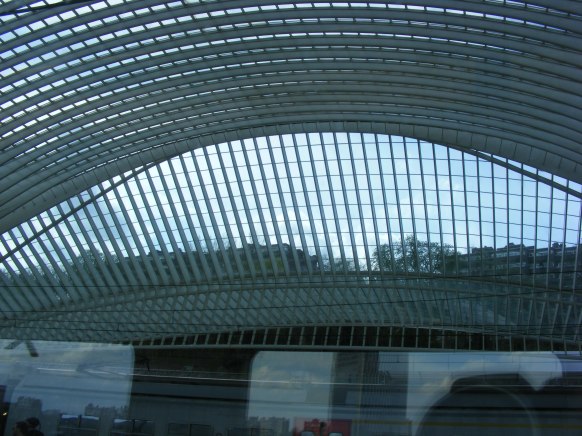
Europe By Rail had recommended watching out for Liège Guillemins station. It’s foreshadowed by a similarly elegant white-painted bridge, but even so it’s a lovely shock, part greenhouse, part palace. After Liège, the train dawdled through tunnels and valleys in the Ardennes, and there were suddenly bright young green leaves on the trees, and the sky was blue.
The train from Welkenraedt to Aachen was a scruffy local affair with only a couple of coaches; it deposited me at the German border without fanfare. I decided that if I was going to be at all spontaneous on this trip, I might as well start now and go and look at where Charlemagne was crowned. I managed to speak (and understand) enough German to find out where the left luggage lockers were, and I shoved my bags and coat into one of them and walked very fast across the city.
If I had any doubt about spring having arrived here, the exuberant full-blossomed magnolia tree outside the cathedral dispelled it. The cathedral itself was surprisingly small, and very full of people. The walls and ceilings were covered in glittering mosaics, mostly blue and gold, and in the choir there was rich stained glass. It felt like being in one of those very superior kaleidoscopes.

Germany would form a sort of hub on this adventure. I would spend several nights there, one way or another, and pass through it in various different directions. Part of that is the geography; part of it the freedom from mandatory reservations. But it was very appropriate. A little over ten years previously I’d been an au pair for my aunt in Frankfurt, and had spent some time hanging around the Hauptbahnhof looking at the departure boards, at all the places I might one day go to. My first international train journey had begun in Frankfurt, when I returned briefly to the UK to attend my sister-in-law’s wedding in Leighton Buzzard. The Eurostar came into Waterloo in those days: that’s how long ago it was. But Germany is still a good place to take a train.

I took one from Aachen to Düsseldorf, and took the brief glimpse of a hot air balloon through the window as a vindication of all my life choices. At Düsseldorf I joined a train with an observation carriage whose panoramic windows stretched all the way up into its roof. There wouldn’t be much to see overhead on the way to Hamburg in the gathering dusk, but it had come from Switzerland that morning. Once more I was reminded of how far the mainland European rail network could take me. The evening drew in and the landscape got less interesting, and I turned to Barchester Towers.
I rolled off the train at Hamburg at half past nine with no other desire than to go to bed. Thirteen hours on the rails was quite enough for one day. I wasn’t remotely interested in Hamburg’s nightlife, anyway. I suspected it of being full of British stag parties.
I turned the wrong way out of the station, which was annoying but meant nothing worse than a walk that was slightly longer than it needed have been. After a little while I looked at Google Maps and retraced my steps. My hotel was possibly the tattiest one I’ve ever stayed in. The floor was imperfectly covered with two ragged-edged pieces of carpet; the washbasin was cracked, and the furniture was battered. Still, I didn’t need to look at it when I was asleep, and, other than washing a few items of clothing in the sink, that was all that I intended to do there.
15th April 2018
I put my suitcase into left luggage and then ate breakfast at a café a short distance from the station – a substantial array of rolls, ham, cheese, and a boiled egg. After that glorious sunny journey the day before, the weather had returned to grey drizzle, but it didn’t seem so depressing now I was on holiday. I watched the umbrellas go by outside the window (red, orange, pink, purple with a frill) and listened to the church bells. I thought about going to see the cathedral, but didn’t want to crash a service. It kept drizzling. I ordered a mint tea (real mint leaves!) and waited for it to stop drizzling. It didn’t.

There was one thing that I really did want to do in Hamburg, and that was visit Miniatur Wunderland. It might be the best train set in the world. It’s certainly the biggest. When I’d finished my mint tea, I set out to walk to it.
For me, some cities remind me irresistibly of others; some quirk of geography or architecture draws a line between places hundreds or thousands of miles apart. I suppose it’s the same impulse that gives us the Athens of the North or all those Little Venices. For me, Hamburg had a sense of Reading about it, for no good reason beyond the watercourses and the wide, pedestrianised, shopping streets, and being there at the beginning of an adventure.

I loved Miniatur Wunderland. Hundreds of model trains; thousands of little people; the cosiness of artificial nightfall, and all the little lights coming on. The only thing was, there was so much of it, and I had so little time there. Already I had an inkling that the whole thing was going to be like this: moving at varying speeds through different landscapes, knowing that I didn’t have a hope of seeing all the detail. In two hours I’d travelled through North America, the Arctic, Germany, Switzerland, and Italy. Night had fallen and day had broken seven or eight times. Really, though (I wrote in my diary) it’s all about the trains going in and out of mountain tunnels and over bridges – so I liked the Switzerland display best.


A brisk walk back across the city, keeping an eye out for somewhere to eat, took me back to the station, where I ordered pork schnitzel and chips in one of the restaurants. I had to wolf it down, having got ‘half past two’ into my head, when my train in fact left at 1423. And I still had to get my suitcase back. And, because I was leaving Germany, I had a reservation on this one.

I made it with about half a minute to spare and crammed myself into the vestibule along with a dozen other people. Once I’d got my breath back, I began to proceed along the train in what I hoped was the direction of first class. This was a Danish train, and even the standard class sections looked pretty comfortable; on the downside, I couldn’t work out the numbering of the carriages or the seats. I got to mine in the end, and was rewarded by being invited to complete a survey by a very pleasant chap. I don’t think the survey was particularly interested in foreign tourists, though, because it didn’t take very long.
We headed north. I looked out for the Kiel ship canal with some interest, having read The Riddle of the Sands fairly recently. The hulking cranes were about as close as I was going to get to Erskine Childers’ shifting islands and treacherous tides. The train stopped for a passport check at the Danish border. A quick change at Fredericia, and now I headed east.
I arrived in Copenhagen as twilight was falling. The railway station faces onto the back of the Tivoli garden. (‘Dead tacky,’ my manager, who had just been to Copenhagen, had told me, ‘but go in the evening because the lights are pretty.’) My hostel was on Hans Christian Andersen Boulevard, which runs parallel to the street where I now stood. I walked around one and a half sides of the Tivoli and then, inevitably, went the wrong way down Hans Christian Andersen Boulevard. Most of the buildings were plate glass slabs with nothing as helpful as numbers on them, so I had to go quite a long way before I could be sure that I needed to turn back.
Danhostel Copenhagen City was tall, and gleamingly white inside and out. Well, the reception area was grey-brown wood-effect, and the lifts (which recognised your keycard and then directed the appropriate lift to you, and you to it) were the usual stainless steel, but mostly it was white. Reading my key holder, I discovered that the building which was now the hostel had once been the headquarters of a major Danish trade union. Talk about a busman’s holiday. I was allocated a bunk in a dormitory on the thirteenth floor, and was very happy to take advice from the lifts. Out of the window I could see the whirling lights of the Tivoli, a long, long way down.
I went and had a closer look: I paid to get into the gardens and then wandered around, not going on any of the rides but just exploring, following illuminated paths, gazing up at lanterns in the trees and brilliant carriages whirling and corkscrewing above me.

After a while, when I’d got thirsty and tired, I went back to the youth hostel and had a beer in the bar. I tried to order breakfast for the next day; some vital bit of the system wasn’t working, so the night receptionist wrote me a note to instruct the morning receptionist that I was entitled to buy breakfast at the discounted, preordered rate.
16th April 2018
The next day was, as it happened, Queen Margarethe’s birthday. The first sign of this was a pair of flags on each bus. It was still rush hour when I left the hostel; aside from the buses, there were vast flocks of cyclists making their way down the broad, segregated, cycle lanes either side of Hans Christian Andersen Boulevard. I was jealous: I live in Cambridge, which has as significant a cycling population as anywhere in the UK, and we have nothing so good.

Hans Christian Andersen himself – at least, his statue – sat at the corner of a square adjoining his boulevard. I crossed it. My manager’s other recommendations had been the Round Tower and the boat trip (‘and don’t bother with the Little Mermaid because the walk takes ages and you see the back of it from the boat’). I set off through the morning mist towards the Round Tower. Along the way I found the cathedral, whose understated, austere, lightness I liked a lot. I liked the Round Tower, too: a former observatory, with a church, an art gallery, and a historical exhibition to look at on the way up, and a theoretical view from the top (it really was quite misty), it combined a lot of the things I’d usually visit in a city. Then there was the novelty of the fact that it has a spiral ramp, rather than stairs, almost all the way to the top. I resolved to report on it to my best friend, who uses a wheelchair, and my husband, who doesn’t like spiral staircases.

I didn’t have time to look at everything, however; at least, not then. I was making my way back down the spiral to go into the church when I heard the sound of a brass band.
I knew it was the Queen’s birthday. The shop assistant in the art gallery had told me so, too, when I’d bought postcards. And she’d told me that the Queen would appear on the balcony at the Amalienborg palace at noon.
In London I would not be seen dead waiting outside Buckingham Palace for Queen Elizabeth to show. But here I was a tourist, and the guards were passing right there in front of me, and really it seemed like a waste not to. The guards looked strangely familiar, in their black bearskins and scarlet tunics. I followed them and the crowd, to faintly unlikely music including The British Grenadiers and Dixie (but not very much of either), along shopping streets and across squares, down gracious avenues; then followed the crowd past embassies and fountains, and into a sea of red, white-crossed, flags under the palace windows.
There were palace windows on every side of the square, and I wasn’t sure where to look until I noticed the open door at one of the balconies. We waited. It wasn’t quite noon. The square filled up some more. We waited a little longer. The Queen appeared: a pleasant-looking old lady with glasses, and grey hair in a bun, wearing a black coat. There was much waving of Danish flags and a cheer that went ‘Hey! Hey! Hey! Hey! Hey!’
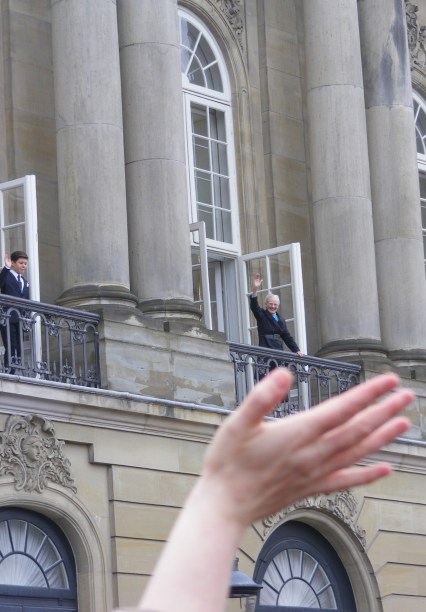
The royal family left after a little while, and the crowd dispersed. I found my way to the harbourside and booked myself onto a boat tour. Because I did want to see the Little Mermaid. I’d been thinking of her story (the Andersen version, not the Disney film, which in fact I’ve never watched all the way to the end, having had to be removed from a screening when it first came out) a lot while I’d been wandering around Copenhagen, finding the tragedy of her ongoing self-destruction both moving and infuriating.
She was smaller than I’d expected. But it was clearly easier to see her from the water than from the land: she had a good couple of dozen tourists clustered around her. From the boat, we also saw the royal yacht, the opera house, some delicate lovely bridges and a whimsical assortment of spires, the latter plentifully decked out in Danish flags. The sun came out half way around.


Back at the harbour, I ate a lateish lunch of various different sorts of fish (pickled herring; smoked salmon; shrimps; fried plaice) with rye bread and white bread at a restaurant across the water from two separate houses where Andersen had once lived. Then I ambled back across the city, looking in at an art exhibition in a church on the way, took another look at the Round Tower, collected my luggage from the youth hostel, and was at the station with plenty of time to buy some apples and still catch my train.
The journey to Malmö was significant largely because it took us across the Øresund bridge. A former housemate was a great fan of The Bridge, in which a corpse is discovered half-way along, making it the problem of both Denmark and Sweden. Nobody was murdered on this journey, however; there was a passport check on the Swedish side and then we proceeded to Malmö.
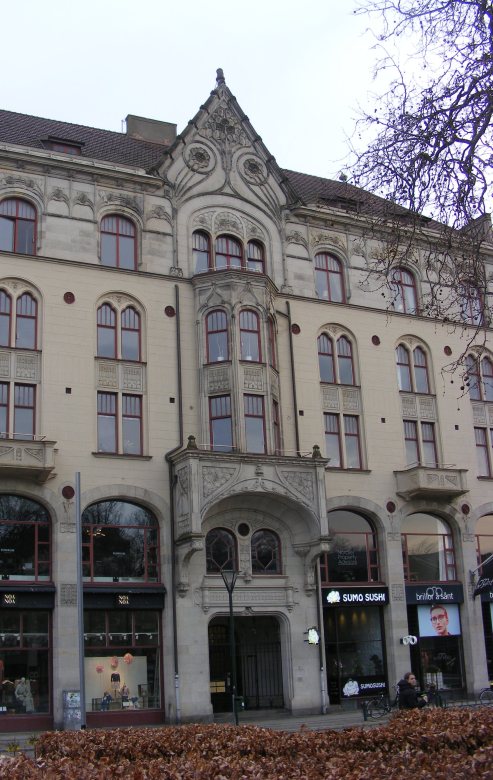
My sleeper to Stockholm was not due to leave until after half past ten, so I left the station and spent an hour or so wandering around Malmö in the evening sunlight, admiring its art nouveau architecture. I stopped at a coffee shop called ‘Condeco’ purely because the name amused me (it’s a deeply unpopular room booking system used in my workplace), and then drank a cup of coffee before returning to the station. There was still a while before I could board my train; I passed the time by eating some bread and cheese and finishing Barchester Towers.

The sleeper was a new experience for me. I had been allocated the top bunk of three, which made it a bit of a scramble, and I couldn’t haul my suitcase up there with me. I did not sleep fantastically well, at least in part because of remembering about the Taunton sleeper fire in the early hours of the morning. I gave up on trying to sleep and turned to writing (my diary) and reading (The Secret of the Tower, a very obscure Anthony Hope novel) instead. We arrived in Stockholm – a little delayed – at about seven in the morning.

17th April 2018
I was conscious of being very warm, very tired, and further north than I’d ever been before in my life. I shoved my case into a left luggage locker and got myself breakfast at one of the coffee shops in the station. It’s a lovely station, very light, with murals depicting the four seasons as they appear in Sweden. The coffee shop spoke English and didn’t take cash, which turned out to be the case in most places I went in Stockholm.
Before I went into any other places, though, I went for a wander. I’d helped myself to a city plan from the tourist information stand, and seen that a) most of the old town was spread over an island to the south of where I was now; and b) my hotel (which was actually a boat) was on the shore of another island to the south of that.
So I crossed the bridge into the old town. It was not yet eight o’clock, and almost everything was still shut. This didn’t particularly bother me (at least, once I’d worked out where the public lavatories were): I’d had breakfast, after all. I just wandered around and enjoyed the sight of the sun on the spires and the water, and regretted how cobbly the streets were. When I got tired of wandering I sat on a bench looking across the bay, and wondered which of the boats on the far shore was my hotel, and read a couple of excerpts of Lesbian Pulp Fiction. (This was an interesting anthology but, since the editor had understandably chosen the most exciting parts of each book, it was rather like eating pudding over and over again and never bothering with a main course. After a while I was craving a more balanced diet.)
The next time I passed through the old town the shops were beginning to open. I wandered some more, mostly following my nose. I’d asked a friend what to do in Stockholm. ‘Wander around,’ she said, ‘and eat cake.’ Well, I was managing half of that. The streets were narrow, and quite steep. A church with an open door turned out to be the cathedral; I went in. At the cash desk I was pleased to find Frälsarkransen for sale – ‘Pearls of Life’, the nearest thing to a rosary this very middle-of-the-road Anglican feels comfortable with. I’ve made a couple of sets in my time, but I did not pass up the chance to buy the official version, so to speak.
Then I passed into the cathedral, and found it deep, and light, with an appealing higgledy-piggledy feel to it. In the north aisle there was a series of sculptures depicting the Easter story, rather naïve; at the east end a huge, magnificent, George and the Dragon; in front of the altar, a display of the trappings from Queen Kristina’s coronation (missing the hundreds of gold crowns which had once adorned her cloak); next the exit door in the south aisle, a seventeenth century painting of sun dogs over Stockholm. It struck the balance between civic space and place of worship as well as many churches I’ve been in, and better than most.
After that, I found a café and drank a cup of coffee, and then set out over the next bridge to the next island. This one was much less touristy than the old town; it had charity shops and greengrocers and an awful lot of building works. My feet hurt, and my back hurt, and I was tired, and there was still a good three hours before I could check into my hotel. I had seen signs to Fotografiska, the museum of photography, on the way over; I decided to go and look at that, and then find some lunch, and then it would be two o’clock and I’d be able to check in.
Fotografiska was further than I’d hoped, and the path alongside the road around the edge of the island was subject to the building works. As far as I could make out, it was something to do with upgrading the harbour. I got there in the end, however, left my coat in the cloakroom, and plunged into the exhibition.
It felt rather liberating, being on my own in a foreign country, knowing that I didn’t have to report back, feeling free of the perceived obligation to pass judgement, to approve or disapprove, that weighs so heavy on me at home. Instead I could just look, liking things or disliking them, being attracted or repelled, responding with something closer to what I really felt than with what I felt I ought to feel, and not worry about whether Ellen van Unwerth’s photographs of women were too male gaze-y. Besides van Unwerth there was Christian Tagliavini, whose very staged portraits recalled Jules Verne (astronauts and aquanauts, all very steampunk) and Ankaret Wells (it was the 3D-printed hats on Renaissance characters that did it) and Hans Strand with some rather depressing landscapes showing the influence of exploitation by humans.
After all that what I was really feeling was hungry, so I went up to the restaurant on the top floor and, after a little dithering, ordered the hot special of the day, which was a delicious piece of aniseedy pork with red cabbage and crisp shredded potatoes. I ate it looking out over the water, and felt generally satisfied with life, although still tired.
After this I ambled back in the direction of the station. I went around the edge of the old town this time, not through the middle. I didn’t hurry. Of course, the sooner I got checked in, the sooner I could have a nap, but hurrying was just so energetic… I even sat down on a bench and finished The Secret of the Tower (not really anything special, but I liked the main character, a woman doctor in the early post WW1 years, a lot). But there was another island across the water, crying out to be explored. I followed the path around the edge of the harbour (noting en route that I was rather relieved that the National Museum turned out to be closed, so nobody could possibly have expected me to visit it) and crossed the bridge. I liked this little island a lot: I climbed to the top and could see out across all the islands and channels and harbours, and I had it more or less to myself.

Eventually I got back to the station and retrieved my case. I didn’t feel quite equal to the metro, so walked all the way across the two islands and two bridges, a choice that I regretted particularly during the cobbled section. I wasn’t massively impressed to find that the harbour works had blocked off much of the pedestrian footway, either, forcing me onto the cyclepath.
But I got there in the end, along with the case, and found the correct boat, and checked in, and was then directed to another boat which was where my room – or cabin, I suppose – was. It was like a white Portakabin on the water, function (in the form of as much sleeping space as physically possible) having taken precedence over form. I wasn’t too bothered. I plugged my phone in to charge, took a shower, and then, finally, lay down for the nap I’d been wanting all day.
I spent the rest of the afternoon dozing, reading, and watching the sunlight on the water. The evening, too. I didn’t want to go far from the boat, and I knew from my exploring earlier in the day that there wasn’t much that was close. So I dined on a surreptitious roll with brie, and opened the window to let the smell out. I did go across to the other boat, thinking that I wouldn’t mind a beer, but the bar was deserted, and music was pumping out too loudly for me to think that I’d be able to enjoy my quiet drink. I returned to my own boat and watched the sun setting, and the moon rising, and the evening star.

18th April 2018
The next morning the bar was full of people, and breakfast, and the view across the water was still lovely. I checked out, trundled my suitcase across town to the station, and set out to enjoy a last few hours in Stockholm. In a café in the old town I at last managed to fulfil the ‘eat cake’ part of my friend’s advice (a fabulous green marzipanny chocolatey thing), writing postcards in between tiny luxurious bites; then I looked around the dance museum, with half an eye on my watch all the time.
But there was plenty of time: time to see the museum, and time to get back to the station, and time to buy a salad for lunch and restock my supplies of rolls and apples and cheese, and time to retrieve my suitcase and get on my train, and still I had almost all of my journey still to come.
Next: Part 3: I spent cities like a handful of change